BRI promotes supply chain cooperation; companies make use of CISCE to expand, deepen partnerships

Visitors try pizza at the "Thailand Day" event held by Pizza Hut during the third China International Supply Chain Expo in Beijing on July 18, 2025. Photo: Courtesy of Yum China
The China-proposed Belt and Road Initiative (BRI) was launched to enhance global trade and connectivity. The China International Supply Chain Expo (CISCE), also proposed by China to promote global supply chain collaboration and communication, serves as a vital bridge for the BRI's vision of "extensive consultation, joint contribution and shared benefits."
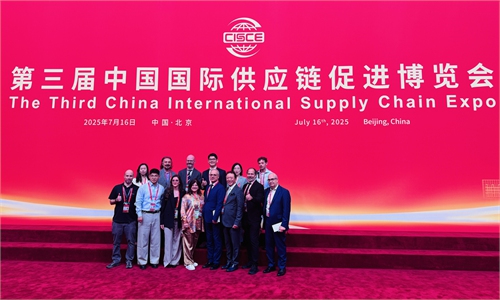
At the third CISCE, which was held from Wednesday to Sunday, global enterprises showcased innovations, strengthened cross-border partnerships, and promoted supply chain integration. Fulfilling China's commitment to maintaining global connectivity, the CISCE embodied the BRI's vision, driving mutual prosperity and sustainable development across participating countries.
New opportunities
The expo has created new opportunities for collaboration among participating enterprises.
On Saturday, a strategic cooperation ceremony was held at the booth of the Silk Road Cooperation Chain, where a Kyrgyz green energy company signed cooperation intent agreements with three Chinese firms, including Altay Gloden Sun Solid-state Lithium Battery Co, the Global Times learned.
The Silk Road Cooperation Chain booth was a joint exhibition area, where Xinjiang enterprises collaborated with energy companies from four Central Asian countries - Kazakhstan, Uzbekistan, Kyrgyzstan and Tajikistan - to exhibit in the Clean Energy Chain Zone of the third CISCE.
While this was one of the latest cooperation agreements signed, more participants see opportunities beyond agreements - expanding partnerships, following the latest industry trends and gaining inspiration from cross-sector collaboration.
By participating in this year's CISCE, Serbia aims to deepen cooperation in technology and supply chain integration with Chinese partners. The expo presents an ideal opportunity to showcase Serbia's growing capabilities in software, logistics and embedded technologies, while also attracting Chinese investment in smart manufacturing, artificial intelligence (AI) and green technologies, Jelena Grubor Stefanovic, director of the Representative Office of the Serbian Chamber of Commerce and Industry in China, told the Global Times.
"Strengthening ties in high-tech supply chains, such as battery production, can position Serbia as a key innovation and logistics hub in Central and Eastern Europe. Additionally, partnerships in digital trade platforms and cross-border e-commerce could streamline Serbian exports, providing smoother access to China's vast market," said Grubor Stefanovic.
European companies are also seeing growing opportunities in China-Europe trade.
"We support Asian clients, particularly Chinese sellers, who are seeking to enter the European market through major e-commerce platforms," Arkadiusz Filipowski, CEO of Polish logistics firm Fulfilio Sp. z o.o., told the Global Times.
This was Fulfilio's first time participating in the CISCE, and Filipowski noted that it is important to meet representatives from various sectors - not just logistics. "It helps me understand how Chinese businesses operate and what matters to them when building partnerships with European companies," Filipowski said.
"We participated in the CISCE because we see a growing number of Chinese clients. We are working to strengthen the cooperation and have boots on the ground over here to understand the clients' needs and provide support for the Chinese companies coming into our region," Dusan Skuban, a senior business developer at CTP Group, Europe's listed developer, owner and operator of industrial and logistics properties, told the Global Times.
China's market is big, and we are glad that we can start cooperation, José Oswaldo Gutiérrez, an official from the Nicaraguan Commercial Department, told the Global Times at the booth of Nicaragua at the CISCE. "We hope that companies participating in the expo can come to our booth and analyze what kind of opportunities we have, and settle down or invest in Nicaragua."
In January 2022, China and Nicaragua signed a memorandum of understanding to jointly advance the Silk Road Economic Belt and the 21st Century Maritime Silk Road.
"Nicaragua and China started the BRI cooperation not too long ago. So far, the cooperation is working fast, with advancement in many sectors. It's looking good for both countries that the mutual benefits brought by BRI," said Oswaldo Gutiérrez.
Mutual benefit
CISCE participants also emphasized that industries and enterprises from BRI participating countries have benefited from the flagship initiative.
Regarding transportation, Filipowski from the Polish logistics firm said the company benefits from China-Europe freight trains, a hallmark of the BRI.
Skuban said that the improvements in the transportation network brought by the BRI are among the reasons that Chinese and European companies are entering each other's markets.
"The transportation infrastructure makes logistics faster. CTP also takes advantage of this. We have business parks across Europe, from the North Sea to the Black Sea," said Skuban.
The BRI promotes infrastructure development, laying a strong foundation for expanded trade. By the end of 2024, the China-Europe freight rail service had reached 227 cities in 25 European countries and connected more than 100 cities in 11 Asian countries, according to official statistics.
"The BRI has significantly boosted Serbia's economic development by enhancing infrastructure, trade and investment ties with China. Key projects such as the Hungary-Serbia Railway and Chinese industrial parks have improved connectivity and attracted foreign capital, creating jobs and promoting industrial growth. Serbia's strategic position as a BRI hub in Europe has strengthened its regional economic influence," said Grubor Stefanovic.
Grubor Stefanovic noted that Serbia has benefited greatly from Chinese collaboration in infrastructure and technology. "For example, the Smederevo Steel Plant, acquired by HBIS Group, was revitalized with modern equipment, boosting production and employment. Additionally, China's investments in 5G and smart city projects with Huawei have accelerated Serbia's digital transformation."
"Durian is a landmark agricultural product of economic and trade cooperation between China and Thailand, and it is also a sweet symbol of the emotional connection between the people of the two countries under BRI," Minister Counsellor of Agriculture at the Embassy of Thailand in China Phatthakorn Tanmanee said on Friday at CISCE's "Thailand Day" event held by YumChina.
Thailand served as the guest country of honor at the expo. Tanmanee expressed appreciation to Pizza Hut (China) for supporting the promotion of Thai durians.
How does a Thai durian cross the ocean to become a star on Chinese dining tables? The answer lies in the deep collaboration throughout the China-Thailand supply chain. The journey of Thailand's KAF Group, a Thai durian supplier, is a prime example.
At the second CISCE in 2024, KAF Group joined Yum China's supplier network. Under Yum China's stringent supply chain standards, KAF Group achieved BRCGS Global Standard for Food Safety certification and developed a refined management system covering every step from planting to processing, said a representative of KAF Group on Friday at the "Thailand Day" event.
"These changes have optimized our factory operations in Thailand, enabling our durians to reach Chinese households through Pizza Hut's extensive network while significantly improving order stability in China - a vivid embodiment of the BRI's principles of extensive consultation, joint contribution, and shared benefits," the representative said.
RELATED ARTICLES