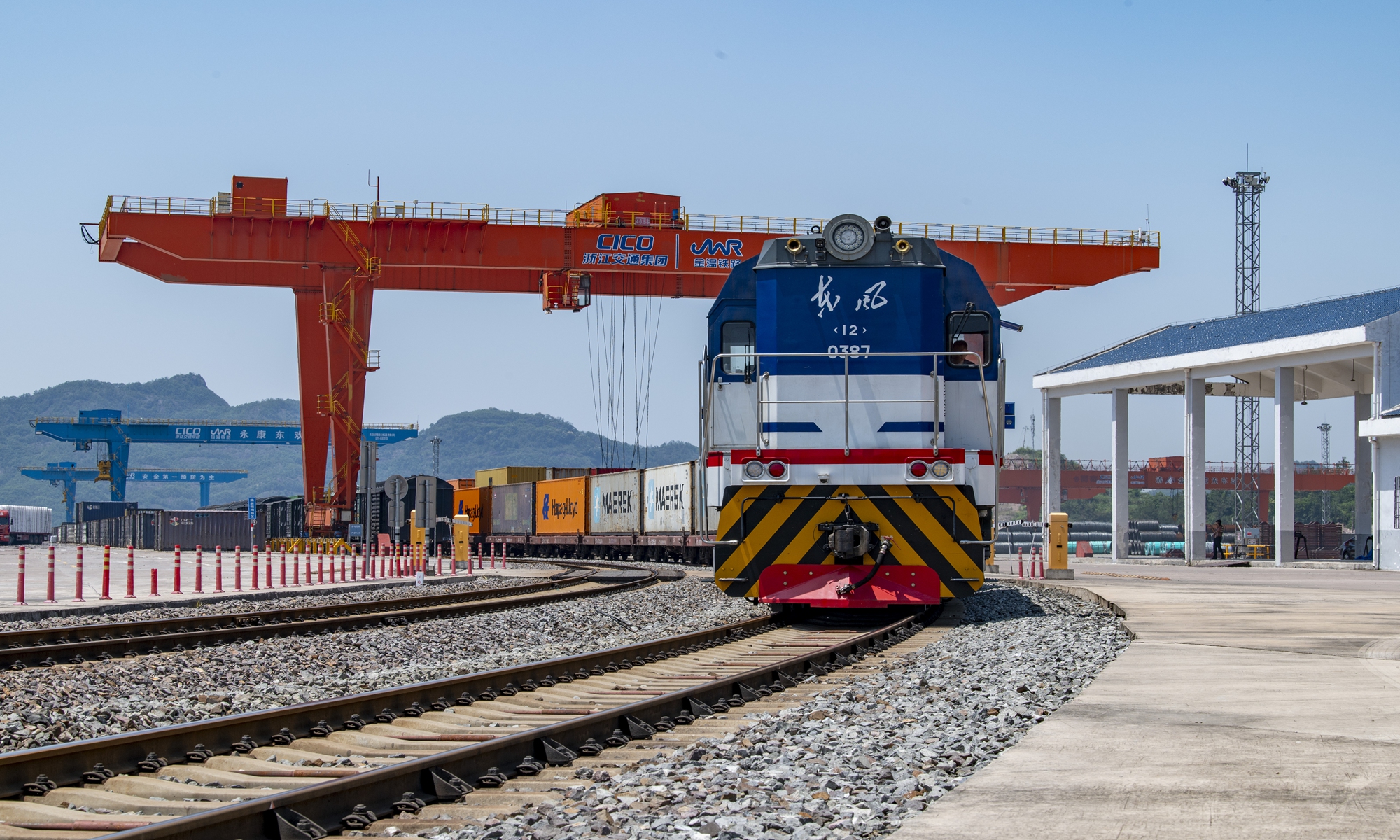
A rail-sea intermodal freight train carrying products such as security doors, thermal mugs, leisure goods, power tools and fitness equipment leaves a train station in Jinhua, East China's Zhejiang Province, for the Ningbo-Zhoushan Port in Zhejiang on May 12, 2025. Photo: VCG
In the first half of this year, the national railway system transported 1.98 billion tons of cargo, a year-on-year increase of 3 percent, with the daily average number of loaded freight cars reaching 182,400, up 4 percent, China State Railway Group said on Sunday.
According to a statement sent to the Global Times, the group noted that it made full use of the integrated rail network and pushed forward market-oriented reforms in railway freight transport to boost logistics capacity, efficiency and service quality.
The group guaranteed the transportation of key materials for the national economy and people's livelihoods, with green channels established to ensure delivery, supporting peak summer demand and key industry development.
The national railways transported 1.02 billion tons of coal, including 695 million tons of thermal coal, in the first half. Shipments of metallurgical goods increased by 8.6 percent, and those of grain by 9.8 percent, per the statement.
The group has built fast logistics channels between major economic regions to strengthen the domestic economic cycle. In the first half, the national railway system transported a total of 8.254 million twenty foot equivalent units (TEUs) of intermodal container cargo a year-on-year increase of 18.1 percent.
Moreover, it has enhanced logistics financial services such as "freight loans," with customers collectively receiving total credit lines of 19.9 billion yuan ($2.77 billion), which is expected to save nearly 60 million yuan in financing costs, effectively supporting the development of the real economy, said the group.
"As railway transportation is a crucial barometer of the national economy, the data showed that in the first half of this year, societal demand remained stable and healthy, laying a solid foundation for the sustained development of the economy in the rest of the year," Li Chang'an, a professor at the Academy of China Open Economy Studies at the University of International Business and Economics, told the Global Times on Sunday.
Railway transportation has provided strong support for the development of the national economy with more efficient network operation and improved services, Li noted.
Cross-border cargo transportation remained stable and smooth. The Central Asia freight train service operated 7,349 trains, up 25 percent from a year earlier. The China-Laos Railway transported nearly 3.03 million tons of cross-border cargo, up 9 percent, according to China State Railway Group.
Li said that cross-border cargo transportation is a vital component of foreign trade, and these data reflect the stability of the country's foreign trade. At the same time, through railway transportation, China has supplied a large number of high-quality goods to related countries, meeting the diverse needs of foreign consumers and contributing to the stability and development of the global economy and supply chains.
RELATED ARTICLES