China, Central Asia trade and investment see great leaps as digital sector, logistics unlock potential
By Published: Jul 20, 2025 09:18 PM

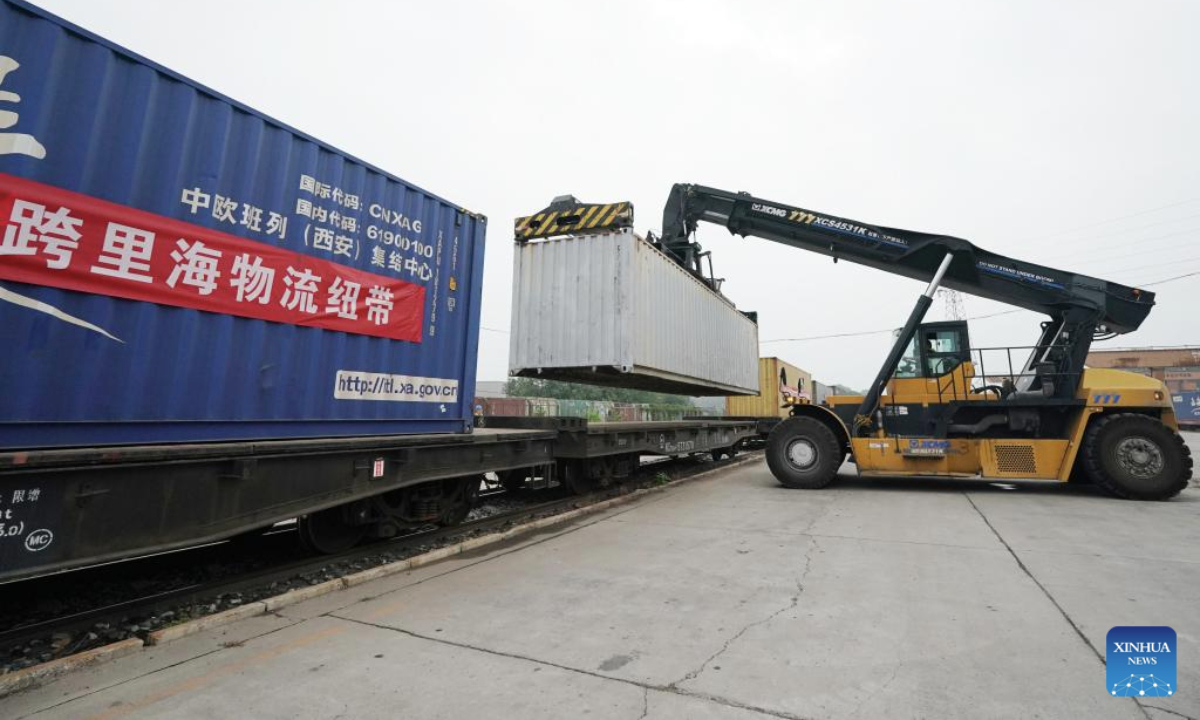
A crane loads a container onto a China-Europe freight train at Beijing International Land Port in Fangshan District of Beijing, capital of China, June 30, 2025. Photo: Xinhua
With the Shanghai Cooperation Organisation Summit set to take place later this year in North China's Tianjin Municipality, trade and investment between China and Central Asian countries continues to gain traction as growing digital links and logistics cooperation unlock new opportunities for entrepreneurs and consumers, industry players told the Global Times on Sunday.
In recent years, China's economic and trade exchanges with the five Central Asian countries have continued to deepen.
Emerging markets including those in Central Asia have become a major driver of incremental growth for China's foreign trade, with China's trade with countries in Central Asia surging by 13.8 percent year-on-year during the first six months of 2025 to 357.2 billion yuan ($49.76 billion), data from the General Administration of Customs showed on July 14.
Uzum, Uzbekistan's leading digital ecosystem combining e-commerce and fintech, said in an email statement sent to the Global Times on Sunday that Chinese sellers are an increasingly important part of the e-commerce platform.
"Products from China now span a wide range of categories, from electronics and household goods to tools and renovation materials, and continue to see growing demand from Uzbek consumers," said the company, which said that more than 17 million people - more than half of Uzbekistan's population - use the platform's services every month.
The company, the country's first "unicorn" firm, said that the number of active Chinese sellers has increased "significantly" this year, with many choosing Uzum as their primary entry point into the Uzbek market. "We anticipate this trend to intensify as cross-border trade becomes more accessible and Uzbek consumers continue to prioritize value and variety."
Zhang Sixin, general manager of Xinjiang Zhonghuan Logistics Co, told the Global Times on Sunday that the fruit and vegetable trade between China and Central Asian countries has been growing rapidly this year.
"Chinese fruits and vegetables are now very popular in Central Asian markets and we have seen continuous climbs in shipment volumes and transport capacity. This is due to enhanced trade facilitation measures between China and Central Asian countries and an overall improvement in the business environment in these markets in recent years," Zhang said.
"Chinese agricultural products such as cherry tomatoes, grapes, dragon fruit and kiwifruit are extremely popular in these markets, due to the strong complementarity between trading partners, and cargoes can be distributed across different countries in the region freely once they are collectively declared for customs in Almaty, Kazakhstan," Zhang said, noting the improvement in the cross-border flow of goods after joint efforts by regional countries.
Analysts said that exploring avenues for successful trade in a world of global trade wars has demonstrated that multilateralism and win-win economic and trade cooperation remain the mainstream choice of the majority of countries.
Chinese localities are also reporting brisk expansion in trade and economic cooperation with Central Asian countries.
According to local news site dzwww.com, trade between East China's Shandong Province and Central Asian countries in the first half of 2025 soared by 36.4 percent year-on-year to 14.19 billion yuan, with broad cooperation space in sectors including modern agriculture, equipment manufacturing and green mining.
Northwest China's Xinjiang Uygur Autonomous Region, where Zhang's company is based, saw its agricultural product exports to the five Central Asian nations - Kazakhstan, Kyrgyzstan, Tajikistan, Turkmenistan and Uzbekistan - jump by 100.1 percent year-on-year to 4.47 billion yuan in the first five months of 2025, according to data from customs authorities, the Xinhua News Agency reported on June 18.
Xinjiang's trade with the five Central Asian nations made up 49.5 percent of Xinjiang's total trade and represented 39.4 percent of China's overall trade with those nations during the period, local customs data showed.
Zhang noted that along with the improved business environment, more Chinese companies are coming to Central Asian markets to invest, with key areas including green energy, oil, and chemicals.
RELATED ARTICLES