LDP suffers unprecedented dual-chamber defeat; Ishiba's leadership prospect faces daunting challenge: media
By Published: Jul 21, 2025 01:13 PM

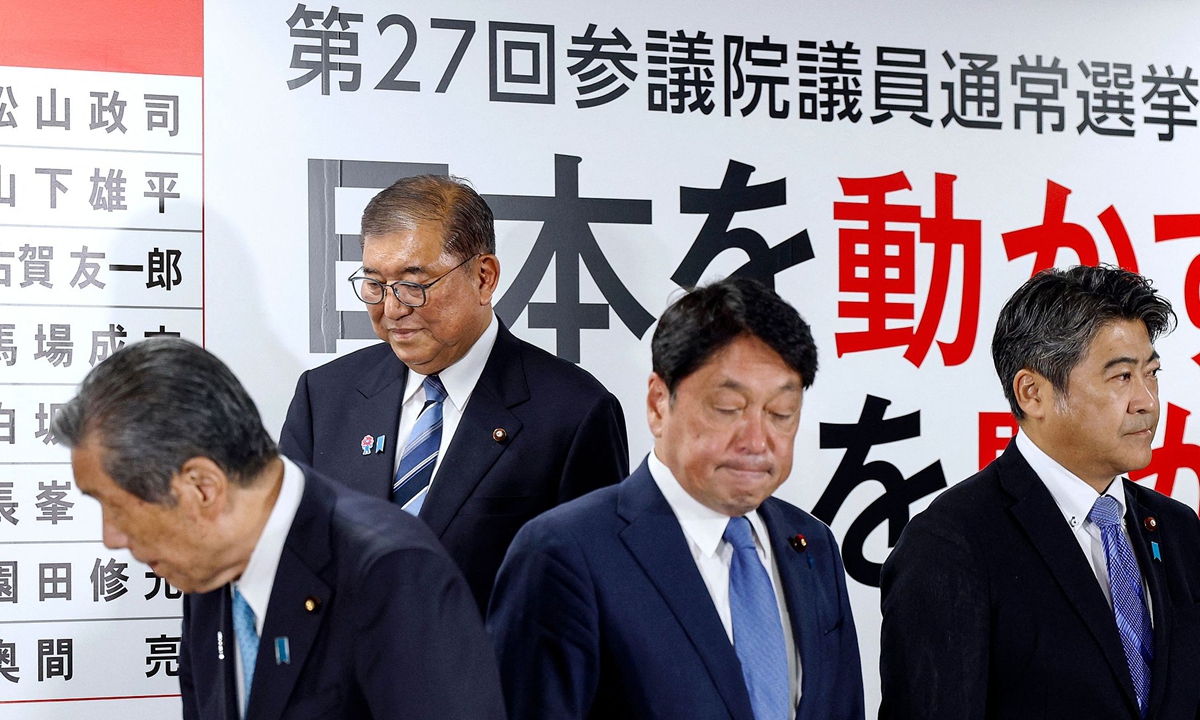
Japan's Prime Minister Shigeru Ishiba arrives for a media briefing following the upper house elections, at Liberal Democratic Party (LDP) headquarters in Tokyo on July 20, 2025.?Photo: VCG
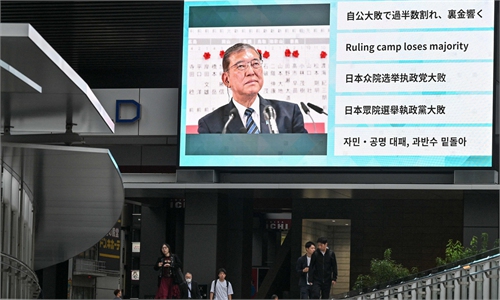
Japan's ruling Liberal Democratic Party (LDP) and its junior coalition partner Komeito lost control of the Upper House in Sunday's election, according to multiple media outlets on Monday, marking the first time the LDP has lost a majority in both houses of parliament since the party's foundation in 1955.
This development is widely believed to further weaken Japanese Prime Minister Shigeru Ishiba's grip on power even as he vowed to remain party leader, citing a looming tariff deadline with the US, Reuters reported Monday.
While the ballot does not directly determine whether Ishiba's administration will fall, it heaps pressure on Ishiba who also lost control of the more powerful lower house in October, the report noted.
The back-to-back losses are likely to increase pressure on Ishiba to resign after less than a year on the job. Voters' trust in LDP and its coalition partner, Komeito, has been waning amid rising prices and discontent over the government's handling of inflation, the Washington Post wrote on Monday.
Taro Aso, a former deputy prime minister and LDP heavyweight, said he "couldn't accept" Ishiba staying on as prime minister, the New York Times citing Japanese media reported Monday.
But Ishiba said Sunday evening that he will stay in office following the day's upper house election, Japan's Jiji News reported. He said his LDP has no intention to abandon power, per the report.
"We are engaged in extremely critical tariff negotiations with the United States...we must never ruin these negotiations. It is only natural to devote our complete dedication and energy to realizing our national interests," he later told TV Tokyo.
A Chinese expert said Ishiba could struggle to maintain support within his party, noting that within the LDP, the forces supporting Ishiba's continued governance and those opposing it have been engaged in a struggle with each other.
"This constitutes the most significant political shift in Japan since 1955 -- a big blow to the LDP," Lü Chao, an expert at the Liaoning Academy of Social Sciences, told the Global Times on Monday.
"Now the LDP is besieged by triple pressures: opposition challenges, intra-party opposition, and public discontentment," the expert said.
Japan Times reported Monday that populist opposition parties, especially the Democratic Party for the People (DPP) and Sanseito, were projected to boost their seats.
Multiple Chinese analysts have noted that populist parties like Sanseito, which champion "Japan First" rhetoric, are accelerating political rightward drift in Japan.
According to the Japan Times, the DPP was expected to win 17 seats. The center-left Constitutional Democratic Party of Japan (CDP) -- the largest opposition party -- meanwhile, was projected to secure 21 seats.
While opposition parties gained ground, fundamental policy differences between the CDP and DPP prevent viable coalition-building in the near term, Lü commented.
"The current situation only demonstrates the LDP's loss of public trust, not the opposition's readiness to govern — Japan's politics remain in flux, " he said.
The expert said a "lame duck" legislative paralysis may emerge in the Diet.
Lu Hao, director of the Strategic Studies Department at the Institute of Japanese Studies, Chinese Academy of Social Sciences, told the Global Times that the election results may not directly trigger a prime ministerial change. He noted while the LDP currently lacks a consensus successor who commands broad support within the party, Ishiba's political standing would face intensified challenges following this electoral setback, Lu emphasized.
He further pointed out that opposition factions within the LDP would likely become more active in their maneuvers to position themselves for future leadership contention.
Lu predicted the election outcome may not fundamentally alter Japan's overall diplomatic trajectory. Currently, Japan's drive for national strategic transformation and pursuit of enhanced international standing has become a cross-party consensus that will not be substantially shaken by the election results.
RELATED ARTICLES