Japan’s ruling bloc to lose majority in Upper House: reports
Election likely to shake Japanese politics amid rising conservative forces: analysts
By , Zhang Changyue and Xing Xiaojing Published: Jul 20, 2025 10:48 PM

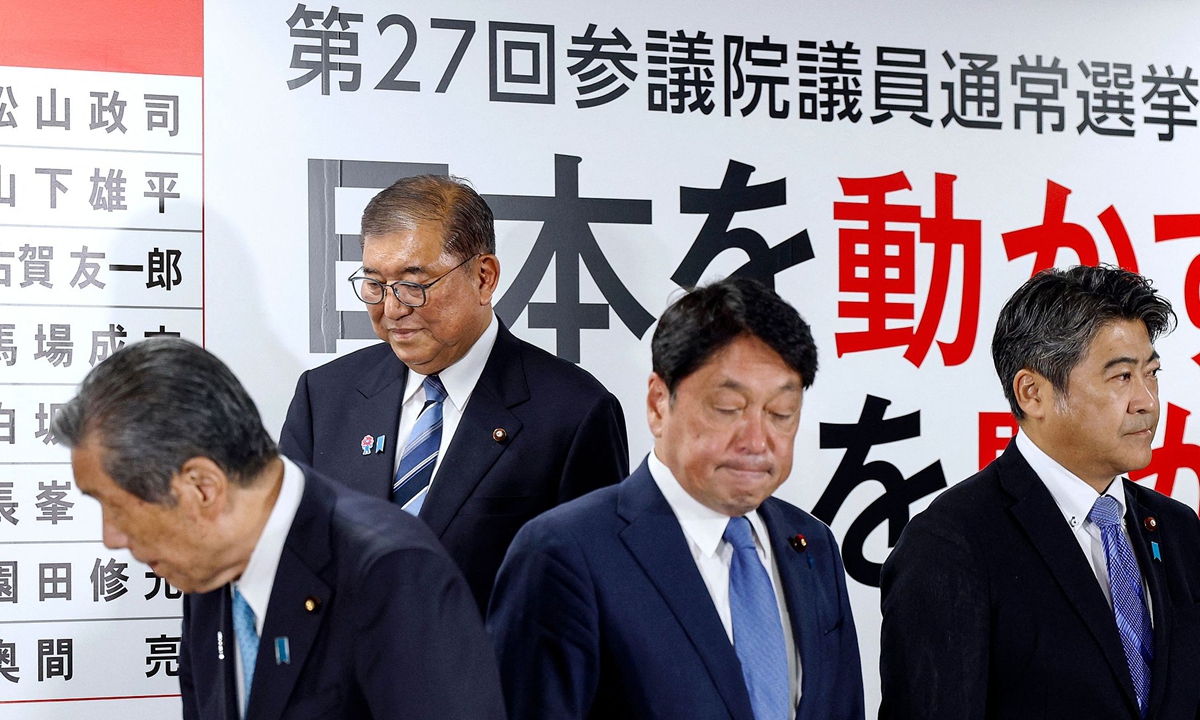
Japan's Prime Minister Shigeru Ishiba arrives for a media briefing following the upper house elections, at Liberal Democratic Party (LDP) headquarters in Tokyo on July 20, 2025. Photo: VCG
It has become certain that Japanese Prime Minister Shigeru Ishiba's Liberal Democratic Party (LDP) and its coalition partner, Komeito, will fall short of winning the 63 seats needed for a majority of the contested seats in the Upper House election, according to local news site The Asahi Shimbun on Sunday night.
Japanese voters cast ballots Sunday in a high-stakes upper house election that media reports suggest could reshape the country's political landscape.
NHK reported Sunday that voting began at 7 am on Sunday (local time) and polling places are open until 8 pm, except for areas such as remote islands. There are more than 44,000 polling stations nationwide.
More than 500 candidates are vying for a seat in electoral districts, or by proportional representation, the report said.
Ishiba said Sunday that he will stay in office following the day's upper house election, Japan's Jiji News reported. He said his ruling Liberal Democratic Party has no intention to abandon power, per the report.
Reuters reported Sunday that recent Japanese opinion polls suggest Ishiba's LDP and coalition partner Komeito may fall short of the 50 seats needed to retain control of the 248-seat upper house of parliament in an election where half the seats are up for grabs.
The Japan Times reported Sunday that since the Lower House election, which saw the coalition fall short of a majority, the LDP hasn't been able to rehabilitate its standing in the eyes of many voters. Sunday's vote will offer a snapshot of the current mood around Ishiba, who also serves as LDP leader and whose political standing has long been tarnished by low approval ratings.
The report claimed that a variety of scenarios now await the country, from an enlarged ruling coalition to an opposition-led chamber, or even a minority leadership in both chambers. Pressure is likely to rise for Ishiba to resign, although it was too early to tell if that would be the case, Japan Times reported.
The development will likely exacerbate instability amid significant challenges at home and abroad, Da Zhigang, director of the Institute of Northeast Asian Studies at the Heilongjiang Provincial Academy of Social Sciences, told the Global Times on Sunday.
Faced with challenges from home and abroad, this election will consequently become a crucial indicator of Japan's future trajectory, potentially marking the beginning of a more entrenched rightward turn in national politics, the expert warned.
LDP's dilemma
According to the NHK on Sunday, the rising cost of living is front and center. Other big issues include social security, the population decline and foreign policy issues.
"Japan's ruling coalition faces a critical test amid Ishiba's declining popularity, fueled by stalled US trade talks, lack of diplomatic breakthroughs, and failure to curb rising food prices," Da said.
Lian Degui, director of the Center for Japanese Studies at Shanghai International Studies University, told the Global Times on Sunday that opposition parties currently lack the unity to effectively challenge the ruling LDP. Even if the ruling coalition fails to secure a majority, a change of administration remains unlikely, and the current "minority government" may persist. However, the coalition might explore expansion - such as forming a governing or policy partnership with the Democratic Party for the People or the Constitutional Democratic Party.
The record early voter turnout signals growing public discontent, particularly among youth, potentially weakening the LDP's dominance, Da said, citing data revealed by The Japan Times on Saturday. According to the report, the number of people who cast their ballots by Friday under the early voting system for the election totaled 21,450,220, a record high for an election for either chamber of parliament.
According to The Japan Times, the last time an LDP government lost a majority in the Upper House was in 2007 during the first stint of former Prime Minister Shinzo Abe, who resigned soon after the election.
Dangerous trend
Meanwhile, the opposition is expected to make strong gains nationwide.
According to NHK poll and trend analysis on Sunday, opposition parties are showing strong performance - the Constitutional Democratic Party is on track to exceed its pre-election seat count, while the Democratic Party for the People and the populist Sanseito party are certain to significantly increase their representation compared to before the election.
Among them, the surge of the Sanseito party - promoting "Japan First" nationalism through savvy social media campaigns, sounds the alarm of Japan's accelerating rightward shift, Chinese and Japanese observers said.
Asahi Shimbun reported on June 27 that the party, which fielded candidates for the first time in the Tokyo Metropolitan Assembly election held on June 22, secured three seats.
According to The Diplomat earlier this month, "Japan First" is the signature slogan of the controversial party. The party, which launched on YouTube in 2020 as a fringe political movement promoting a conservative stance on economic security and immigration, is gaining momentum among social media savvy men in the 30s to 50s age bracket.
During recent on-the-ground interviews in Japan, multiple sources including an opposition legislator, peace campaigners and veteran educators have separately mentioned the "dangerous" nationalist Sanseito party.
"This is an extremely dangerous party that has drafted its own constitutional proposal and champions 'Japan First' rhetoric, a term that inevitably evokes memories of the imperial Japanese military before WWII," Yoko Kojiya, secretary-general of the Children and Textbooks Japan Network 21, a non-governmental organization that has long been focusing on issues surrounding textbook approval and the presentation of war history in Japan, told the Global Times in Tokyo.
"The fact that such a xenophobic party secured three seats is alarming enough, and I fear they may gain even more in the upcoming national election," Yoko said, noting that last month's Tokyo Metropolitan Assembly election is often seen as a bellwether for the upper house race.
If Ishiba seeks to incorporate Sanseito into his governing coalition after the Upper House election, the party's radical nationalist agenda could influence Japan's foreign policy toward more confrontational stances, accelerate military expansion, and promote illiberal domestic policies - developments that could destabilize regional security dynamics, Da warned.
Complicating matters further is the imminent deadline for US tariff threats against Japan, Da said.
According to The Japan Times on Sunday, regardless of the outcome of the election, economic issues will be at the top of the agenda in the coming weeks and months - "reciprocal" tariffs of 25 percent will be charged on almost all Japanese goods entering the US starting August 1 unless a compromise with the current US administration is reached.
Washington's pressure serves dual purposes - achieving economic rebalancing while strategically pushing for increased Japanese defense spending, Da said, noting this intersection of economic and security demands creates additional challenges for Tokyo's policymaking.
RELATED ARTICLES