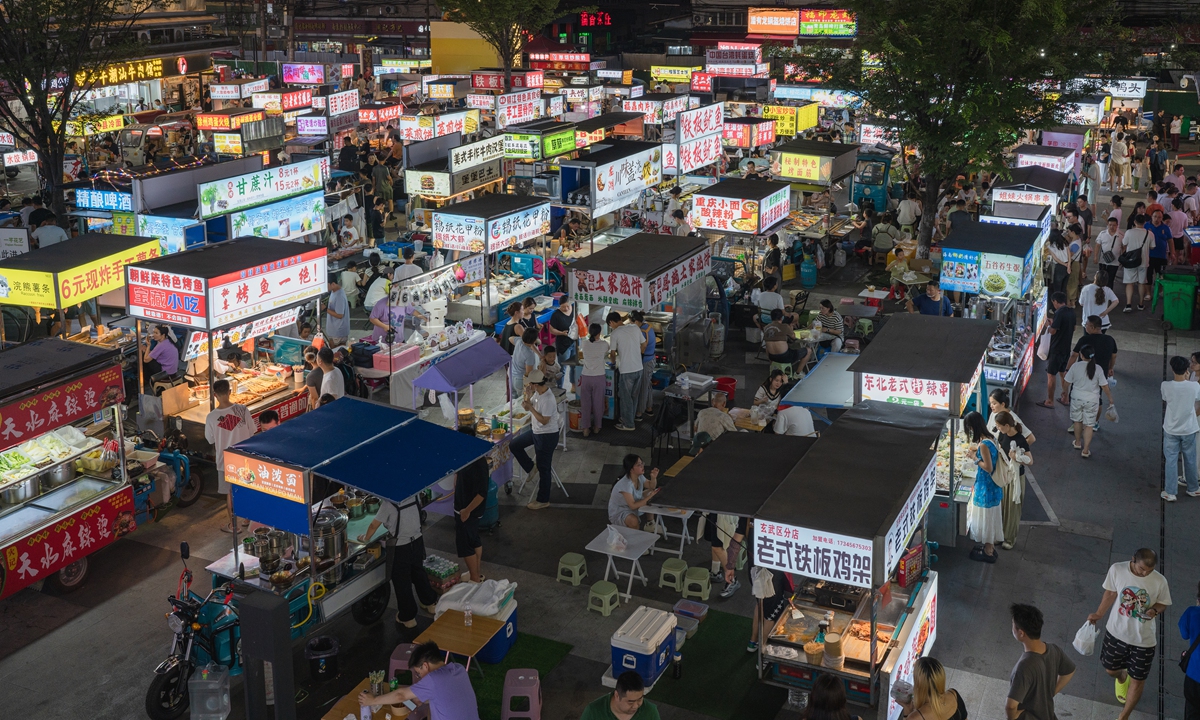
A view of a night fair in Nanjing, East China's Jiangsu Province on July 20, 2025. Photo: VCG
One-hour delivery service platform Taobao Flash Sale reported that night orders in 127 Chinese cities have more than doubled month-on-month since July, with more than 80 percent of the growth coming from central and western provinces, the Securities Times reported on Monday.
The surge signals a broader summer consumption boom driven by nighttime, cool-down and stay-at-home spending -- what Chinese experts call a "triple resonance" of digital platforms, targeted policy subsidies and ongoing consumption upgrades.
Nighttime delivery orders in cities including Luohe in Central China's Henan Province, Baotou in North China's Inner Mongolia Autonomous Region, Shuozhou in North China's Shanxi Province, Xuchang and Shangqiu in Henan surged more than 200 percent, according to Taobao's report. Nearly 160,000 non-restaurant small and medium-sized merchants nationwide logged record sales this month, while catering firms added tens of thousands of jobs via enterprise communication platform DingTalk, data showed.
The nighttime economy has become a hot term this summer. It refers to business activity between 6 pm and 6 am in the services sector.
Meanwhile, as the temperature continues to rise, orders on Taobao Flash Sale for ice-cream machines, cold-air fans and small air-conditioners jumped more than 200 percent, ice-shaver sales rose 98 percent, and beer sales after 8 pm far outpaced daytime levels.
Multiple cities, such as Shanghai, Southwest China's Chongqing Municipality and Guangzhou, South China's Guangdong Province, have rolled out plans to support nighttime consumption to drive economic growth.
For instance, in Urumqi, Northwest China's Xinjiang Uygur Autonomous Region, some shopping malls and night markets have extended their business hours, enriched consumers' experience and provided fine management, so as to provide tourists with a diverse experience.
Chongqing, touted as China's most active night-economy megacity, is running a nightlife festival from mid-July through September. More than 200 themed events—including drone light shows, water carnivals and beer-music nights—are being bankrolled with 100 million yuan ($13.93 million) in platform subsidies from food delivery platforms including Taobao Flash Sale, Ele.me and Alibaba's Freshippo stores, local media outlets cqbntv.cn reported
Experts said that the nighttime economy has increasingly become a new engine to drive economic growth in China. The increasing consumer demand will not only stimulate the vitality of traditional industries such as tourism, catering, and entertainment, but also provide richer content for new formats and models such as the digital, sharing, and platform economies, and give birth to more new formats.
The nighttime economy has become a new engine to enhance cities' vitality and promote China's development, Wang Peng, an associate research fellow at the Beijing Academy of Social Sciences, told the Global Times on Monday.
The nighttime economy, spanning the dining, tourism and leisure sectors, has emerged as a new driving force for economic growth nationwide, Hu Qimu, deputy secretary-general of Forum 50 for Digital-Real Economies Integration, told the Global Times on Monday.
Hu further noted that developing the nighttime economy is inseparable from supporting policies and infrastructure, adding that nighttime consumption will enhance people's sense of happiness, and inject more momentum into local economic development.
A 2024 survey by the Ministry of Commerce found that more than 60 percent of consumer spending happened during the night. Sales between 6 pm and 10 pm in major shopping centers make up more than half of daily sales, making nighttime the prime time for consumption.
Data suggested that the country's nighttime economy grew from 22.54 trillion yuan in 2018 to 50.25 trillion yuan in 2023.
RELATED ARTICLES