China creates 6.95 million new jobs in H1 2025, as governments at all levels focus on enlarging employment
Experts say rise in employment result of coordinated policy efforts

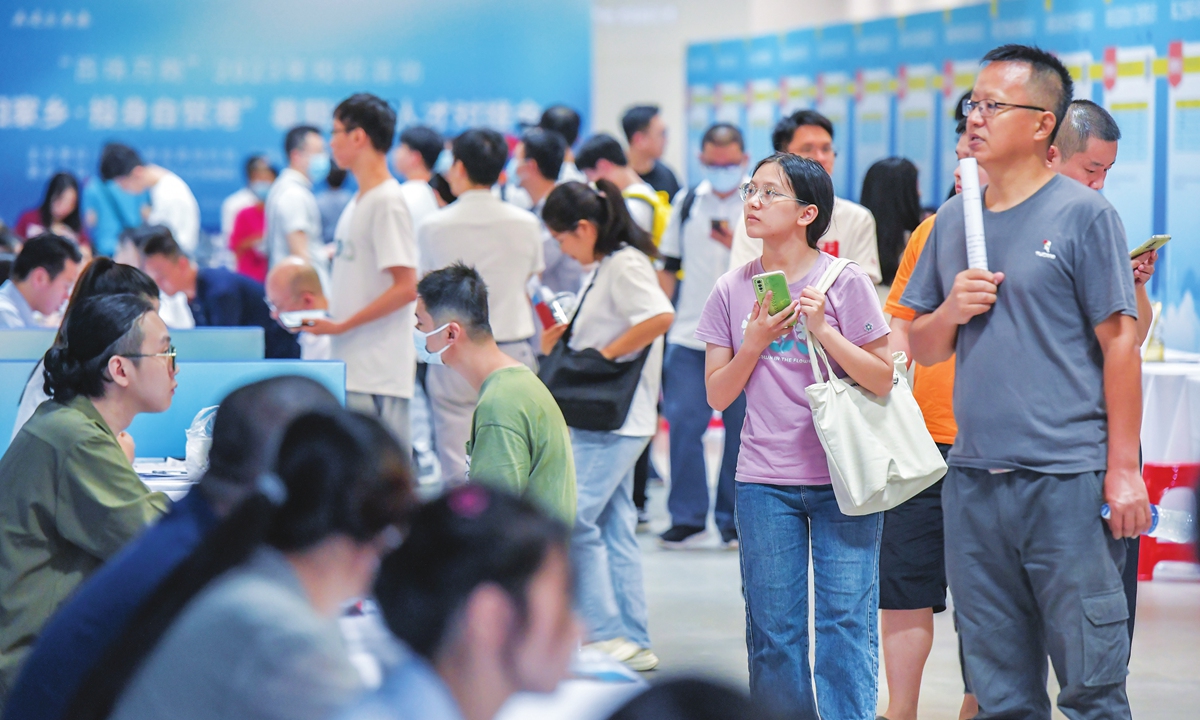
College students look for jobs at an employment fair held on the campus of the Huaibei Normal University in Huaibei, East China's Anhui Province on October 16, 2024. The job fair attracted more than 183 companies offering more than 10,000 positions. The year 2024 is expected to see 11.79 million students graduating from colleges, an increase of 210,000 from 2023. Photo: VCG
China created 6.95 million new urban jobs in the first half of 2025, with overall employment remaining stable, the Ministry of Human Resources and Social Security said at a press briefing on Tuesday.
China's three main social insurance funds posted a combined surplus of 9.83 trillion yuan ($1.35 trillion) in the first half of 2025. During the same period, 6.95 million new urban jobs were created, accounting for 58 percent of the annual target, according to the ministry.
China's surveyed urban unemployment rate stood at 5 percent in June, unchanged from a year earlier. A reduced unemployment insurance rate helped cut labor costs for enterprises by over 90 billion yuan, while 6.2 billion yuan in job stabilization subsidies were distributed to 815,000 enterprises. An additional 11.3 billion yuan was allocated to support employment-boosting initiatives such as vocational training.
The recent rise in employment and the stabilization of the unemployment rate are seen as results of strong, coordinated policy efforts at both central and local levels, experts said.
"The government is using both targeted support and broader fiscal tools like increased infrastructure investment to spur hiring," Bian Yongzu, executive deputy editor-in-chief of Modernization of Management magazine, told the Global Times on Tuesday, adding that measures such as job fairs, employment subsidies, and lower social insurance costs have also been rolled out to support businesses and boost labor demand.
"Expanding employment is fundamental to boosting consumer confidence and driving domestic demand. That's why we've seen a policy focus on stabilizing key sectors, supporting small and medium-sized enterprises, and promoting vocational training," Bian said. As job opportunities grow, household incomes rise, creating a positive cycle that helps underpin broader economic stability, he said.
Tian Yun, a Beijing-based veteran economist, noted that most companies applying for employment subsidies this year received funds more efficiently than in the past. "However, despite these measures, China's employment pressure -particularly for young people - remains largely structural. Many manufacturers are expanding again but still face worker shortages, while the supply of fresh graduates with the right skills remains limited."
However, structural challenges persist, both experts agreed, with education outcomes lagging behind labour market needs. "Many university graduates lack the practical skills needed in emerging industries, while technical and vocational roles remain hard to fill," Bian said. Tian added that bridging this gap requires a long-term overhaul of the higher education system.
Besides, China's three main social insurance funds recorded total revenue of 4.53 trillion yuan and expenditures of 3.89 trillion yuan in the first half of 2025, with a cumulative surplus of 9.83 trillion yuan by the end of June, indicating stable fund operations. Pension fund investments reached 2.55 trillion yuan.
On the sustainability of China's social security funds, Bian said the near-term outlook remains sound, thanks to healthy surpluses and solid investment returns. "Helping companies stay afloat today ensures future contributions and eases long-term pressure," he said. Tian added that with China's large industrial base and growing capital market, the social security system has room for long-term value appreciation.
Looking ahead, Tian said that cities like Hangzhou, East China's Zhejiang Province, and Chengdu, Southwest China's Sichuan Province, are seeing stronger job and wage growth by tapping into innovation and industrial upgrading. "To address hidden unemployment and ease fiscal pressure, more institutional support is needed for entrepreneurship and vocational training. Local governments have made progress on wage arrears, but there's still room to improve reskilling and job placement," he said.
The ministry also mentioned that the functions of social security cards continued to expand, with 1.39 billion people holding cards - covering 98.9 percent of the population - including 1.097 billion electronic cardholders, the ministry said.
"With the expanded use of social security cards and digital tools, the government can build more accurate individual profiles and tailor support based on specific needs," Bian said. "This enables more targeted assistance and smarter policymaking to support social stability and sustainable growth."
The Ministry also launched its seventh batch of new professions on the same day, including 17 new occupations. These encompass elderly care service specialist, cross-border E-commerce operation and Management Specialist, and drone swarm flight planner. Additionally, 42 new job titles were established, such as the "barbecue cuisine chef" job title under the occupation of "Chinese cuisine chef."
Experts say these emerging professions and jobs are driven by new technologies, nurtured by new consumption trends, and catalyzed by new business models.
An official from the ministry also noted that demand and supply for many emerging jobs are growing rapidly, though some sectors still face major talent gaps. The ministry will set standards, enhance training and assessments, and better align talent development with market needs.
RELATED ARTICLES