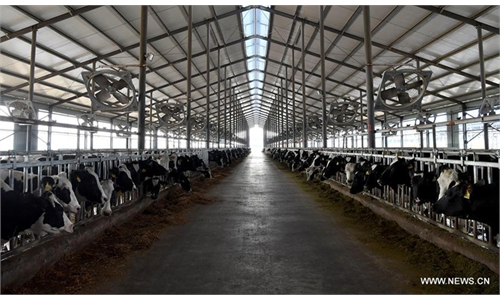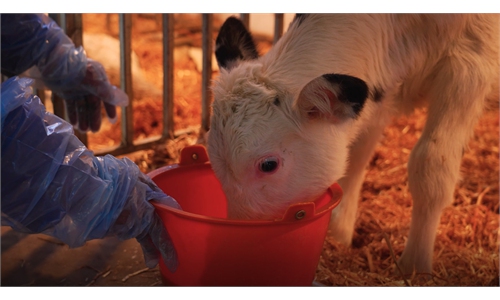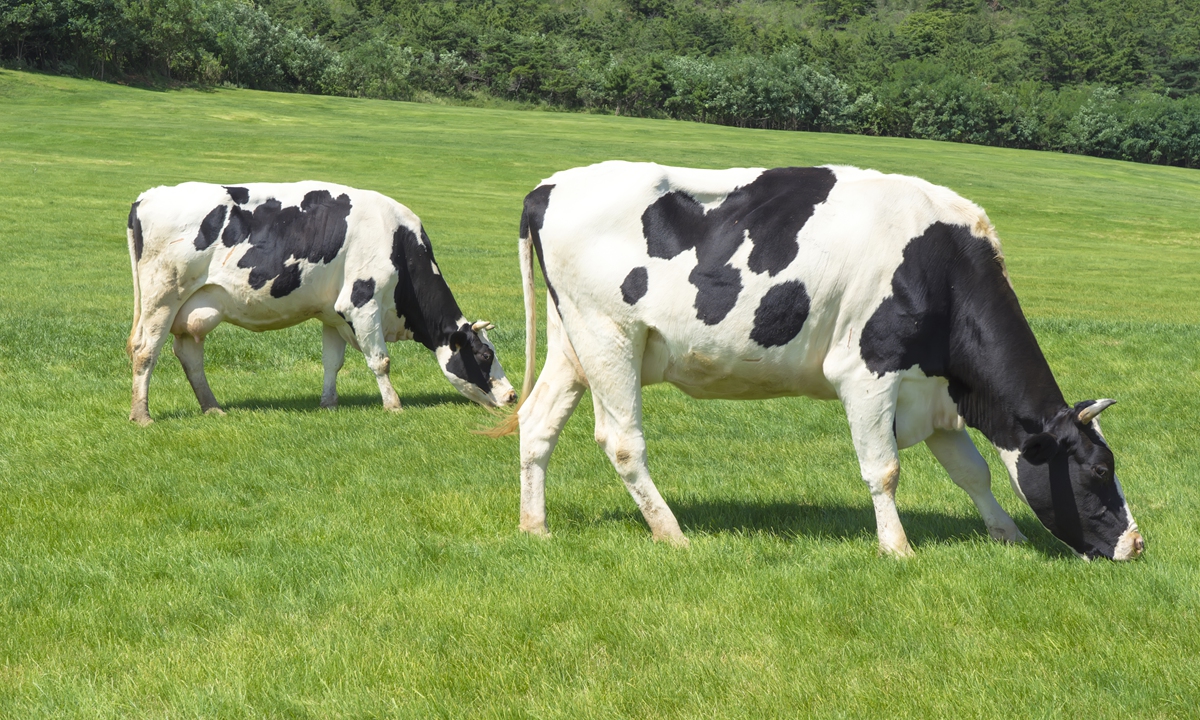
Cattle Photo: VCG
China has achieved a major breakthrough in dairy cattle breeding technology with the successful development of two independently designed genetic chips to evaluate and filter the best dairy cattle breeds in milk production and disease resistance at their early development stage, filling a key domestic gap in genetic evaluation technology for dairy cattle.
Developed by the National Center of Technology Innovation for Dairy (NCTID), the new genetic chips enable testing that is more than four times faster and only one-fifth the cost of whole-genome sequencing, the Global Times learned from the center on Tuesday.
Genetic chips, based on microarray technology, are a high-throughput bioinformatics tool used to analyze the position, quantity, and type of genes associated with desirable traits. These chips are known for their high sensitivity, specificity, and throughput.
Developed countries such as the US and those in Europe widely use genetic chips to accelerate dairy cattle improvement by shortening generation intervals and speeding up genetic progress, according to the NCTID.
Li Xihe, a research fellow with the NCTID, noted that to address key challenges hindering the healthy growth of China's dairy sector, the center joined forces with universities, research institutes and dairy companies, and established a large-scale dairy breeding big data platform based on 96 large-scale farms and more than 600,000 dairy cattle across the country. Through genomic testing, it created individual health and production profiles, and applied machine learning and algorithmic models to analyze vast gene-trait data, said Li.
This effort led to the successful identification of genetic fingerprints of top international dairy breeds and local Chinese cattle lines. "Based on these insights, the team developed the two new chips aimed at ensuring that selected cows produce high-protein, high-fat milk with low somatic cell and bacterial counts," said Li.
Official data shows that in 1949, China's per capita milk availability was just 0.4 kilograms, enough only for infants, patients and a limited number of population. By 2024, it had risen to 40.5 kilograms—a 100-fold increase over 75 years. Since 2023, China's annual milk output has surpassed 40 million tons, ensuring the nation's milk self-sufficiency, according to a report by China News Service.
Li added that the center is now focusing on cultivating new localized dairy cow lines and developing a series of functional genetic chips. "These new tools will support not only breeding, milk production, and health performance, but also identify traits for low carbon emissions, heat resistance, and unique flavor profiles," he said.
RELATED ARTICLES