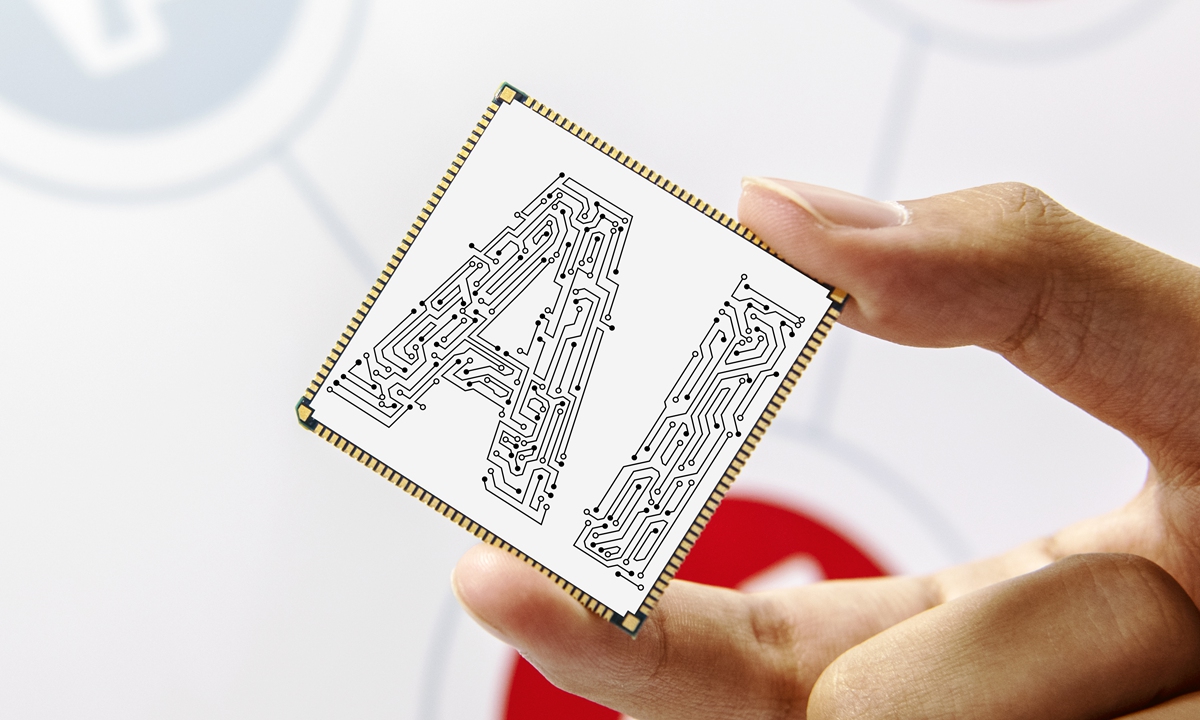
AI Chip Photo: VCG
Chinese tech giant Alibaba deepened its presence in the artificial intelligence (AI) race as it announced on Wednesday the launch of an open-source AI coder. In a statement sent to the Global Times, Alibaba announced the launch of Qwen3-Coder - an AI model that is designed for high-performance software development, it said.
The company also said that its model matched the performance of leading US models, including Anthropic's Claude and OpenAI's GPT-4, in certain areas.
Alibaba touted Qwen-3 Coder as "our most powerful open agentic code model to date," it said in a post on Qwen's X account.
The model excels in agentic AI coding tasks, from generating new codes to managing complex coding workflows, and it achieves "top-tier performance" across multiple agentic coding benchmarks among open models, according to the statement.
With Qwen3-Coder, junior developers can now finish in one day what used to take senior programmers a week, and a brand-new corporate website can be generated in as little as five minutes, according to the company.
The model has been adopted by numerous industry giants such as China FAW Group, PetroChina, China Construction Bank, Ping An, China Southern Airlines and XPeng Motors. Downloads of the broader Qwen-coder series have surpassed 20 million, making it the most downloaded open-source coding suite globally.
The launch also comes amid intensifying competition among Chinese technology companies in the global AI development race.
An industry analyst said the latest releases mark the first time open-source Chinese models have challenged Western rivals on large-language model (LLM) capability, cost and accessibility, underscoring the country's rapid ascent to the top tier of AI research.
Downloads of the new AI model Kimi K2 doubled in a few days after Chinese tech start-up Moonshot AI released an update to its Kimi reasoning model on July 11, drawing growing attention from multiple media outlets and the global AI community, with some of them saying that it is "another DeepSeek moment."
On AI and machine-learning developer platform Hugging Face, downloads of Kimi K2 soared to 145,000 on Monday from 76,000 on Friday, the South China Morning Post reported on Tuesday.
On Wednesday, Alibaba said that its healthcare AI has matched senior-level doctors in national medical exams across 12 major medical specialties, making it the first LLM in the country to meet this standard. It is now integrated into its flagship AI assistant Quark, allowing users to access it by selecting deep search when querying health issues.
This follows the model's May success in reaching the standard of a "Deputy Chief Physician," and represents another leap in its ability to handle complex medical reasoning tasks, underscoring the potential of domain-specific models in healthcare.
Xu Jian, head of Quark Health's algorithms, noted that the Quark Health model based on the Ali's Qwen series foundation has taken a deep engineering approach tailored to vertical scenarios, adding that "we are not training the AI to answer medical questions; we are training it to think like a medical professional."
The tool has been refined in collaboration with hospitals and medical institutions, which are also beginning to adopt it in their own platforms, the company said.
The latest development signaled that China's open-source surge is anything but a one-off fluke, Tian Feng, president of the Fast Think Institute and former dean of Chinese AI software giant SenseTime's Intelligence Industry Research Institute, told the Global Times, adding that it also reflected the growing recognition and influence of Chinese AI innovation, though facing a relentless US crackdown.
China's influence in the field of AI has risen significantly, according to a report from the China Internet Network Information Center. As of March, a total of 346 generative AI services had completed registration with the Cyberspace Administration of China, said the Xinhua News Agency.
RELATED ARTICLES