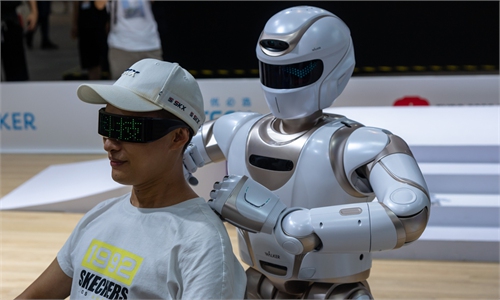
Chinese tech firms ride AI boom at industry event, vowing accelerating global expansion
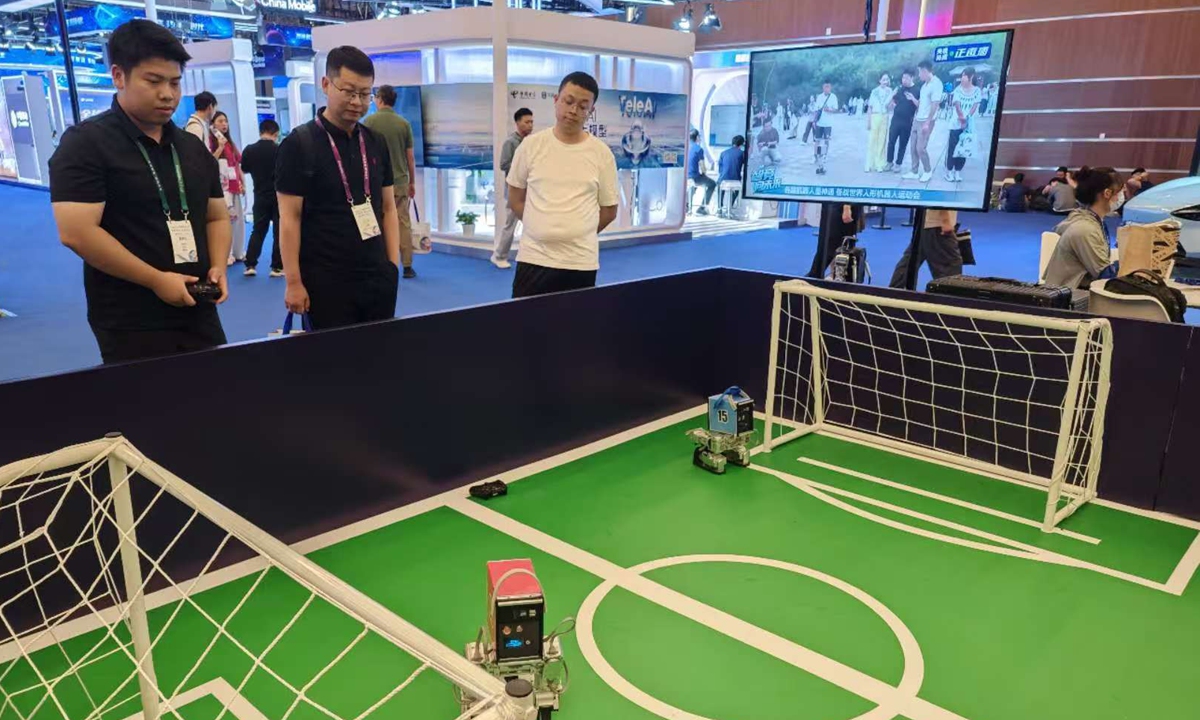
Photo: Yin Yeping/GT
Chinese technology companies participating in an ongoing industry event in Beijing have expressed strong interest and readiness to further tap into the field of artificial intelligence (AI) as they expand their presence in international markets.
The 2025 China Internet Conference, a major industry gathering held in Beijing from Wednesday to Friday, has attracted hundreds of tech firms and a few thousand participants, with a strong focus on the latest developments in domestic technology, particularly AI.
China's AI industry has been expanding rapidly, driven by demand. According to industry statistics, there were 249 million internet users in China using AI as of the end of last year. By May this year, the number had risen to 570 million, more than doubling in just about half a year, said Wu Hequan, an academician at the Chinese Academy of Engineering and former chairperson of the Internet Society of China, during his opening remarks at Wednesday's event.
As of early 2025, China was consuming 10 trillion tokens per day, a 100-fold increase compared with early 2024, Wu added.
Speaking at the event, Tang Ke, deputy general manager of China Telecom, said that the world is going through a new round of technological revolution and industrial transformation.
"Technologies related to AI, including computing power, data, algorithms, applications, and security, are being significantly upgraded and are reshaping the industrial ecosystem... AI is quickly integrating into various industries, becoming a new engine for advancing high-quality economic and social development," Tang said.
Against this backdrop, China Telecom will work to expand the use of AI in real world applications, so that it can better support the real economy and speed up the integration of devices with large language models, Tang said.
China Mobile began investing in AI as early as 2013, with the Jiutian general large model and a highly valuable and capable research and development (R&D) team that has been built up, said Cheng Jianjun, deputy general manager of China Mobile, at the event on Wednesday.
In recent years, China Mobile has increased its investment in R&D, which will reach 39.1 billion yuan ($5.45 billion) this year, Cheng said.
The integration of AI is playing a key role in helping China Mobile become one of the world's leading operators of autonomous networks. The company has also led the formulation of more than 80 percent of international standards related to network intelligence, according to Science and Technology Daily.
In addition to large state-owned enterprises, private businesses are embracing the booming trend of AI, while expanding their global presence.
At the exhibition area of the conference, a robot played with a ball on a small football field. With a quick flick of its eye, the ball was sent straight into the goal. Equipped with AI technology, the robot can be controlled not only by a staff member nearby but also through voice commands.
"Both the motor and battery are independently developed and manufactured in-house, which makes the robot, competitive among many other robots of similar kinds on price," Xie Xingsong, a sales manager at High Torque Robotics based in Guangzhou, South China's Guangdong Province, told the Global Times.
"Our customers include clients in South Korea and the US. In South Korea, most are universities using the robots for research or teaching, and some have even built full courses around them. In the US, our main clients are research labs," Xie said.
The company's core market is education, but it is exploring applications in areas like elder care, where both the domestic and global markets offer strong growth potential, said Xie.
Another company at the event showcased its "digital human" inside a compact display box, where a projection of a real person interacted vividly with users in real time.
"Experts such as professors and doctors can deliver lectures and structured content, but often lack the adequate time for one-on-one consultations. By training 'digital humans' using their voices and expertise, the system can handle frequent, repetitive questions within their field, significantly improving service efficiency," Ye Renqian, founder of Zhang Tong Jia Yuan, an AI-related technology company based in Suzhou, East China's Jiangsu Province, told the Global Times on Wednesday.
The corresponding products are already available in several Southeast Asian markets and are gradually gaining traction.
Despite these advantages, Ye said globalization is not about blind expansion but steady, deliberate progress. "We see 2025 as the year of AI application for Chinese businesses - a tipping point where every industry will be reshaped by AI, and those who adopt it early will move ahead faster," he said.
According to the China Internet Network Information Center, the scale of China's AI industry exceeded 700 billion yuan last year, maintaining a growth rate of more than 20 percent for several consecutive years.
With continuous innovation and development in China's AI sector, high-quality domestic AI products are accelerating their expansion into international markets, enhancing China's influence in the global AI arena, Dai Wei, deputy secretary-general of the Internet Society of China, told the Global Times on Wednesday.
Dai said that the country is expected to further engage in global AI governance, actively participate in the formulation of international rules, and promote the establishment of a fair, just, and secure global AI governance system.
RELATED ARTICLES