China’s Ministry of Science and Technology issues guideline of ethics of driving automation technology research and development
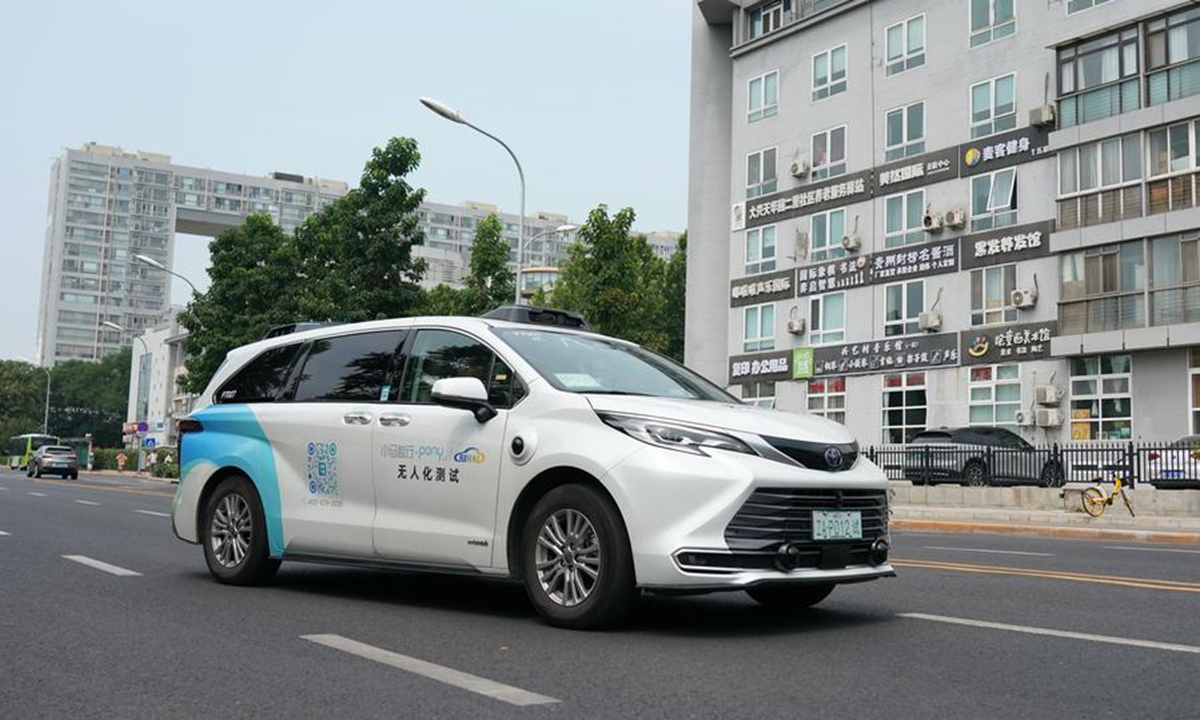
An autonomous vehicle undergoes road testing at an autonomous driving demonstration area in Yizhuang in Beijing, capital of China, June 19, 2024. (Photo: Xinhua)
China's Ministry of Science and Technology on Wednesday released a guideline of ethics of driving automation technology research and development on its official website, aiming to prevent ethical risks in technology research and product application, and to promote the healthy development of the field.
Notably, the guideline said that in the face of unavoidable traffic accidents or extreme driving conditions, the driving automation system should highly respect life and actively seek effective measures to minimize harm to individuals; algorithms, models, and other content related to driving automation technology should be clearly documented and readily accessible for review.
The guideline specified that the research and development of driving automation technology should incorporate robust risk monitoring and emergency mechanisms to ensure that relevant responsible entities can promptly identify, intervene, and control risks, keeping potential threats within a reasonably manageable range. Additionally, the research, development, and application of driving automation technology should establish comprehensive privacy protection mechanisms for the entire data lifecycle.
The guideline also specified corresponding ethical requirements for different types of driving automation technologies.
At the advanced driver assistance stage, the responsible entity is typically the human driver. At the conditional automation stage, the responsible entity varies depending on the specific operational scenario, with either the user or the autonomous driving system potentially being the responsible entity, while at the full automation stage, unless the user actively intervenes in special circumstances, the autonomous driving system is primarily the responsible entity.
When the autonomous driving system is the responsible entity, it should be capable of clearly attributing responsibility to relevant natural persons or legal entities in accordance with applicable laws and regulations, according to the guideline.
The guidelines also noted that when releasing significant research results, relevant entities should adhere to objectivity and accuracy, and must not fabricate or disseminate false information that is inconsistent with the actual functions and effects of the driving automation system.
Additionally, during the processes of research, development, production, and promotion, relevant entities should clearly inform and explain to the public the functional levels, usage conditions, and usage methods of driving automation products, and promptly clarify and correct any misleading information that could lead to public misunderstanding of driving automation technology.
Also on Wednesday, China's Ministry of Public Security vowed to tighten regulation of intelligent driving. Wang Qiang, director of the traffic management bureau of the ministry, said during a press conference that China will tighten regulation and management of intelligent driving as the current intelligent driving systems installed in vehicles have not yet achieved true autonomous driving.
Wang noted that the ministry will actively cooperate with industry authorities to urge automakers to fulfill their primary responsibilities, thoroughly conduct testing and validation of advanced driver assistance systems, and clearly define the boundaries and safety response measures of system functions. Automakers are prohibited from engaging in exaggerated or false advertising and are urged to strictly fulfill their obligation to inform, strengthen training for new users, and help them become familiar with the usage methods and restrictions of vehicle driver assistance functions.
The ministry, in collaboration with relevant departments, will also promote the refinement of related law and regulations, encouraging intelligent connected vehicle manufacturers to continuously improve the technical reliability of driver assistance systems, develop related safety technical standards, and explore incorporating autonomous driving classification standards and operational norms for driver assistance into driver education, training, and examination scopes, Wang said.
Global Times
RELATED ARTICLES