US releases new AI blueprint; Chinese expert warns risks of ‘technological bullying'
By , and Zhang Weilan Published: Jul 24, 2025 01:38 PM


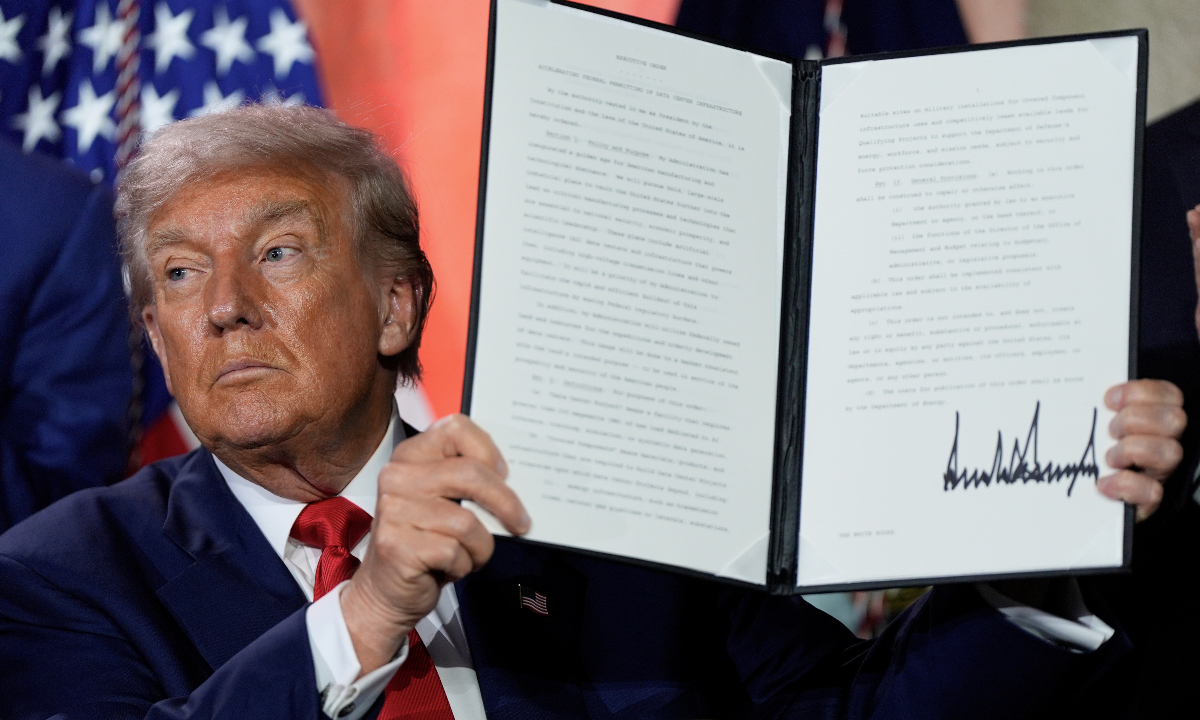
President Donald Trump holds a signed executive order regarding permitting for AI infrastructure after speaking during an AI summit at the Andrew W. Mellon Auditorium, Wednesday, July 23, 2025, in Washington.Photo: VCG
The Trump administration on Wednesday unveiled its AI action plan, a package of initiatives and policy recommendations meant to cement the US as a global leader, according to CNN. A Chinese expert said it is not simply a strategy for technological development, but a hybrid policy encompassing politics, economics, ideology, while warning "technological bullying" against others.The 28-page document, titled "Winning the Race: America's AI Action Plan," outlines more than 90 federal actions set to be implemented within the next year, according to Politico.
CNN summarized that the plan includes three pillars: accelerating innovation, building out AI infrastructure in the US and making American hardware and software the "standard" platform for AI innovations built around the world.
The announcement came before US President Donald Trump outlined his AI plans during an event in Washington Wednesday evening called Winning the AI Race, CNN reported. "America is the country that started the AI race, and as president of the United States, I'm here today to declare that America is going to win it," Trump said.
"The plan calls for the export of US AI software and hardware abroad as well as a crackdown on state laws deemed too restrictive to let it flourish," Reuter wrote. An expansion in exports of a full suite of AI products could benefit AI chip juggernauts Nvidia and AMD, as well as AI model giants Alphabet's Google, Microsoft, OpenAI and Facebook parent Meta, per Reuters.
BBC wrote that the AI plan also promises to build data center infrastructure, and promote American technology - but was panned by critics who consider it an ideological flex by the White House.
In addition, the Trump administration has positioned the expansion of AI infrastructure and investments in the US as a way to stay ahead of China. But critics argued that the plan was a giveaway to Big Tech, BBC reported.
It cited Sarah Myers West, co-executive director of the AI Now Institute, as saying that "The White House AI Action plan was written by and for tech billionaires, and will not serve the interests of the broader public."
Reuters further said the plan marked departure from predecessor Joe Biden's 'high fence' approach that limited global access to coveted AI chips."
The report cited Trump as saying, "We also have to have a single federal standard, not 50 different states regulating this industry in the future."
Trump rescinded Biden's executive order aimed at promoting competition, protecting consumers and ensuring AI was not used for misinformation. He also rescinded Biden's so-called AI diffusion rule, which capped the amount of American AI computing capacity some countries were allowed to obtain via US AI chip imports, according to Reuters.
Ma Jihua, an industry veteran, told the Global Times that although the Trump and Biden administrations have differed in their approaches to the development and global cooperation of AI technology, the US government has consistently pursued a strategic goal to restrict China's AI advancement and maintain its dominant position in the global AI industry — a stance that has remained unchanged.
'China targeted'
Reuters described that the blueprint aims "to maintain the American edge over China in the critical technology." The report continued that, "President Trump marked the plan's release with a speech where he laid out the stakes of the technological arms race with China, calling it a fight that will define the 21st century."
Axion also wrote that "the AI Action Plan is focused on ensuring US dominance over China and allowing companies to grow and scale quickly."
"America is going to win the AI race... we're going to work hard and we're going to win it," Trump said.
Vice President JD Vance said in a separate appearance at the Washington event, "If we're regulating ourselves to death and allowing the Chinese to catch up to us, that's not something ... we should blame the Chinese for..., that is something we should blame our own leaders for, for having stupid policies that allow other countries to catch up with America."
Responding to a question about the release of the action plan on Wednesday, Chinese Foreign Ministry spokesperson Guo Jiakun stated on Thursday that China believes that all parties should jointly promote the open and inclusive development of AI for good and for all. Our emphasis should not be on confrontation and competition, but rather on sharing the dividends of AI and achieving common development, Guo said.
"This is not simply a strategy for technological development, but a hybrid policy encompassing politics, technology, economics, ideology, and more," Li Baiyang, an associate professor of intelligence studies at Nanjing University, told the Global Times. By tying AI strategy to politics, it highlights US anxiety over China's continued breakthroughs in technology, Li said.
US objective is to engage in an AI development race with other nations, particularly China. By leveraging development pace and technological penetration as well as mobilizing allies, the US aims to outcompete China in AI dominance—ultimately securing maximum commercial and strategic gains for American interests, Ma told the Global Times.
In detail, the plan proposes to restrict exports of American AI equipment and curbing the spread of Chinese AI models, media reports said.
According to the plan released on the White House, it emphasizes the need to "plug loopholes in existing semiconductor manufacturing export controls."
The plan proposes the US Commerce Department to lead an effort to "develop new export controls on semiconductor manufacturing subsystems." It says that the US and its allies impose export controls on major systems necessary for semiconductor manufacturing, but do not control many of the component sub-systems.
"The US must also prevent our adversaries from using our innovations to their own ends in ways that undermine our national security. This requires new measures to address gaps in semiconductor manufacturing export controls, coupled with enhanced enforcement," the plan noted.
Li criticized the plan as the US government's efforts to engage in its "technological bullying." He said that the plan itself not only aims to promote open-source AI ecosystems and sell AI products to allies, but also impose strict restrictions on China in terms of computing power, models, and talent — calling it an act of technological coercion.
The US Commerce Department will be in collaboration with industry, explore leveraging new and existing location verification features on advanced AI compute to ensure that the chips are not in countries of concern, the plan proposes.
"We must remain vigilant against the negative spillover effects of the US extending its national security narrative into the AI domain, as well as its aggressive tactics —including tracking chip exports, restricting high-end talent, and rallying allies to suppress competitors," Li warned.
China has noted that the US has recently taken the initiative to announce the approval of Nvidia's H20 chip sales to China, a spokesperson for the Ministry of Commerce said on July 18.
China hopes the US will work in the same direction, engage in equal consultations, and correct its erroneous practices to foster a favorable environment for mutually beneficial cooperation between enterprises of both countries, and jointly safeguard the stability of global semiconductor production and supply chains, the spokesperson said.
An analysis of the Trump administration's recent policies suggests a seemingly relaxed approach toward restricting China's access to chips and AI-related technologies. However, this apparent easing is in fact a forced adjustment — the result of China's accelerated breakthroughs in both AI hardware and software development, Ma said.
The contest in AI will ultimately depend not only on core indigenous technologies but also on fostering a healthy ecosystem and global partnerships, Li said.
Looking ahead, China's AI industry must remain self-reliant and continue making breakthroughs in core technologies—particularly in high-end chip R&D — to achieve truly independent and controllable technological pathways and hardware systems, Ma said.
RELATED ARTICLES