China's NEV makers embrace overseas market expansion, accelerating auto cooperation with overseas partners
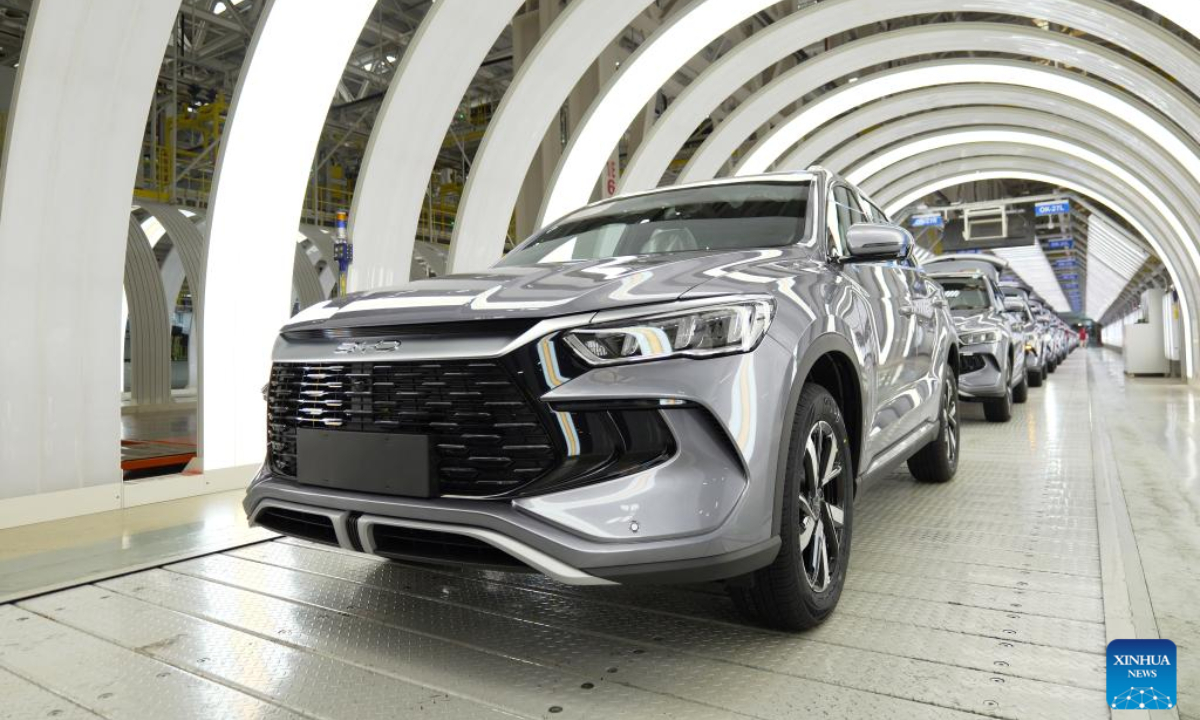
This photo taken on April 24, 2024 shows a new energy vehicle (NEV) assembly line of BYD, China's leading NEV manufacturer, at the plant of BYD in Zhengzhou, central China's Henan Province. Photo:Xinhua
Chinese automakers, especially in the new-energy vehicle (NEV) sector, are increasingly adopting a localized strategy by building factories in overseas markets, as they embrace global collaboration with openness and innovation amid growing uncertainties caused by Washington's tariffs policy.
Chinese electric vehicle maker XPeng Motors announced on Thursday that it had delivered the first vehicle manufactured at XPeng's new assembly plant in Indonesia, an X9, to an Indonesian consumer, according to a press release on the company's WeChat account.
As of now, the company operates in 46 markets, with cumulative deliveries exceeding 800,000 units, the company said.
In addition, BYD announced on July 1 that the company had rolled out the first BYD Dolphin Mini manufactured in Brazil, a milestone for the vehicle industry in Latin America.
Chinese automakers are expanding their overseas footprint, aiming to achieve multi-market growth and thriving across diverse global markets.
In May, Chinese automaker Changan Automobile Co officially inaugurated the Changan Automobile Rayong Factory - its first NEV production base in Rayong Province, Thailand. The plant has five main workshops: welding, painting, assembly, engine assembly, and battery assembly, with an initial annual production capacity of 100,000 vehicles.
"By shifting from exporting assembled cars to completely knocked down kits, Chinese automakers are ramping up the development of localized production systems, which shows that the overseas development of Chinese automobile companies has entered a new stage," Cui Dongshu, secretary-general of the China Passenger Car Association, told the Global Times.
Cui said supply chain integration and the well-known "China speed" will better empower the global automotive industry while allowing other countries to rapidly develop their local automotive sectors, achieving resource complementarity and win-win cooperation.
The confidence behind Chinese NEV makers going global stems from the multi-dimensional synergy of its industrial system, technological innovation, policy support, and logistics network, analysts said.
In order to promote high-quality cooperation involving NEVs, the Ministry of Commerce, along with eight other government departments, issued a document in 2024, including detailed measures to improve international operational and logistics systems, strengthen financial support, create a benign trade environment, and bolster risk prevention capability.
In the first half of 2025, China's NEV production and sales surpassed 6.9 million units each, up by 40 percent year-on-year, according to the China Association of Automobile Manufacturers. Total NEV exports surged 75.2 percent, the data showed.
The strong performance of Chinese automotive exports reflects the transformation of China's auto industry and signals a major shift in the global NEV industry, an expert said.
"Chinese automakers possess core technologies, enabling them to achieve leapfrog development in the sector. Additionally, Chinese NEVs offer exceptionally high cost-performance ratios," Zhang Xiang, secretary-general of the International Intelligent Vehicle Engineering Association, told the Global Times on Thursday. He said China's early entry into the NEV market, coupled with a robust domestic supply chain, has significantly reduced component costs.
With the window for China's NEVs to expand globally likely to remain open for merely a few years, as foreign automakers catch up with Chinese advancements, Chinese automakers must prioritize continuous innovation to enhance product competitiveness and win recognition from overseas consumers, Zhang said.
RELATED ARTICLES