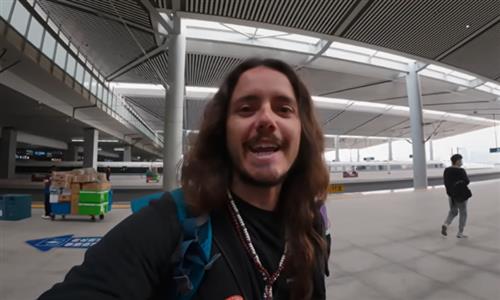
A foreign tourist poses for photos at the Temple of Heaven in Beijing, capital of China, on July 17, 2025. Photo: VCG
Recently, the issue of the executive of US bank Wells Fargo, Mao Chenyue, being subjected to exit restrictions in China has attracted attention from Western media. The Chinese Foreign Ministry earlier this week stated that Mao is involved in a criminal case currently being handled by Chinese law-enforcement authorities and is subject to exit restrictions in accordance with the law. Pursuant to Chinese laws, with the case still under investigation, Mao cannot leave the country for the time being and has an obligation to cooperate with the investigation. Two key facts are evident from this: First, Mao's exit restriction stems from her involvement in a criminal case; second, as the investigation is ongoing, her cooperation is not only a legal obligation but also consistent with international practice.
Those reports hyping the so-called "disappearance of a US bank executive in China" attempt to paint a scene in which, in this "chilling" social environment, anyone can suddenly vanish - either for being "suspected of espionage," or even be "used as a bargaining chip in disputes between foreign companies and the government." Traveling to China is portrayed as "risky," and the business environment is depicted as "worrisome." It's no wonder these US media outlets would conjure such collective associations easily - if you disregard the subject, most people would probably think it refers to the US government. From ex-Alstom executive Frederic Pierucci to Huawei's Meng Wanzhou, and even the many scientists, Chinese scholars and students who have been repeatedly harassed by the FBI, the US is most adept at overstretching the concept of "national security," engaging in contemporary "McCarthyism" and creating a "chilling effect" through the unjust detention of foreign citizens.
Besides, some media outlets have also been hyping up other individual cases, lumping them together with Mao's case, to hype up the so-called "risks of traveling to China." This is like "wielding a hammer and seeing every problem as a nail." In today's world, frequent international travel inevitably brings occasional disputes. If every case involving an American is blown out of proportion and becomes "evidence" of a worrying "Chinese social environment" in the "bitter complaints" of US public opinion, do the US media consider it "safe" only if all Americans in China possess "extraterritorial privilege"?
Whether Chinese or foreign citizens, as long as they are within China's territory, their legitimate rights and interests are protected under Chinese laws and their behaviors must comply with Chinese laws. All legal rights and obligations are mutually corresponding and inseparable. One cannot expect that just because someone holds US citizenship, they are superior and can be exempt from the law and even come and go freely when involved in a criminal case. Such an exception is not allowed in China, nor in the vast majority of sovereign nations, including the US. Whoever is involved in a criminal case has an obligation to cooperate with the investigation. Some Western institutions and public opinion often describe China's legal handling of foreign-related cases as "undermining the business environment" and "intimidating foreigners in China." However, if China does not adhere to the rule of law, it would actually be the situation of "undermining the business environment."
China has maintained a low profile during the investigation of Mao, disclosing information as much as possible while the case is still under probe. These serve as a response to concerns raised by US public opinion. Regarding this isolated case, China's handling has been reasonable, rational and lawful. As for Mao's fate, it should be determined by Chinese laws; it is neither necessary nor possible to rely on US public opinion to "settle a lawsuit."
The Exit and Entry Administration Law of the People's Republic of China explicitly states that "the legitimate rights and interests of foreigners in China shall be protected by laws." In recent years, the country has continued to relax its visa policies, improve the business environment and welcome friends from all over the world. The stable environment brought about by China's comprehensive advancement of the rule of law is an important reason for attracting more and more foreigners to invest, start businesses and travel in China.
The increasing investment by foreign enterprises in the Chinese market, along with the surge of videos showcasing foreign tourists enjoying their travels in China, vividly illustrates the safety and friendliness of Chinese society. As a spokesperson for the Chinese Ministry of Foreign Affairs stressed, it is an individual judicial case and the country will as always welcome people from all countries to travel and do business in China and ensure their rights and interests in accordance with the law. With people-to-people exchanges between China and foreign countries multiplying, the narrative of "China is risky" is collapsing and fairness prevails in the hearts of the people.
In the context of the irreversible trend of exchanges between China and foreign countries, the marginal returns of making a fuss about the "China threat" and "risks of traveling to China" are increasingly diminishing. We advise some individuals that if they are truly concerned about the safety issues facing Americans, they should focus their attention not on a particular judicial case in China, but rather on their own domestic issues that are more relevant to the safety of the American public.