European businesses eager for deeper green cooperation with China as bilateral joint statement fuels low-carbon momentum
China EU Photo:VCG
European businesses expressed enthusiasm to further tap into potential cooperation in greenfield cooperation with their Chinese partners, following the release of a joint statement on climate change by Chinese and EU leaders that injects new impetus into collaboration in the booming green sector.
The document was issued on the occasion of the 50th anniversary of the establishment of diplomatic relations between China and the EU and the 10th anniversary of the adoption of the Paris Agreement.
According to the statement released on Thursday, both sides recognize that the China-EU green partnership is an important part of the China-EU partnership, that green is the defining color of China-EU cooperation, and that the two sides have a solid foundation and broad space for cooperation in the field of green transition.
Commenting on the strong complementarity and growing opportunities in China-EU green cooperation from the business perspective, Jens Eskelund, president of the EU Chamber of Commerce in China (European Chamber), said that it is "very significant, probably the most obvious area of collaboration with much low hanging fruit."
The areas with the most potential cover a wide range, from batteries and solar power to green fuels, as well as political cooperation on agreeing to targets and standards, Eskelund told the Global Times.
"We see, for example, China playing a significant and positive role in the International Maritime Organization in terms of supporting schemes, which will encourage the adoption of green maritime fuels," Eskelund said.
European businesses also reaffirmed their commitment to the Chinese market, with a strong focus on the green sector.
Danish pump manufacturer Grundfos views the consensus on deepening the EU-China green partnership as a tremendous opportunity, the company said in a statement sent to the Global Times on Friday. The firm said it would leverage its leading water technologies, local expertise, and unwavering commitment to sustainability to support the green transition agendas of both China and the EU.
Having deeply embedded green transformation into the company's strategic positioning, the firm said it continuously pursues technological innovation to deliver efficient and pioneering solutions. "These efforts accelerate carbon neutrality across our own operations and customer value chains, thereby advancing sustainable development globally and in the Chinese market," the statement said.
Another Danish company, shipping and logistics giant Maersk, said that China has the potential to become a global green marine fuel production hub, and the company will continue exploring opportunities to collaborate with the Chinese government and relevant parties to develop sustainable logistics, enhance green supply chains, and invest in renewable energy projects.
Maersk is committed to achieving net zero greenhouse gas emissions across its entire business by 2040 and has been pioneering energy transformation for the shipping and logistics industry, the company told the Global Times on Friday.
Maersk has been working with partners in China to create scalable fuel solutions, it said, including an offtake agreement with Chinese developer Goldwind with an annual volume of 500KT from 2026.
Marking the 50th anniversary of China-EU diplomatic relations, German auto giant BMW has taken further steps in its journey toward carbon neutrality in China. On Thursday, its joint venture in China BMW Brilliance Automotive (BBA) and China Datang Corporation, a leading Chinese energy company, formally signed a strategic partnership agreement to jointly develop a sustainable automotive industry chain, according to a document the German company shared with the Global Times on Friday.
This collaboration represents another major milestone in BMW's commitment to deepening innovation partnerships and advancing sustainable development in China, the carmaker said.
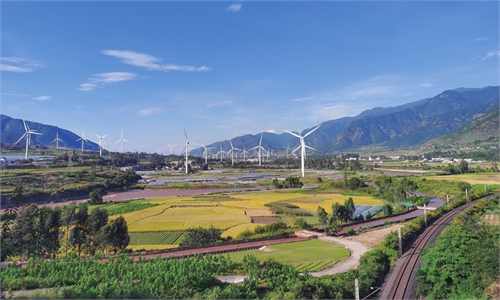
The partnership also makes BBA one of China's first automakers to establish a renewable power joint venture. Under the agreement, BBA and China Datang will establish a renewable power joint venture to develop onshore wind power projects.
Commenting on the growing interest of European companies in partnering with Chinese firms in the green sector, Zhou Mi, a senior researcher at the Chinese Academy of International Trade and Economic Cooperation, told the Global Times on Friday that this trend reflects real market demand. "They are voting with their feet, drawn by China's openness and readiness to further cooperate, and are looking to tap into broader opportunities in both the Chinese and global markets."
As European firms step up their investments in the green sector, Chinese companies are likewise expanding their presence across the entire green value chain.
For instance, battery maker CALB is investing 2 billion euros ($2.34 billion) in a lithium battery plant in Portugal, while CATL, a leading Chinese green energy solution provider, has also launched gigafactory projects in Germany, Hungary and Spain to support the region's electric vehicle ecosystem, the Xinhua News Agency reported.
Like their European counterparts, Chinese businesses have also played an increasingly important role in supporting the bloc's green transition. That said, EU policies toward Chinese companies and green products — particularly new-energy vehicles — still carry elements of bias or restrictions based on so-called "overcapacity" claims, Zhou said, noting that promoting industry development requires a commitment to openness and cooperation.
"To move forward, China and the EU should continue to build mutual trust and strengthen communication at the industry and enterprise levels, helping green products achieve more efficient and sustainable market access," Zhou said.
RELATED ARTICLES