World AI conference in Shanghai showcases China’s tech prowess and booming industry amid rising global AI competition
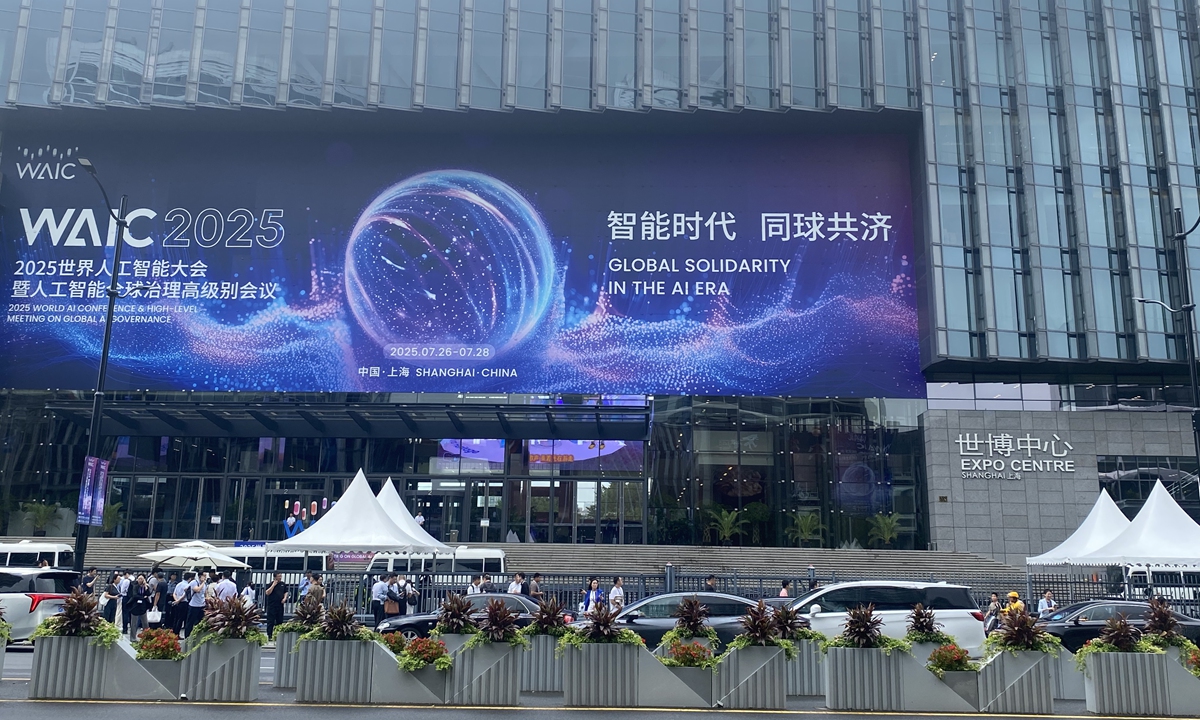
A view of the World Artificial Intelligence Conference in Shanghai on July 26, 2025. Zhang Weilan/GT
The 2025 World Artificial Intelligence Conference (WAIC2025) kicked off in Shanghai on Saturday, highlighting three core themes: academic breakthroughs, software-hardware integration, and global governance. The event has reached an unprecedented scale, with an exhibition area exceeding 70,000 square meters, according to the organizer.
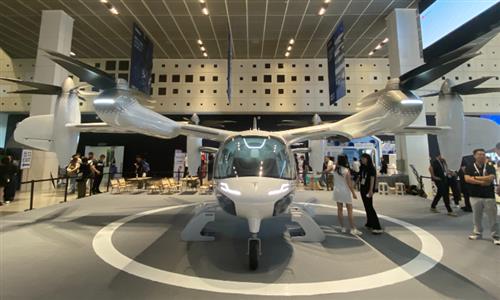
Under the theme "Global Solidarity in the AI Era," the annual three-day conference, running from Saturday to Monday, has attracted over 800 Chinese and international exhibitors, showcasing more than 3,000 exhibits - a record high, including 40 large language models, 50 AI-powered devices, and 60 intelligent robots, according to the organizer.
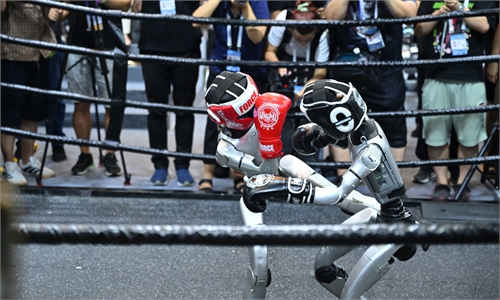
For instance, in the field of model application, Siemens debuts its Industrial Copilot AI industrial assistant in China. In embodied intelligence, Tesla showcases the Tesla Bot, and Unitree Robotics displays a boxing robot. Other AI-powered hardware products unveiled include AI pets, AI glasses, AI computers, and multilingual transparent AI screens.
A notable change at this year's event is the strong presence of embodied intelligence. While only 18 robotics companies participated in the previous edition, WAIC2025 has drawn over 80 companies in this field, including leading Shanghai-based robot maker AgiBot, the National and Local Co-Built Humanoid Robotics Innovation Center, as well as Hangzhou-based Unitree Robotics and DeepRobotics, according to the organizer. The event serves not only as a showcase of cutting-edge technologies but also as a platform for global collaboration and academic exchange in the AI field.
Step into the exhibition hall of the WAIC 2025 and the future unfolds. This year's WAIC exhibition center has expanded to more than 70,000 square meters, up 34.6 percent from last year, and has attracted more than 800 companies, nearly 60 percent more than in 2024. Over half are from outside Shanghai or overseas, bringing 100 world-first debuts and 3,000 cutting-edge products. A new Future Tech hatchery highlights 200 global AI emerging start-ups.
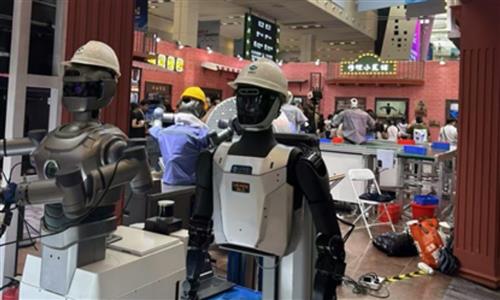
To bring AI to life for everyone, the organizer has built an AI-powered living city block - art station, repair shop, snack street - populated by robots. At the core themed street, robots are taking on various roles in old Shanghai alley scenarios, performing high-precision tasks such as drumming, calligraphy, cooking skewers and peeling eggs. These actions demonstrate the iterative development of cognitive, motor, and interactive intelligence.
"AI, as a driving force of the new technological and industrial revolution, is fundamentally transforming how we live and work," a visitor surnamed Liu from Shenzhen told the Global Times on Saturday. "On the show floor, what's on display is more than a tech feast - it's a productivity revolution driven by indigenous innovation and real-world scenarios, as China's AI sector advances through hardware-software synergy to seize the high ground in global competition," he said.
China's AI rise can be summed up in two phrases, that is "skyrocketing progress" and "sci-fi made real," Liu told the Global Times.
The WAIC has transformed into a nationwide AI carnival. Forums, creator meet-ups, and pop-up investment institution activities spill out of every hallway. This weekend, every table along the Huangpu River will buzz with pitches, demos, and impromptu partnerships, Wang Qiuhua, a representative from an AI software company in Beijing, told the Global Times on Saturday.
The conference offers China a platform to showcase its latest AI advancements to the global community, the Hong Kong-based South China Morning Post (SCMP) reported on Friday.
The US administration on Wednesday released a 28-page AI Action Plan designed to further aim at tightening controls on AI technology exports to China and limit the spread of Chinese AI models, as part of Washington's broader effort to shape the rules governing the fast-moving technology, said the SCMP report.
The move reflects Washington's broader intentions: strengthening chip export controls on China, building an AI alliance designed to isolate China, and framing global AI diplomacy and governance targeting China, Tian Feng, president of the Fast Think Institute and former dean of Chinese AI software giant SenseTime's Intelligence Industry Research Institute, told the Global Times on Saturday.
WAIC 2025 serves not only as a technology showcase but also as a global dialogue forum on AI governance, as well as a cooperation platform for enterprises across the AI supply chain, Tian noted.
According to information shared by the organizers with the Global Times, the event features a lineup of renowned international scientists, global leaders, and industry players. Nobel laureate and "AI godfather" Geoffrey Hinton, Harry Shum, council chairman at Hong Kong University of Science and Technology, and Turing Award winner Andrew Yao, secretary-General of ASEAN Kao Kim Hourn, vice president of Developer Ecosystems at Nvidia Neil Trevett, representatives from Google, Tesla and Microsoft, are among the participants.
"As an engine of global economic growth, China's strong industrial foundation, diverse industry applications and abundant innovation resources have laid a solid foundation for the industrialization of AI. At the same time, new productivity emphasizes the driving force of scientific and technological innovation, and AI technology is the key driving force," Philippe Rambach, chief Artificial Intelligence Officer, Schneider Electric, told the Global Times on Saturday.
China has become a global highland for AI industry development and a key node in Schneider Electric's global AI innovation strategy, Philippe Rambach said. In China, the policy support of "AI+", a strong industrial foundation, diverse application scenarios, and abundant innovation resources are giving birth to a rapidly emerging AI industry cluster, making China a highland for the development of the global AI industry and the most active global market in practicing large-scale AI applications.
Compared to the US' protectionist and hegemonic approach to AI development, the broad participation of enterprises, scholars and officials from across the world at the WAIC demonstrates the robust vitality of international AI cooperation while also underscoring openness and exchange are the future of global AI, Tian noted.
China's influence in the field of AI has grown significantly, according to a report from the China Internet Network Information Center. As of March, 346 generative AI services had completed registration with the Cyberspace Administration of China. In 2024, China's AI market surpassed 700 billion yuan ($97.65 billion), maintaining a growth rate of more than 20 percent, Xinhua reported.
RELATED ARTICLES