EU-US trade deal draws criticism within the bloc; some sectors likely to face substantial disruptions: Chinese expert
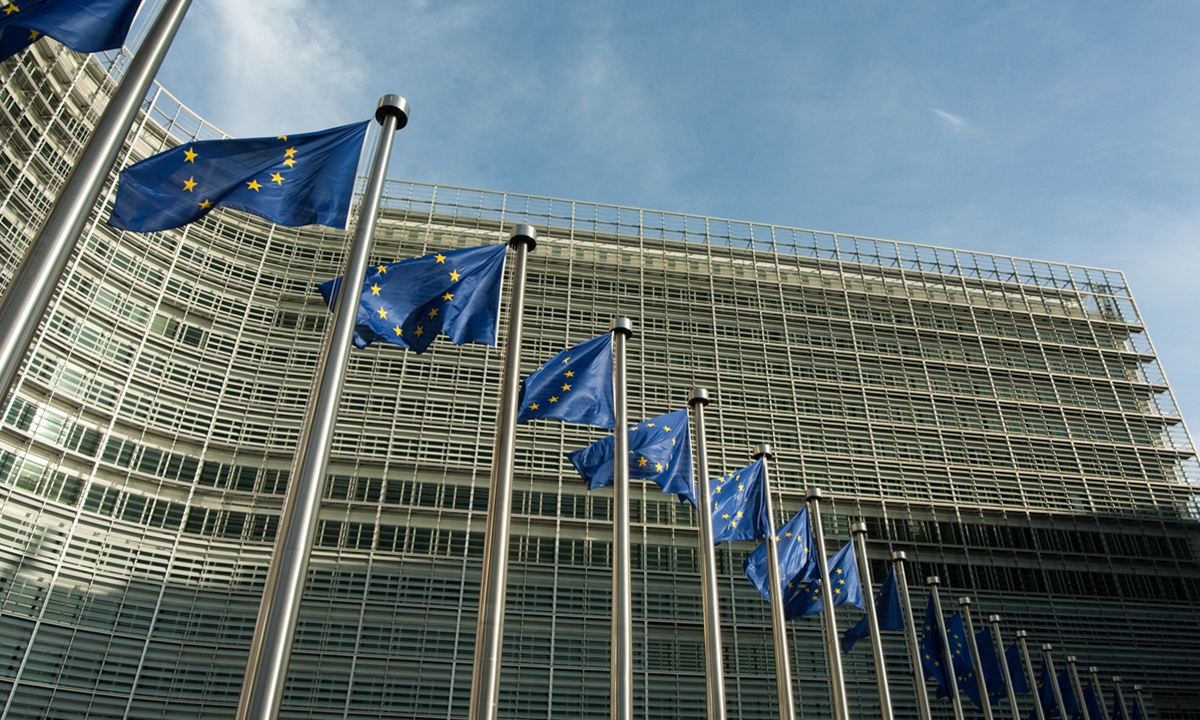
EU headquarters in Brussels Photo: VCG
The EU-US trade deal has drawn harsh criticism from some officials and business representatives within the bloc, with some accusing the EU of caving in to the US with an unbalanced deal and warning damages on EU businesses from elevated tariff levels on European products, according to several media reports on Monday.
The US and the EU have reached a trade deal framework, which includes a 15-percent tariff on EU goods, the BBC reported on Monday. The agreement also includes terms unilaterally proposed by the US administration, under which the EU would increase investment in the US by $600 billion, including purchases of US military equipment, and commit $750 billion to energy spending, per the BBC report.
The deal drew both somewhat positive reactions as well as blatant criticism from within the EU. German Chancellor Friedrich Merz and some business groups offered statements of cautious support, voicing hope that the agreement would prevent an escalation in pain and uncertainty; However, others, such as François Bayrou, France's prime minister, said on social media that it was a "dark day" for Europe, according to the New York Times.
Bayrou further said that the bloc had caved in to the US president with an unbalanced deal that imposes a headline 15 percent tariff on EU goods while saving US imports from any immediate European retaliation, Reuters reported on Monday.
Hungarian Prime Minister Viktor Orban also joined a growing chorus of critics against the EU deal. Orban slammed European Commission President as a "featherweight" negotiator in response to the trade deal struck Sunday between the US and the EU, according to Politico.
Meanwhile, Ville Tavio, minister for development cooperation and foreign trade of Finland, said that the agreement "has calmed the situation but there's absolutely no reason for celebration," the Helsinki Times reported.
The deal also drew criticisms from some EU businesses. Describing the deal as a painful compromise that was an "existential threat" for many of its members, Germany's BGA wholesale and export association said that it was time for Europe to reduce its reliance on its biggest trading partner, Reuters reported on Monday.
"Let's look on the past months as a wake-up call," said BGA President Dirk Jandura, according to Reuters. "Europe must now prepare itself strategically for the future - we need new trade deals with the biggest industrial powers of the world."
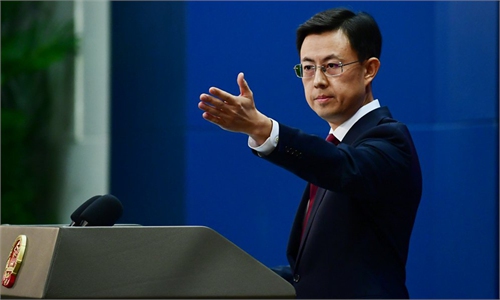
At a regular press briefing of the Chinese Foreign Ministry on Monday, a reporter noted that the EU said that its recent deal with the US was "not ideal" but "the best" deal that it could get and asked whether China would be willing to accept a sub-optimal deal if that is all that is on the table or whether China would be willing to walk away from the talks if necessary.
In response, Guo Jiakun, a spokesperson for the ministry, said that China, as always, believes that all parties should resolve economic and trade differences through equal-footed dialogue, uphold a sound environment for international trade and economic cooperation, and observe the WTO rules. "That said, we firmly oppose any party's move to strike a deal at the cost of China's interests," Guo said.
There appear to be no clear beneficiaries within the EU, and several sectors are likely to face substantial disruptions, Liao Shuping, a senior researcher at the Bank of China Research Institute, told the Global Times on Monday, pointing to some of the EU's main exports to the US, including luxury goods, agricultural products, automobiles and auto parts, aircraft components, machinery, and chemical and pharmaceutical products.
Jian Junbo, director of the Center for China-Europe Relations at Fudan University's Institute of International Studies, said that the agreement may temporarily help stabilize transatlantic trade ties and prevent further escalation of bilateral tensions; However, it is still expected to exert negative pressure on the EU side, particularly in industrial development.
Jian told the Global Times that while it is too early to fully gauge the impact, a 15-percent tariff marks a significant increase from the EU's current average export tariff rate to the US. This sharp rise could pose a considerable challenge to the competitiveness of EU goods in the US market, according to the expert.
RELATED ARTICLES