IN-DEPTH / IN-DEPTH
China pioneers waste-to-energy tech, fueling green cities under Xi’s ecological guidance
Turning trash into treasure
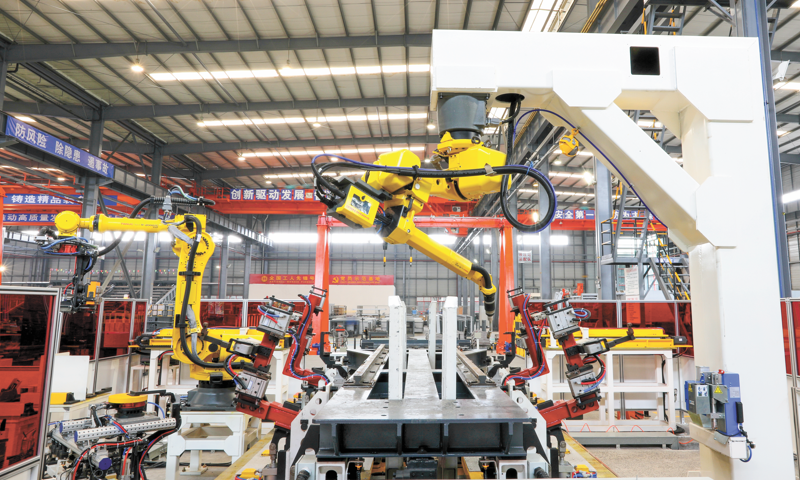
The main assembly base of Sanfeng Environment in Southwest China's Chongqing Municipality Photo: Courtesy of Sanfeng Environment
Editor's Note:
Xi Jinping, general secretary of the Communist Party of China (CPC) Central Committee, Chinese president, and chairman of the Central Military Commission, has stressed that the environment concerns the well-being of people in all countries. During his inspections, Xi has always paid great attention to ecosystems, spanning from cities to rural areas, and from enterprises to communities.
Under the guidance of Xi's thought on ecological civilization, China has been advancing the green transition of its economy over the last decade. Regions across the country are actively promoting the construction of ecological civilization and advancing Chinese modernization featuring harmony between humanity and nature. These efforts are creating a "Beautiful China."
The coming five years will be critical for the building of a "Beautiful China." The Global Times is launching a series of stories to explore the progress of ecological civilization projects that Xi is concerned with, delving into the positive environmental changes occurring now, and offering valuable insights and references for both national and global efforts. From these practical examples, we can see how Xi's thought on ecological civilization is put into practice and further inspires public action.
In this installment, we focus on the topic of waste recycling and reuse in China. Through visits to frontline waste treatment facilities and interviews with experts, the Global Times learned that green development is the foundation of urban progress, and utilizing household waste as a "clean energy" source through more efficient and scientific treatment plays a vital role in building low-carbon cities.
Where does all the garbage go?
For most residents, once a bag of household waste is tossed into a trash can, its journey may no longer be of concern.
In reality, China has developed a vast and efficient network for the collection, transportation, and disposal of household waste. Over just a few decades, the country has not only built a high-performance waste treatment system, but also made significant breakthroughs in waste-to-energy technologies and operational management, achieving a world-leading position and expanding its presence abroad.
The Central Urban Work Conference was held in Beijing from July 14 to 15, 2025.
Chinese President Xi Jinping attended the conference and delivered an important speech, according to the Xinhua News Agency.
Key tasks for urban development across seven aspects were outlined at the meeting, among which "focus will be directed toward building green, low-carbon and beautiful cities," was highlighted, Xinhua reported.
In recent years, an increasing number of institutions and urban communities have intensified their efforts in garbage sorting, as it has become a popular trend to promote a green and low-carbon lifestyle in the country, contributing to building a "Beautiful China."
Garbage sorting and recycling is a systematic project that requires concerted and long-term efforts from all parties, precise measures and active participation of both urban and rural residents, Xi pointed out while replying to a letter from volunteers involved in garbage sorting in a residential community in Shanghai in May, 2023, Xinhua reported.
Waste becomes energy
Located in northern Beijing, the Asuwei Domestic Waste Incineration Power Plant handles all household waste from Changping district as well as the northern parts of Dongcheng and Xicheng districts, processing up to 3,000 tons of waste per day.
When the Global Times visited the plant, there was no noticeable odor in the air. Instead, the site featured clean roads and modern facilities, a stark contrast to the stereotypical image of mountains of garbage.
From an operations room overlooking a massive waste pit, one could directly observe the waste treatment process. Fully enclosed transport trucks, after being weighed on a scale, enter the unloading area in an orderly manner. The waste is not incinerated immediately; instead, it undergoes a fermentation process lasting five to seven days in a deep storage pit.
"This step is crucial," explained Wang Hongshun, director of production and operations department at the Asuwei plant. "Fermentation significantly increases the calorific value of the waste, making the subsequent incineration more complete and efficient."
Above the waste pit, two large cranes move slowly. Each grapple can lift up to 10 tons of garbage. "The electricity generated from a single grab of incinerated waste is enough to power a family of three for an entire year," Wang noted.
According to Wang, the waste then enters the incinerator, where it is transformed into slag through the drying, combustion, and burnout phases. The heat produced is used to generate steam in a waste heat boiler, which powers a turbine generator. The plant supplies approximately 420 million kilowatt-hours of green electricity to the Beijing grid each year. Even the remaining slag is not wasted. After resource recovery processing, metals such as iron, aluminum, gold, and silver can be extracted. The remaining material is turned into environmentally friendly construction materials, with a resource utilization rate of over 90 percent. Thanks to a combination of advanced flue gas purification technologies, levels of dust, nitrogen oxides, hydrogen chloride, and other pollutants are all below EU standards. The leachate from waste is also purified and reused through a "pre-treatment + advanced treatment" system, achieving zero discharge of wastewater.
Additionally, the large amounts of thermal energy generated during incineration are used to heat the plant, and plans are underway to expand heating services to nearby areas, further maximizing energy utilization.
The Asuwei is also open to the public. "Many residents gain a deeper understanding of advanced waste treatment technology and green development after visiting," Wang said, adding that public visits have helped reduce the "Not in My Backyard" effect.
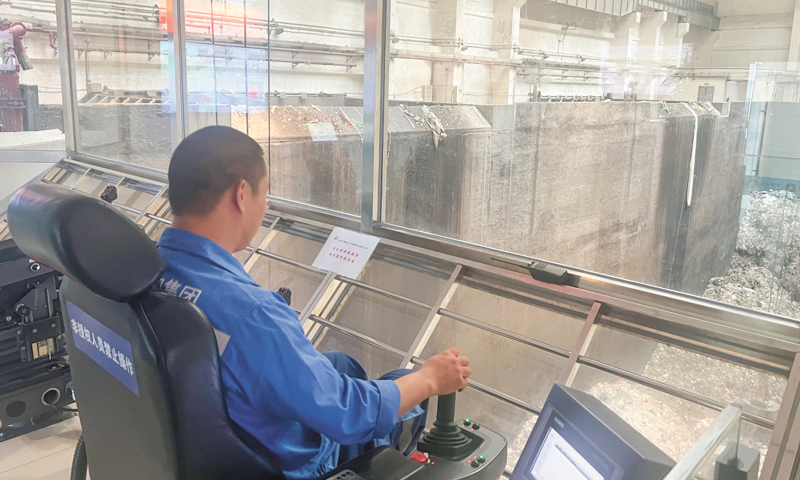
A technician operates a waste grab crane at the Asuwei Domestic Waste Incineration Power Plant in Beijing in July, 2025. Photo: Ren Xiaonan/GT
Not enough garbage to burn?
"Far ahead." That's how Pan Gong, director and chief industry researcher of the E20 Environment Platform's Solid Waste Industry Research Center, described the current state of Chinese waste-to-energy technology.
Pan told the Global Times that Chinese enterprises now lead the world in technology, cost control, and operational experience.
Currently, China has built over 1,000 household waste incineration plants, covering virtually all densely populated areas. The total treatment capacity of China's waste-to-energy sector now surpasses that of the US, Europe, and Japan combined, according to the Guangming Daily. This achievement didn't happen overnight.
Pan explained that in the early stages, landfills were the dominant method for waste disposal worldwide. In East Asia and Europe - especially in countries like Japan, where land is extremely scarce - waste incineration began developing as early as the 19th century due to a lack of space for landfills.
Chinese companies started importing incineration technologies from German and Japanese firms in the 1970s and 1980s. They then localized these technologies through absorption and innovation.
A relevant person in charge at SUS Environment headquartered in Shanghai told the Global Times that in its early days, the company introduced foreign technologies and, based on the characteristics of domestic waste in China, optimized, improved, and innovated these technologies.
This enabled the development of technologies and equipment adaptable to different climates and geographical conditions, the establishment of a complete system of independent intellectual property rights, and the localization of grate-firing equipment.
Pan pointed out that the current leading position of China's waste incineration technology is mainly reflected in the following aspects: Based on the country's large population, the tonnage of individual grate furnaces is relatively high; most equipment and components have been domestically produced, achieving independent control over the entire industry chain from waste collection and incineration to flue gas treatment. In many specific application scenarios, China has surpassed other countries.
"Overall, we have completely absorbed foreign technologies and transformed them into our own comprehensive disposal capabilities," he said.
Recently, some media outlets reported that large waste incineration plants in certain cities have faced a "shortage of raw materials," forcing them to collect and transport waste across regions.
For a time, the phrase "not enough garbage to burn" became a hot topic online. In response, Pan noted that surplus capacity is an inevitable phenomenon as the industry matures.
The current surplus capacity is caused by a variety of factors: First, capacity planning must allow for a certain level of surplus to handle emergencies; second, the planning and construction of waste incineration plants are based on future population forecasts, and discrepancies between the projected and actual figures have led to designed capacities exceeding real demand; furthermore, different administrative regions building their own plants has resulted in diversion and competition.
"In actual operation, the differences between plants are significant. Some plants have a load rate of only 50 percent to 60 percent, while others can reach 100 percent," he said.

An aerial view of Yanqi Lake in Huairou district, Beijing Photo: VCG
Set sights overseas
After decades of development, Chinese waste incineration companies, now equipped with strong capacity and technological advantages, are turning their attention to overseas markets. Among these, Southeast Asia and South Asia have become key destinations for many companies going abroad.
Industry insiders believe that as urbanization continues to advance in regions such as Southeast Asia and South Asia, the volume of municipal solid waste is also increasing, creating a genuine demand for waste incineration technologies and equipment. A representative from Sanfeng Environment based in Southwest China's Chongqing Municipality told the Global Times that its current international projects are mainly located in Southeast Asia and South Asia. In addition, the company is also expanding its business in many BRI partner countries.
The representative from SUS Environment stated that the company's current overseas expansion is mainly focused on Southeast Asia, Central Asia, the Middle East, and Europe. "In the future, we hope to expand into the Americas and Oceania, allowing more countries to experience China's technological and operational strengths," he said.
In terms of overseas expansion models, Chinese companies have evolved from simply selling equipment in the early days to now covering the entire industry chain, including investment, EPC (Engineering, Procurement, and Construction) contracting, core equipment supply, and operational services. According to the representative from Sanfeng Environmental, the overall advancement of China's supply chain is unmatched by other countries.
In addition, Chinese companies going overseas have also benefited from China's leading emission standards. However, differences in standards remain an unavoidable issue in the process of going overseas.
Pan gave an example, saying, "Some products exported to Europe may not meet EU standards, not because of insufficient technical capability, but due to differences between the EU's standard system and ours, making it difficult to align the standards. Therefore, we need to develop international-compatible standards as soon as possible."
Turning trash into treasure
RELATED ARTICLES