IN-DEPTH / IN-DEPTH
Young people innovatively rebrand local community’s ethnic uniqueness in Xinjiang
Editor's Note:
The youth are the vanguards of our time, showcasing boundless energy and vibrant personalities.
Gen Zers not only represent the makers of the future but also serve as agents of change in the present. With an open mindset and an international outlook, they actively integrate into the currents of globalization, engaging in deep exchanges, and collaborating with youth from around the world to explore pathways and strategies to address global challenges.
The Global Times has launched the "Voice from Gen Z" series, which focuses on the proactive actions and innovative achievements of young people in areas such as global governance, cultural exchange, environmental protection, and technological innovation. Through this series, we aim to showcase the unique charm and future leadership of global Gen Zers.
"Does melody from the bayan accordion still echo through the Liuxingjie area?" These lyrics come from a song viral on social media platform Douyin.
The Liuxingjie area, nestled in the city of Yining in the Ili Kazak Autonomous Prefecture, Northwest China's Xinjiang Uygur Autonomous Region, is a hexogen community divided by three crossed main roads into six fan-shaped zones. Designed by a German architect in 1934 and constructed in the 1930s, it embraced the ideals of a garden city.
Today, this neighborhood is home to people from 13 ethnic groups, with ethnic minorities comprising 86 percent of all residents. In this mosaic of diverse ethnic cultures, 142 households, many with their unique courtyards, continue to tell stories of a modern, diverse, and vibrant Xinjiang.
Liu Lianzhi from the Xibe ethnic group transformed his house into a guesthouse. Pointing to a mural at the entrance of his courtyard, Liu explained the Xibe bannermen's westward journey 261 years ago in the Qing Dynasty (1644-1911). A red flag at the reception desk symbolizes the Xibe people, who guarded China's western frontiers for generations and were among the "Plain Red Banner."
"While the Xibe written language has disappeared in Northeastern China where we originally came from, here in Xinjiang, our ethnic language is preserved in full," Liu said.
Yet Liuxingjie is not only a place where history lingers - the younger generations, especially Gen Zers, are injecting their creativity and innovation into ethnic cultures, injecting contemporary vitality and newfound popularity into traditional cultural heritages.
Diving into regional, ethnic uniqueness
The shadow of homogenous competition always persists in cultural tourism. Xuanzi, a Gen Zer who owns a boutique shop in Liuxingjie, said that scarves, keychains, and cup mats with similar motifs are abundant in the markets, the only difference lies in pricing and retail stores.
"Any pattern printed onto a bag can be branded as Etles silk," said Xuanzi. Etles is a type of silk ikat fabric traditionally made by the Uygur and Uzbek peoples, the crafting of which was recognized as a national intangible cultural heritage (ICH) in 2008.
When Xuanzi founded her store in 2023, she deliberately steered away from this "mass-produced" path. To her, relying on factories means abandoning the true essence of Etles - authentic silk texture, unique hand-dyed patterns, and the tangible facet of the ICH. "Despite the higher cost and slower output, I insist on creating unique products that stand apart from the factory-made products."
Xuanzi and her mother source genuine handwoven and tie-dyed Etles fabric from senior artisans in southern Xinjiang's counties such as Hotan and Shache. These traditional cloths, just 45 centimeters wide, are woven on traditional looms.
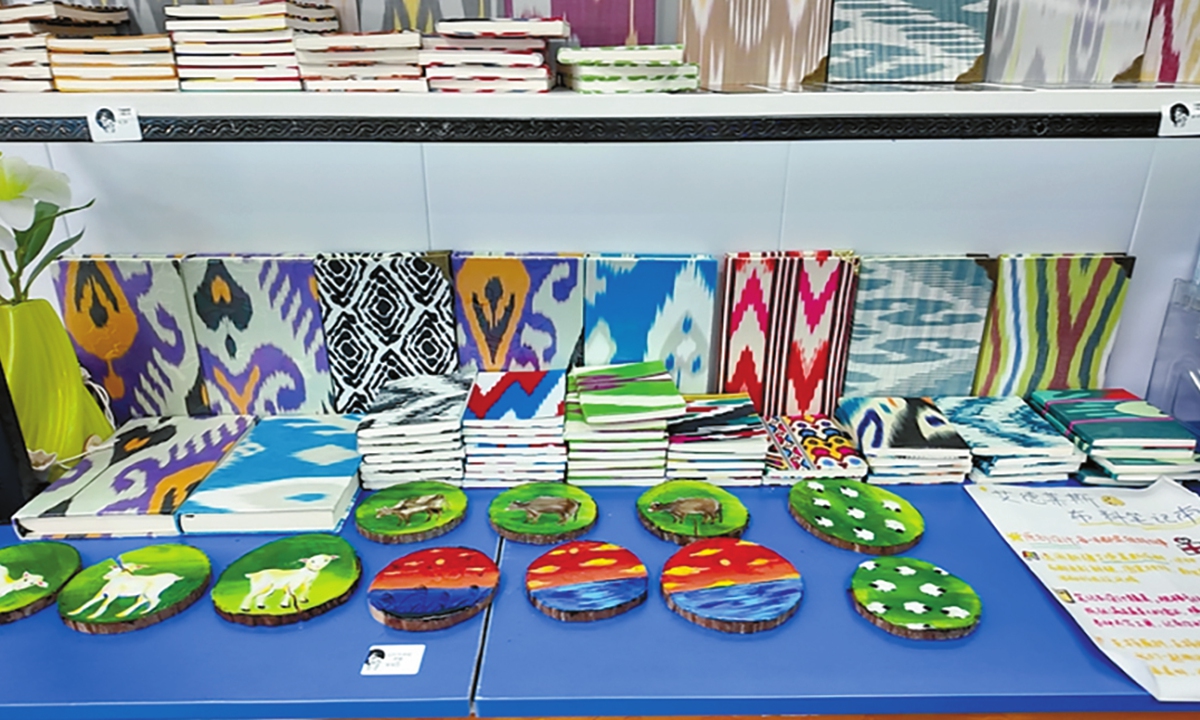
While conducting market research in inland cities, they found that people were more interested in practical, everyday items. Therefore, instead of selling commonly seen Etles garments, she put Etles on notebook covers and other small creative products.
Xuanzi integrates elements from various ethnic groups into designs, including fragrant products infused with the scents of Hami melons and dried apricots and paintings on paper made from Uygur mulberry bark among others. This winter, she plans to visit Guangzhou, South China's Guangdong Province, where economic activities and manufacturing are active. Xuanzi hopes to develop products that merge Xinjiang's cultural aesthetics with those of other regions to uncover what she calls "cultures that can't be replicated."
After graduating from university and working as a designer in East China's Nanjing for years, Yining native Xue Qin returned with her husband at the age of 28 to their hometown out of love for Kazak culture, and opened a teahouse in Liuxingjie. The couple designed and renovated the space using local techniques - mixing straw with mud and decorating the teahouse with Kazak patterns, all to bring back the "childhood memories of home."
Xinjiang itself is not a tea-cultivating region, but it was a crucial trade hub on the ancient Silk Road. Merchants passing through would compress teas from various origins into compact forms for easier transportation, giving rise to a tea culture of combination and diversity.
Today, a major challenge is the lack of recognition of "Xinjiang tea," Xue said. What are the defining qualities of Xinjiang tea? The market has ambiguous expectations and a unique style is yet to take shape.
Replicating popular brands will not suffice, so they aim to root their creations in the memories of local flavors.
Amid fierce market competition from similar products and the prevalence of artificial flavorings, the couple interviewed many suppliers before finding their current partner who uses the traditional "scenting" method to produce rose tea. "The tea base is a type of black tea commonly found in Xinjiang, and the roses are locally sourced," Xue explained. "We scent the tea three to five times with the roses; absolutely no artificial flavors."
Given the trend of a low-sugar diet and healthy lifestyle among young people, the "unsweetened, additive-free tea has become a customer favorite." The teahouse also offers drinks with local specialties, such as black tea with fresh or dried mint and special "Sanpaotai," a tea popular in China's northwestern region, comprised of small white apricots, longan, jujube, and rock sugar. All these blends are beloved for their "pure and authentic" taste of Xinjiang.
In Liuxingjie, there is another unique courtyard that stands out for its faithful recreation of a Tatar rural household - from the wall decorations to the choice of tableware. From inside the courtyard emanates the heady aroma of traditional Tatar home cooked pastries: Honey cakes, apricot cookies, and chak-chak, a dessert similar to sachima, a caramel fritter originally from Manchu and popular all across China. Chak-chak, however, is sweeter and moister.
That aroma connects Ilidar Iliyar, the Tatar shop owner, to the ancestral place of his grandparents in Kazan, Russia, where large numbers of Tatars reside.
Ilidar went to a university in Kazan and during his time abroad, he delved into rural life in Kazan, gaining a deep understanding of the region's baking culture. This cross-cultural experience not only deepened his appreciation for his ethnic traditions, but also planted the seed for cultural integration and dissemination.
Returning to Yining city to care for his aging parents, Ilidar refused to limit himself to the courtyard his family had living in for over 80 years. Through platforms like Xiaohongshu and WeChat, he continues to popularize Tatar pastries to a growing online audience, introducing them as a blend of ethnic culture and local memories. Tatar pastry making was recognized as a national ICH in 2021.
Another local flavor that evokes childhood memories for Yining local Tang Ping is also sweet. When Tang was a teenager, ice cream sold by an elderly Uzbek man outside her school was famous across the city. "After school, I had to have an ice cream every day before going home," Tang recalled. "The adults used to jokingly say, 'You love it so much. Maybe you'll open your own ice cream shop one day' and I never imagined it would come true."
After working for a Fortune 500 company for years, Tang never let go of her entrepreneurial dream. When a visiting classmate rhapsodized about local ice cream, Tang had a brainwave: "What about sharing such a delicacy with the whole country?"
Tang located the elderly vendor Muhamet Abdiryim - an inheritor of local ice cream making techniques. They started a small business, but Tang soon realized that to bring this street food to more tables, they would have to be far more professional.
"We established a factory, registered a company, and streamlined hygiene and production standards. Otherwise, the product would remain confined to local markets," Tang told the Global Times. The brand "Jiji Guowang" was thus created. The brand name's literal meaning is king of the cactus fruit, but is also a pun about a cartoon figure in the series Boonie Bears that is popular among youngsters.
"Xinjiang has so many local treasures, the problem is just a matter of branding and promotion," Tang said. Love for her homeland is evident in the product packaging, which incorporates typical Etles silk patterns and Kazak cartoon figures. Together with the mouthwatering ice cream, they serve as everyday cultural ambassadors for the region. Now, "Jiji Guowang" has gone far beyond Yining city and the Ili Kazak Autonomous Prefecture, boasting three major warehouses outside Xinjiang scattered across China, with exports to markets in Central and Southeast Asia.
Bustling with visitors, Liuxingjie is where tradition meets modernity and ethnic diversity finds resonance with the world. Built upon history and craftsmanship, this vibrant district functions as a living museum - a window into Xinjiang's rich cultural heritage and an epitome of the region's unity with diversity, inclusiveness, and openness. Its burgeoning would be difficult without favorable policies and government support, nor possible without local residents' initiative and creativity, said Ma Liying from a company that operates in the cultural tourism sector in this community.
Nourished by people from different ethnic groups, this hexagonal community is emerging as a powerful symbol of coexistence - telling a compelling story of Xinjiang, where people of different backgrounds inherit and pass on valuable traditions, embrace a future with innovation and dynamics, and join hands in crafting a happy and harmonious life.
The youth are the vanguards of our time, showcasing boundless energy and vibrant personalities.
Gen Zers not only represent the makers of the future but also serve as agents of change in the present. With an open mindset and an international outlook, they actively integrate into the currents of globalization, engaging in deep exchanges, and collaborating with youth from around the world to explore pathways and strategies to address global challenges.
The Global Times has launched the "Voice from Gen Z" series, which focuses on the proactive actions and innovative achievements of young people in areas such as global governance, cultural exchange, environmental protection, and technological innovation. Through this series, we aim to showcase the unique charm and future leadership of global Gen Zers.
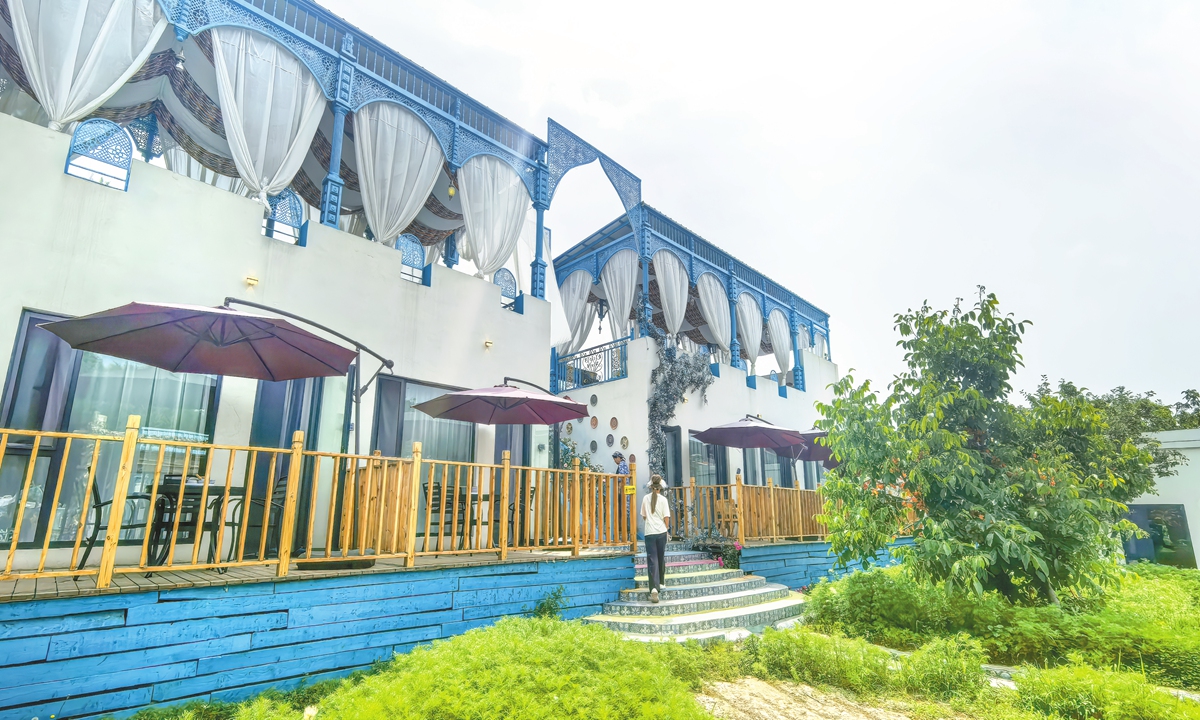
A guesthouse in Ili Kazak Autonomous Prefecture, Northwest China's Xinjiang Uygur Autonomous Region, on June 10, 2025 Photo: VCG
"Does melody from the bayan accordion still echo through the Liuxingjie area?" These lyrics come from a song viral on social media platform Douyin.
The Liuxingjie area, nestled in the city of Yining in the Ili Kazak Autonomous Prefecture, Northwest China's Xinjiang Uygur Autonomous Region, is a hexogen community divided by three crossed main roads into six fan-shaped zones. Designed by a German architect in 1934 and constructed in the 1930s, it embraced the ideals of a garden city.
Today, this neighborhood is home to people from 13 ethnic groups, with ethnic minorities comprising 86 percent of all residents. In this mosaic of diverse ethnic cultures, 142 households, many with their unique courtyards, continue to tell stories of a modern, diverse, and vibrant Xinjiang.
Liu Lianzhi from the Xibe ethnic group transformed his house into a guesthouse. Pointing to a mural at the entrance of his courtyard, Liu explained the Xibe bannermen's westward journey 261 years ago in the Qing Dynasty (1644-1911). A red flag at the reception desk symbolizes the Xibe people, who guarded China's western frontiers for generations and were among the "Plain Red Banner."
"While the Xibe written language has disappeared in Northeastern China where we originally came from, here in Xinjiang, our ethnic language is preserved in full," Liu said.
Yet Liuxingjie is not only a place where history lingers - the younger generations, especially Gen Zers, are injecting their creativity and innovation into ethnic cultures, injecting contemporary vitality and newfound popularity into traditional cultural heritages.
Notebooks with covers made of Etles silk on display at Xuanzi's boutique store Photo: Courtesy of Liu Yang
Diving into regional, ethnic uniqueness
The shadow of homogenous competition always persists in cultural tourism. Xuanzi, a Gen Zer who owns a boutique shop in Liuxingjie, said that scarves, keychains, and cup mats with similar motifs are abundant in the markets, the only difference lies in pricing and retail stores.
"Any pattern printed onto a bag can be branded as Etles silk," said Xuanzi. Etles is a type of silk ikat fabric traditionally made by the Uygur and Uzbek peoples, the crafting of which was recognized as a national intangible cultural heritage (ICH) in 2008.
When Xuanzi founded her store in 2023, she deliberately steered away from this "mass-produced" path. To her, relying on factories means abandoning the true essence of Etles - authentic silk texture, unique hand-dyed patterns, and the tangible facet of the ICH. "Despite the higher cost and slower output, I insist on creating unique products that stand apart from the factory-made products."
Xuanzi and her mother source genuine handwoven and tie-dyed Etles fabric from senior artisans in southern Xinjiang's counties such as Hotan and Shache. These traditional cloths, just 45 centimeters wide, are woven on traditional looms.
While conducting market research in inland cities, they found that people were more interested in practical, everyday items. Therefore, instead of selling commonly seen Etles garments, she put Etles on notebook covers and other small creative products.
Xuanzi integrates elements from various ethnic groups into designs, including fragrant products infused with the scents of Hami melons and dried apricots and paintings on paper made from Uygur mulberry bark among others. This winter, she plans to visit Guangzhou, South China's Guangdong Province, where economic activities and manufacturing are active. Xuanzi hopes to develop products that merge Xinjiang's cultural aesthetics with those of other regions to uncover what she calls "cultures that can't be replicated."
After graduating from university and working as a designer in East China's Nanjing for years, Yining native Xue Qin returned with her husband at the age of 28 to their hometown out of love for Kazak culture, and opened a teahouse in Liuxingjie. The couple designed and renovated the space using local techniques - mixing straw with mud and decorating the teahouse with Kazak patterns, all to bring back the "childhood memories of home."
Xinjiang itself is not a tea-cultivating region, but it was a crucial trade hub on the ancient Silk Road. Merchants passing through would compress teas from various origins into compact forms for easier transportation, giving rise to a tea culture of combination and diversity.
Today, a major challenge is the lack of recognition of "Xinjiang tea," Xue said. What are the defining qualities of Xinjiang tea? The market has ambiguous expectations and a unique style is yet to take shape.
Replicating popular brands will not suffice, so they aim to root their creations in the memories of local flavors.
Amid fierce market competition from similar products and the prevalence of artificial flavorings, the couple interviewed many suppliers before finding their current partner who uses the traditional "scenting" method to produce rose tea. "The tea base is a type of black tea commonly found in Xinjiang, and the roses are locally sourced," Xue explained. "We scent the tea three to five times with the roses; absolutely no artificial flavors."
Given the trend of a low-sugar diet and healthy lifestyle among young people, the "unsweetened, additive-free tea has become a customer favorite." The teahouse also offers drinks with local specialties, such as black tea with fresh or dried mint and special "Sanpaotai," a tea popular in China's northwestern region, comprised of small white apricots, longan, jujube, and rock sugar. All these blends are beloved for their "pure and authentic" taste of Xinjiang.
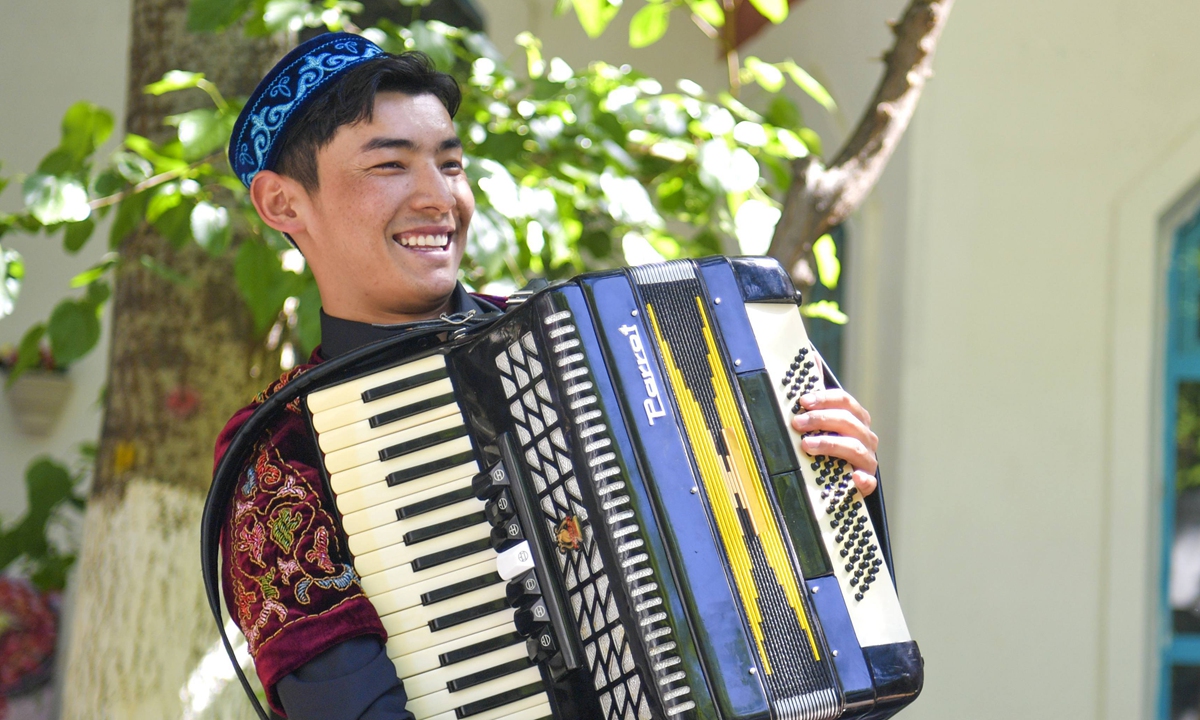
A young man plays an accordion in Yining, Ili Kazak Autonomous Prefecture. Photo: IC
Local roots, global reachIn Liuxingjie, there is another unique courtyard that stands out for its faithful recreation of a Tatar rural household - from the wall decorations to the choice of tableware. From inside the courtyard emanates the heady aroma of traditional Tatar home cooked pastries: Honey cakes, apricot cookies, and chak-chak, a dessert similar to sachima, a caramel fritter originally from Manchu and popular all across China. Chak-chak, however, is sweeter and moister.
That aroma connects Ilidar Iliyar, the Tatar shop owner, to the ancestral place of his grandparents in Kazan, Russia, where large numbers of Tatars reside.
Ilidar went to a university in Kazan and during his time abroad, he delved into rural life in Kazan, gaining a deep understanding of the region's baking culture. This cross-cultural experience not only deepened his appreciation for his ethnic traditions, but also planted the seed for cultural integration and dissemination.
Returning to Yining city to care for his aging parents, Ilidar refused to limit himself to the courtyard his family had living in for over 80 years. Through platforms like Xiaohongshu and WeChat, he continues to popularize Tatar pastries to a growing online audience, introducing them as a blend of ethnic culture and local memories. Tatar pastry making was recognized as a national ICH in 2021.
Another local flavor that evokes childhood memories for Yining local Tang Ping is also sweet. When Tang was a teenager, ice cream sold by an elderly Uzbek man outside her school was famous across the city. "After school, I had to have an ice cream every day before going home," Tang recalled. "The adults used to jokingly say, 'You love it so much. Maybe you'll open your own ice cream shop one day' and I never imagined it would come true."
After working for a Fortune 500 company for years, Tang never let go of her entrepreneurial dream. When a visiting classmate rhapsodized about local ice cream, Tang had a brainwave: "What about sharing such a delicacy with the whole country?"
Tang located the elderly vendor Muhamet Abdiryim - an inheritor of local ice cream making techniques. They started a small business, but Tang soon realized that to bring this street food to more tables, they would have to be far more professional.
"We established a factory, registered a company, and streamlined hygiene and production standards. Otherwise, the product would remain confined to local markets," Tang told the Global Times. The brand "Jiji Guowang" was thus created. The brand name's literal meaning is king of the cactus fruit, but is also a pun about a cartoon figure in the series Boonie Bears that is popular among youngsters.
"Xinjiang has so many local treasures, the problem is just a matter of branding and promotion," Tang said. Love for her homeland is evident in the product packaging, which incorporates typical Etles silk patterns and Kazak cartoon figures. Together with the mouthwatering ice cream, they serve as everyday cultural ambassadors for the region. Now, "Jiji Guowang" has gone far beyond Yining city and the Ili Kazak Autonomous Prefecture, boasting three major warehouses outside Xinjiang scattered across China, with exports to markets in Central and Southeast Asia.
Bustling with visitors, Liuxingjie is where tradition meets modernity and ethnic diversity finds resonance with the world. Built upon history and craftsmanship, this vibrant district functions as a living museum - a window into Xinjiang's rich cultural heritage and an epitome of the region's unity with diversity, inclusiveness, and openness. Its burgeoning would be difficult without favorable policies and government support, nor possible without local residents' initiative and creativity, said Ma Liying from a company that operates in the cultural tourism sector in this community.
Nourished by people from different ethnic groups, this hexagonal community is emerging as a powerful symbol of coexistence - telling a compelling story of Xinjiang, where people of different backgrounds inherit and pass on valuable traditions, embrace a future with innovation and dynamics, and join hands in crafting a happy and harmonious life.
Liu Yang, Zhang Yiwen, Qi Xiaohan, and Liu Keyi contributed to this story
RELATED ARTICLES