ARTS / CULTURE & LEISURE
The life of Cho-yun Hsu: Historian, wartime witness
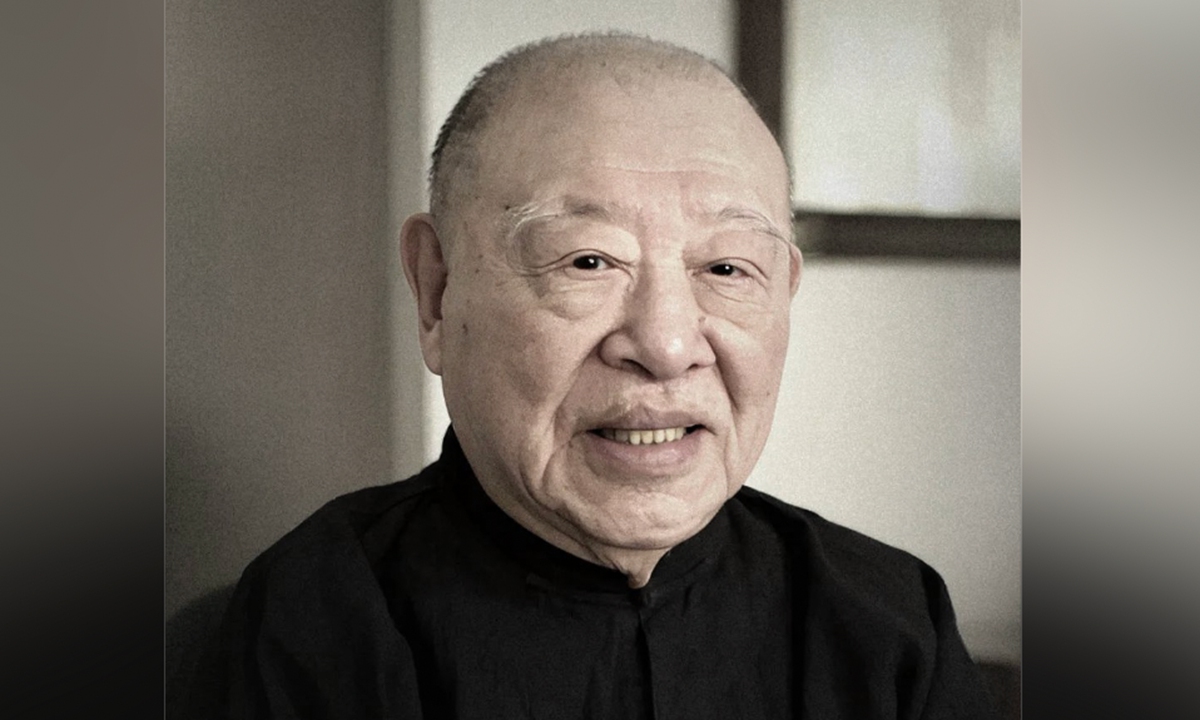
Cho-yun Hsu
With his last Sina Weibo post 11 days ago recounting a poignant childhood memory of witnessing the Battle of Taierzhuang, Cho-yun Hsu, a historian born with a disability yet later revered by generations, passed away on Monday in the US at the age of 95, according to multiple media sources such as the Xinhua News Agency.Born in Xiamen, East China's Fujian Province, and later studying and settling in the US, Hsu's cross-cultural life experiences endowed him with the talents he needed to tie Chinese and Western histories together for readers. Yet witnessing how his family had lived through turbulent times, Hsu's inevitable reflections on war cast an indelible undertone on his life - one that appeared in both his personal writings and books.
When the War of Resistance against Japanese Aggression (1931-45) began, Hsu was only 7 years old. In an interview with media, he recounted how the full-scale outbreak of the war forced his family into a life of displacement, leading him to witness the Japanese military gunning down non-combatants. During a conversation with culturalist Xu Zhiyuan, Hsu was seen tearing up while recalling his memories of the war.
When asked whether he had any regrets in life, the late historian, who had once relocated to China's island of Taiwan with his family, quoted ancient poet Lu You's line, "My only hatred is that a unified land is not seen" to express his deepest yearning. The word "China," he added, is "engraved in my heart."
"The war remains an indelible part of my memory. Watching people become separated, witnessing death and fire, learning firsthand what hunger and fear truly meant, these were irreplaceable experiences," the historian once told media.
Yet just as his physical disability never crushed his intellect, the wartime tragedies only intensified Hsu's love for his country, while giving him new perspectives on historical research.
Han Agriculture: The Formation of the Early Chinese Agrarian Economy (206BC-AD220) stands as one of Hsu's most celebrated works among his "Trilogy of Ancient China" collection. As it examines ancient China's land systems and agricultural technologies, few would realize that its inspiration came from Hsu's experiences crossing China's ravaged landscapes during the war. In his Hsu Cho-yun Conversing, he noted that in those turbulent years, he witnessed "firsthand agricultural practices that eluded the comprehension of book-bound scholars," while discovering the intricate social fabric of rural communities. These visceral experiences granted him insight into traditional Chinese society.
Though he eventually departed his homeland for life and learning overseas, Hsu had never stopped observing how Chinese society progressed with the times. "Rivers" and "lakes" are recurring themes in his writings, serving as threads stitching together his historical narratives.
In his book Eternal River, published in 2006, the historian used rivers and lakes as metaphors to describe culture's evolution in China, from Chinese civilization's basis on the natural geography of Chinese civilization to the emergence of philosophical and religious systems and all the way to modern transformations.
In his 2024 book A Short History of the Yangtze River, Hsu affectively chronicled his lifelong connection with the Yangtze River in the form of a narrated memoir. The historian dearly likened the river to the zoetropes of his childhood, documenting his observations about the Three Gorges and the changing vistas of the country from Nanjing to Chongqing.
The more one reads his works, the more one realizes that the writer's "rivers and lakes" theme goes beyond an academic approach to become an emotional bond. As he describes in his book, the Yangtze River remains the place where he felt "most profoundly tethered to my motherland."
Besides authoring these two "rivers and lakes" books, Hsu was a prolific writer who could not just write for academia, but also for the general public.
He published several works of popular history, including The Transcendental and the Mundane. Yet, the book Wanglizou, Andun Ziji, roughly translated as Inward Journey: Where the Soul Rests, seemingly defies all expectations of a historical work, becoming instead a window into Hsu's soul, allowing readers to meet not the scholar, but the man.
The book delves into themes such as embracing simplicity in life and reconciling one's desires in the modern world, offering what might be called Hsu's philosophical prescription for contemporary readers.
The writer turned 92 when the book was published in 2022, but one can feel that his mind re-mained as sharp as ever, as he remained up to date on topics such as "technology and humanity." It is clear he spent a lifetime doing what he truly loved.
"To 'journey inward' is to cast our observations and experiences into the deepest recesses of the heart, engaging in rigorous reflection…" he wrote in the book.
RELATED ARTICLES