China rolls out 34 measures to safeguard autumn grain harvest following extreme weather events
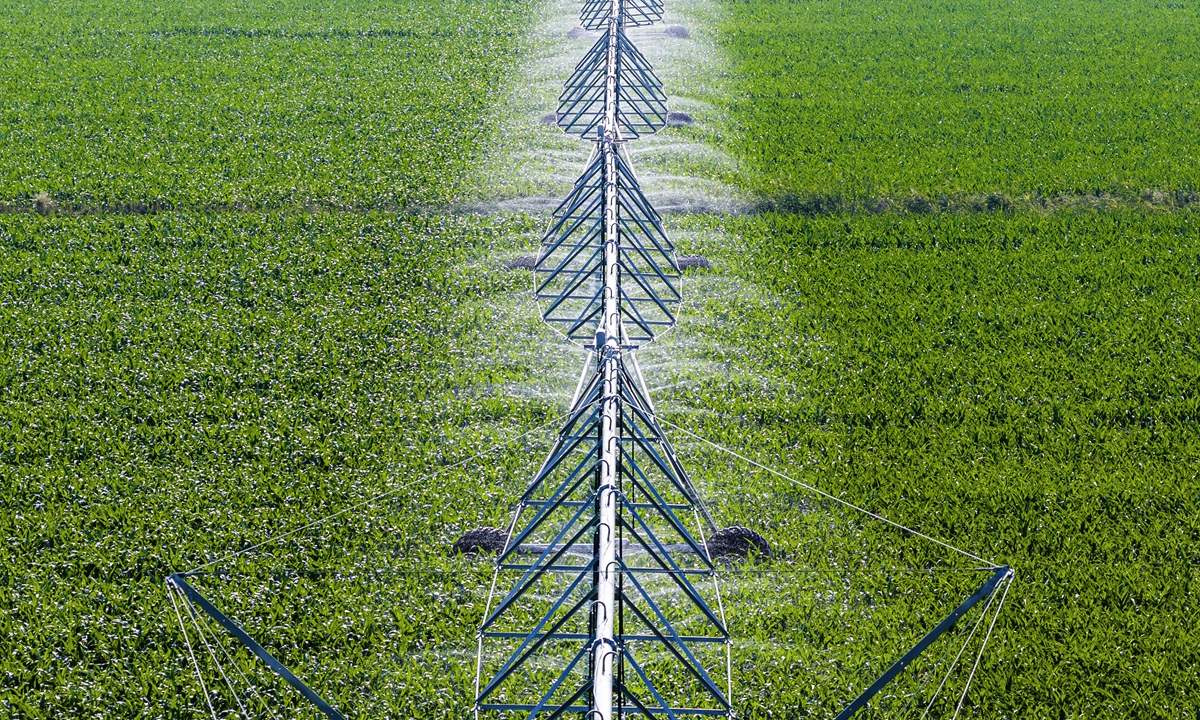
July 29, 2025 - Corn plants are now in the critical tasseling and silking stage. Farmers in Dong Village, Qingtou Town, Yongji City, Yuncheng, Shanxi Province, are busy irrigating and fertilizing the cornfields to ensure a bumper harvest. Photo: VCG
China's Ministry of Agriculture and Rural Affairs on Monday announced 34 targeted measures to prevent and mitigate disasters by region, crop type and risk profile, aiming to ensure a bumper autumn grain harvest.
Autumn crops account for about three-quarters of China's annual grain output, making them vital to meeting the national target of about 700 million tons this year.
However, with frequent extreme weather events this summer, agricultural disasters have emerged in a pattern of flooding in the south and north, and drought in the central regions. The newly announced plan seeks to address those overlapping risks.
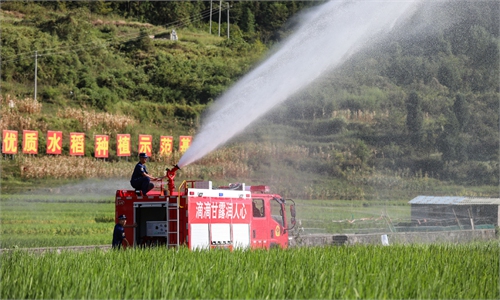
In the Huang-Huai region, where persistent high temperatures and below-average rainfall have been recorded since July, drought conditions have emerged. The area of drought-affected crops has exceeded levels seen in both the same period last year and the multi-year average.
In August, high temperatures and limited rainfall are expected to persist, potentially intensifying drought conditions. Authorities have stressed the need to ensure sufficient irrigation sources and implement key growth-promoting measures, according to the China Media Group (CMG).
In North and Northeast China, the focus is on flood control. Authorities are adopting a multi-pronged approach involving drainage, water dispersion, field management and crop recovery, the CMG said. Immediate efforts include draining standing water, improving soil aeration, and restoring plant health to support recovery in waterlogged areas.
Meanwhile, in the Yangtze River basin, southern rice crops are in critical stages of development. Late-season rice is in the seedling phase, while mid-season rice is entering the panicle initiation stage.
The region is expected to face higher-than-normal temperatures and reduced rainfall in August, raising the risk of heat and drought damage to rice during grain filling. The ministry has called for enhanced water management and microclimate control to mitigate the impact of heat stress.
In addition to emergency management measures, major grain-producing regions have received fiscal support to bolster disaster prevention and mitigation efforts.
On Monday, Central China's Henan Province announced the allocation of 131.5 million yuan ($18.1 million) for agricultural disaster prevention and water conservancy relief, including 63.3 million yuan for agricultural disaster prevention and 68.2 million yuan for water conservancy relief, according to the province's department of finance.
To support drought relief and safeguard autumn grain production, Henan has made every effort to mobilize resources. In mid-July, 30 million yuan was allocated for drought response, followed by an emergency disbursement of 100 million yuan on August 1 to assist local governments in crop maintenance efforts. So far, a total of 260 million yuan has been allocated to fully support drought mitigation and ensure a stable autumn harvest.
The key to disaster prevention and mitigation at this stage is to implement region-specific, targeted measures, said Li Guoxiang, a research fellow at the Rural Development Institute of the Chinese Academy of Social Sciences.
"In drought-stricken areas, irrigation should be stepped up to boost soil moisture and reduce surface temperatures, ensuring crops can grow normally. In waterlogged regions, timely drainage is crucial to prevent excess moisture from damaging crop root systems," Li said.
Li said that despite the wide extent of the affected areas, the nation still stands a strong chance of maintaining stable grain output and securing a successful autumn harvest.
He said that China's agricultural production depends heavily on a well-established system of socialized services. He noted that if local agricultural authorities provide strong guidance -- through policy directives, meetings, and public outreach — to clearly convey technical requirements to service providers and ensure their effective implementation, the country's ability to prevent and mitigate disasters can be significantly strengthened.
The stable output of the summer grain harvest has already set a solid foundation for ensuring food security for the remainder of the year.
Despite regional challenges, China's summer grain output this year reached 149.74 million tons, achieving stable and abundant production. It marked the second-highest summer yield on record, just below last year's harvest, according to the Xinhua News Agency.
Global Times
RELATED ARTICLES