IN-DEPTH / IN-DEPTH
Young Chinese fans revive historical figures through digital media, emotional rituals, and cultural tourism
Digital age, ancient idols
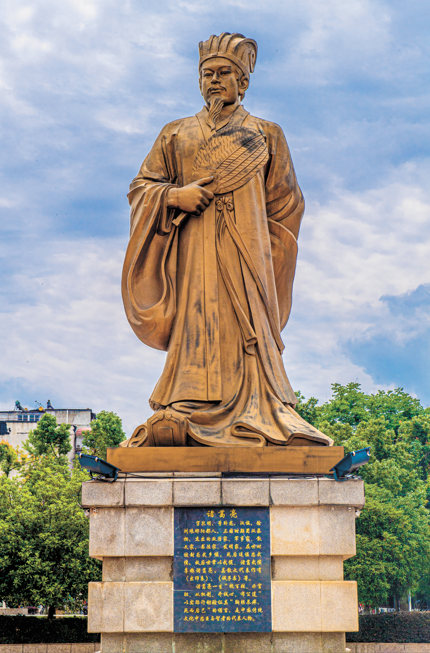
The statue of China's renowned military strategist Zhuge Liang in Xianning, Central China's Hubei Province Photo: VCG
Editor Notes:
A vibrant new retro wave is gaining momentum among younger generations in China. This trend is not about simply replicating the past or indulging in nostalgia. Rather, young Chinese people are actively unearthing, curating, and reinterpreting fragments of daily life, reviving and reinventing them using the contemporary language and sensibilities they are familiar with.
What drives the retro mindset among today's youth? What fresh and imaginative products have emerged from this cultural shift? What kinds of positive energy and influence has this practice unleashed, and what tensions and challenges does it conceal?
To explore these questions, the Global Times launched the "New Retro Wave" series, dedicated to examining this vibrant soil in depth. Beyond capturing vivid stories and phenomena, we will investigate the psychology, communication patterns, and innovative dynamics behind the wave; assess its unique contributions to cultural continuity, community formation, industrial creativity, and collective mentality; and how young people are becoming central agents of innovation.
It's peak summer travel season. While many are heading to tourist hotspots, 28-year-old freelancer Liu Muzi is packing her bag and checking in with friends in her fan circle - before heading off to another grave.
As the historical drama film The Litchi Road gained nationwide popularity in China, audiences were once again reminded of the allure of cultural products rooted in history. And in this space, the young generations today are nothing short of creative trailblazers.
Recently, Chinese youth are "idolizing" historical figures through the logic of the digital media era. They deconstruct history through fan creations and merchandise, reconstruct public personas of historical figures via fragmented media contents, and even transform emotional devotion into concrete actions: Meticulously studying historical texts, traveling to ancient tombs, and bringing visibility to lesser-known historical sites.
Many young people have begun to travel to the graves of ancient figures, often combining these visits with trips to local historical museums, cultural parks, and heritage sites, according to the China Youth Daily.
While commemorating the past is a tradition spanning millennia, the influence of social media has given the practice a trendy new twist. Media outlets documented offerings left by fans: like ibuprofen at Cao Cao Mausoleum Museum in Anyang, Central China's Henan Province to cure his legendary headaches, a high-speed rail ticket to Xi'an in Northwest China's Shaanxi Province at Chengdu Wuhou Shrine in Southwest China's Sichuan Province to fulfill renowned military strategist Zhuge Liang's uncompleted northern expedition;, or even chocolate and spicy konjac snacks at famous Chinese general Huo Qubing's tomb, because the young general died so young, he was likely still quite fond of snacks.
What needs are young people trying to meet through idolizing ancient figures? Does this behavior represent a new mode of cultural inheritance? What are the benefits and risks of such an entertainment-infused narrative? The Global Times interviewed two of these "historical fans" and a media scholar to explore the logic of cultural transmission amid this novel trend.
Historical figures as 'idols'
For Liu, admiring the leading warlord of the Three Kingdoms period, Cao Cao, has been a habit since childhood. But it wasn't until July of this year that she finally had the time to visit the Cao Cao Mausoleum Museum, which started welcoming the public only in 2023.
She didn't come empty-handed - she brought illustrated postcards featuring comic versions of Cao and handwritten notes packed with words she wished to say to her "idol."
"In a fan group I joined, some people bring much more elaborate things, like plush dolls modeled after their historical idols, long handwritten letters, and fresh flowers ordered that very morning. You'd think they were going to a celebrity meet-and-greet," Liu smiled.
She recalled how in school, she loved fan-made edits about her favorite historical figures and became deeply familiar with the Romance of the Three Kingdoms and its related cultural products.
Liu has clearly observed how practices like fan fiction and tomb visits - once niche interests - are now embraced by a wider group of young people.
On lifestyle-sharing social media platform Xiaohongshu (also known as RedNote), related hashtags have tens of thousands to hundreds of thousands of related posts, ranging from traditional fan works like digital paintings and video edits to AI-generated content. "We have never seen this level of enthusiasm before," Liu said.
Her trip to the Cao Cao Mausoleum Museum confirmed that these once-quiet spaces are now bustling. Smiling at the fan badges, cards, and medicines left behind, she added her own offerings to the collection.
After the museum, Liu went on to Mangshan Township of Luoyang, Henan, visiting 18 tombs and ruins in a single day. The Mangshan tomb cluster is the largest ancient tomb complex in China, where many emperors and ministers were buried.
"Some places were remote and hard to find, so I had to charter a car and hike. It really tested my planning, stamina, and strength. But even so, many fans have made the journey and shared helpful tips online," Liu said.
Unlike Liu, 20-year-old art student Xiang Bei became interested in historical figures - particularly those embodying loyalty and righteousness - after playing historical video games and engaging in fan content in 2024. She has since visited three tombs during breaks.
"I didn't go to the tombs just to express emotion, it was more about seeing them in real life and visiting someone I deeply admire. It made the connection feel more tangible. Plus, the inscriptions taught me new things," she said.
During her visits, Xiang met many fellow fans, each interacting with their idols in their own way. Because the tombs she visited had no offering area, Xiang took photos of game screenshots next to the tombstones as a keepsake.
More than entertainment
Though it may seem like fan culture at first glance, idolizing historical figures is more than superficial.
"This trend has gone viral thanks to short video platforms, but at its core, it stems from a deep passion for history and cultural heritage. From the language used in tributes to the types of offerings, it's clear fans have an in-depth understanding of the historical figures they admire," Zhu Wei, a professor at the China University of Political Science and Law, told the Global Times.
Rather than blind idol worship, these behaviors reflect profound empathy built on careful study. It's a kind of spiritual dialogue across time, Zhu added.
Liu, for instance, can confidently discuss ancient texts and research papers on the multiple claimed burial sites of Zhou Yu, a prominent figure in the Three Kingdoms period of Chinese history. "There's no consensus on the true location of Zhou's tomb, but I lean toward Suzhou, East China's Jiangsu Province, based on records of excavations and burial customs aligned with Han Dynasty rituals."
After visiting one of Zhou's tombs, Liu noted inaccuracies on its info boards. "I'm gathering materials to write a formal email to the local cultural bureau. I'm not majoring in history, and it's hard reading classical Chinese, but passion drives me."
Within fan communities, some enthusiasts even teach others how to locate the old residences of lesser-known historical figures, based on ancient records - a practice gaining popularity.
"I used to be terrible at history, especially ancient Chinese history," Xiang admitted. "I just wasn't interested. But this makes it feel completely different."
"Memes show how the digital generation communicates," said Zhu. Through creative reinterpretation, they bring textbook figures to life in ways that feel accessible and modern, shrinking the distance between people and history and showcasing young people's deep desire to be part of historical storytelling.
Online, fans use digital tools to create portraits, write fan fiction, and run social media accounts for their favorite ancient figures. Offline, they make "pilgrimages" to real-life tombs. These acts - shared and liked across platforms - are all manifestations of participatory culture. Henry Jenkins, the scholar who coined "participatory culture" and a pioneer in fan culture studies, mentioned in a 2024 interview last year that his website aims to foster dialogue between fan studies globally. Through this, he has seen both cultural commonalities and differences, according to The Paper.
"Idolizing historical figures is a quintessential example of China's homegrown fan culture," Zhu said. "Chinese youth combine their emotional expression with historical depth, offering a new path for preserving traditional culture."
Balancing pop and depth
"Chinese culture should not only go global, but also reach inward," Zhu said, noting that this sense of participation is crucial for cultural confidence.
Retelling history in popular formats shouldn't be dismissed as trivial, he argued. "If history is treated only as a dry academic subject, it's hard to engage the public. Without popular books like Those Things in Ming Dynasty, Ming history wouldn't have so many fans today, and we'd lack many of our digital-era tools for cultural transmission."
Idolizing historical figures is not the same as historical nihilism. "This affection is built on understanding," Zhu emphasized. "Over time, it cultivates cultural confidence. Without emotional connection and relatability, there's no cultural identity - and without identity, no cultural confidence."
Authorities have shown support for this new participatory culture trend.
One popular wave involved using AI to "resurrect" historical figures, giving them lifelike appearances, expressions, gestures, and voices. These digital personas would answer contemporary questions - on cultural tourism, healthy living, or improving cultural literacy. Mainstream media participated, helping the phenomenon reach a wider audience, according to an article from scholar Tian Hao at Fudan University.
Descendants of Zhang Juzheng, a renowned politician of the Ming Dynasty, created a Xiaohongshu account to promote his legacy, sharing updates from the memorial site and interacting with fans by displaying gifts and offering tribute advice, which proved to be very effective.
"Unlike quick, clout-chasing 'check-ins,' tomb visits are a kind of 'deep tourism' that blends emotion and knowledge, benefiting both heritage sites and local tourism," Zhu said.
Still, debates persist about the boundary between playful expression and respect for history.
For instance, the Zhang Juzheng account once posted a reflection on fan-made reinterpretations of history. As descendants and cultural custodians, they sometimes feel disrupted. "When fan creations become a bridge, rather than a barrier, to serious history, they realize modern cultural transmission. But even as we look toward the future from the shoulders of our ancestors, we must keep a level head," they wrote.
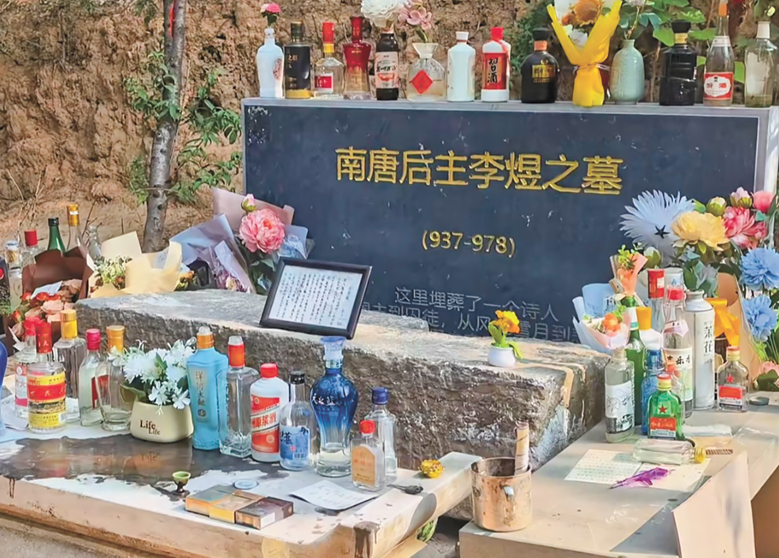
Tributes are arranged by fans at the private-funded tomb of Li Yu, the last lord of Southern Tang Dynasty, in Luoyang, Central China's Henan Province. Photo: courtesy of Liu Muzi
Some criticism targets commercialized or artificial historical attractions. One popular site in Luoyang - said to be the tomb of Li Yu, the last lord of Southern Tang Dynasty - is in fact a privately funded symbolic gravestone. According to The Paper, local officials stated that there is insufficient evidence to confirm its authenticity, raising questions about motivations.
Nevertheless, many fans still leave flowers and wine at the site. "It doesn't matter if it's the real grave," supporters say. "What matters is having a place to mourn - a form of cultural inheritance and respect for ancestors."
This points to a deeper issue: Heritage preservation and cultural governance. For Liu, having a physical tombstone for her idol is a blessing.
"Some places have rich resources but no proper planning. Many historical figures have names but no confirmed resting places, so fans rely on symbolic 'spiritual coordinates,'" she said.
"Still, like the villagers near Li Yu's tomb who offer rest stops, or the staff at Chengdu Wuhou Shrine who help burn fans' letters to convey emotions, or the Zhang Juzheng memorial that carefully preserves fan gifts, I believe more places will begin to value this kind of cultural protection and service," Liu said.
Liu is still on the road. "These new trends excite me, I want to visit more places. The idols in history books will never change. They live on in ink, in code, and in their own kind of immortality."
RELATED ARTICLES