80 years after the atomic bombings of Hiroshima, what should be reflected on and pursued?: Global Times editorial
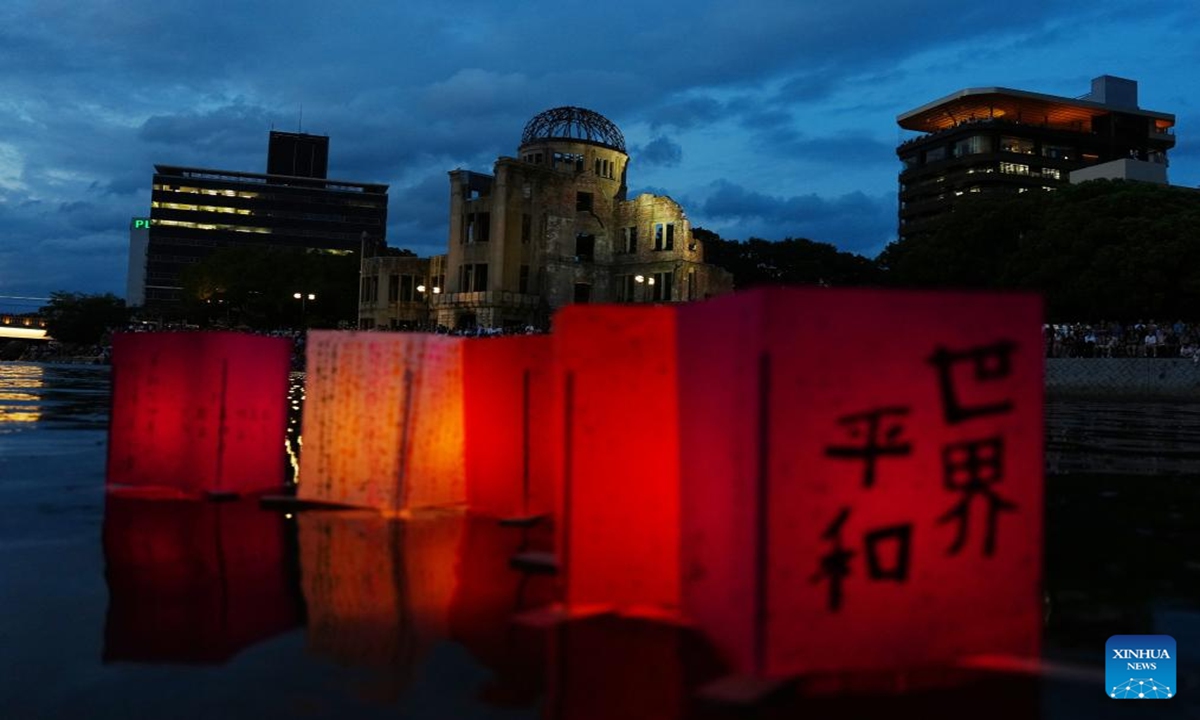
Paper lanterns are seen floating on a river at Hiroshima Peace Memorial Park in Hiroshima, Japan, on Aug. 6, 2025. Photo: Xinhua
On Wednesday, the bell at Hiroshima's Peace Memorial Park tolled once again. A solemn memorial ceremony was held in Hiroshima, where attendees reaffirmed their commitment to peace. In his speech, Japanese Prime Minister Shigeru Ishiba called for the establishment of "a world without nuclear war and a world without nuclear weapons." As Wednesday marks the 80th anniversary of the Hiroshima atomic bombing, people should deeply examine the true meaning of the remembrance and explore how to uphold a correct historical perspective on WWII and maintain global common security.
The atomic bombings that struck 80 years ago was undoubtedly one of humanity's greatest tragedies. Hence, "Hiroshima" and "Nagasaki" became powerful symbols driving postwar Japan onto a path of pacifism. Based on this painful memory, Article 9 of Japan's Constitution renounces war as a sovereign right of the nation, and in 1971, the Japanese Diet established the "three non-nuclear principles" - not to possess , produce, or permit the introduction of nuclear weapons - as a national policy. As the only country to have suffered a nuclear attack, Japan has actively positioned itself on the international stage as a "leading advocate" of nuclear disarmament. However, behind this narrative lies a selectively constructed "safe zone" that renders Japan's stance contradictory.
Japan's proclaimed anti-nuclear weapons position stands in sharp contrast to its deep reliance on the US "nuclear umbrella." On one hand, the Japanese government waves the banner of "a world without nuclear weapons." On the other, it firmly anchors its national security to the deterrent power of the US nuclear arsenal. Whether in urging the US to extend its nuclear deterrence or proposing "nuclear sharing," the essence is to pursue a preemptive nuclear deterrent - one that heightens the risks of nuclear proliferation and conflict. This severely undermines Japan's moral standing in advocating for global nuclear disarmament.
While amplifying its "victimhood" narrative, Japan's nuclear materials policy also raises serious concerns. Although Japan is a signatory to the Treaty on the Non-Proliferation of Nuclear Weapons (NPT), it stores large quantities of separated plutonium - sensitive material that can be directly used to manufacture nuclear weapons - under the pretext of peaceful nuclear energy use. A few years ago, Japan even underreported 640 kilograms of plutonium, a serious violation. According to the International Atomic Energy Agency, Japan possesses enough separated plutonium to make thousands of nuclear warheads. In addition to its surplus of nuclear material, Japan also has the necessary technical expertise, making it a potential "nuclear threshold state." Occasional calls by some right-wing politicians to pursue "independent nuclear deterrent" counter to Japan's ideal of "a world without nuclear weapons" and only add further instability to regional security.
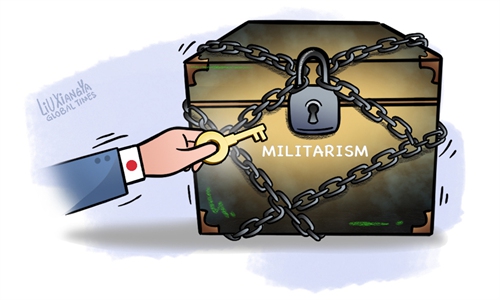
Some people in Japan portray themselves as "victims of nuclear bombings" while simultaneously displaying an intense obsession with building "nuclear deterrence." As the US now views China as its greatest strategic competitor, Japan's right-wing forces see an opportunity to break free from the strategic restraints that have bound them for 80 years. In recent years, Japan has repeatedly hyped up the so-called "nuclear threat" posed by China, Russia, and others as a pretext to strengthen its own defense capabilities and bolster the US-Japan alliance. Meanwhile, Washington, driven by geopolitical interests, turns a blind eye to the signs of a resurgence of Japanese militarism. It's worth noting that if Japan makes a qualitative breakthrough on the nuclear issue, the cage that has contained Japanese militarism will collapse, severely challenging peace and stability in the Asia-Pacific region, which would backfire on the US.
The so-called "nuclear umbrella" is far from the safe and reliable shield Japan has imagined. On the contrary, it could actually push Japan to the frontline of a nuclear conflict as risks escalate, making it a sacrificial pawn in geopolitics. The US Navy's nuclear submarines visiting Japanese ports, and the AUKUS alliance deploying nuclear submarines in the Asia-Pacific, are clear signs that "nuclear sharing" among these countries is eroding the global nuclear security order, undermining strategic balance and stability at both regional and global levels, and obstructing the process of international arms control.
The commemoration of the atomic bombings of Hiroshima and Nagasaki should begin with a deep reflection on the brutality of war. The tragedy of the atomic bombings was rooted in the war of aggression launched by Japanese militarism. If this historical context is ignored and the victims of the bombings are mourned in isolation, it risks falling into the trap of historical nihilism and blurring Japan's culpability as a wartime aggressor. Therefore, upholding a correct historical perspective on WWII should be both the premise and the core of the commemoration. This means Japan must confront its history of aggression and wartime atrocities with honest and comprehensive attitude, acknowledging the tremendous suffering it inflicted upon its Asian neighbors. Only then can the commemoration of Hiroshima bombing resonate with moral significance, and only then will its calls for peace carry weight.
Having endured the ravages of war, human society has come to understand the importance of cherishing peace, expanding cooperation, and pursuing common development. Today's global security challenges, including the risks of nuclear proliferation, cannot be solved by strengthening military alliances or fueling bloc confrontations. Finding answers to prevent the recurrence of past tragedies requires the courage to face history, the wisdom to transcend group rivalry, and above all, the resolve to build a community with a shared future for mankind. This is the true meaning of commemorating the atomic bombings of Hiroshima.
RELATED ARTICLES