China’s foreign trade in first 7 months up 3.5%, despite global headwinds, as nation pursues further opening-up
Diversification, industrial upgrading fuel growth: expert
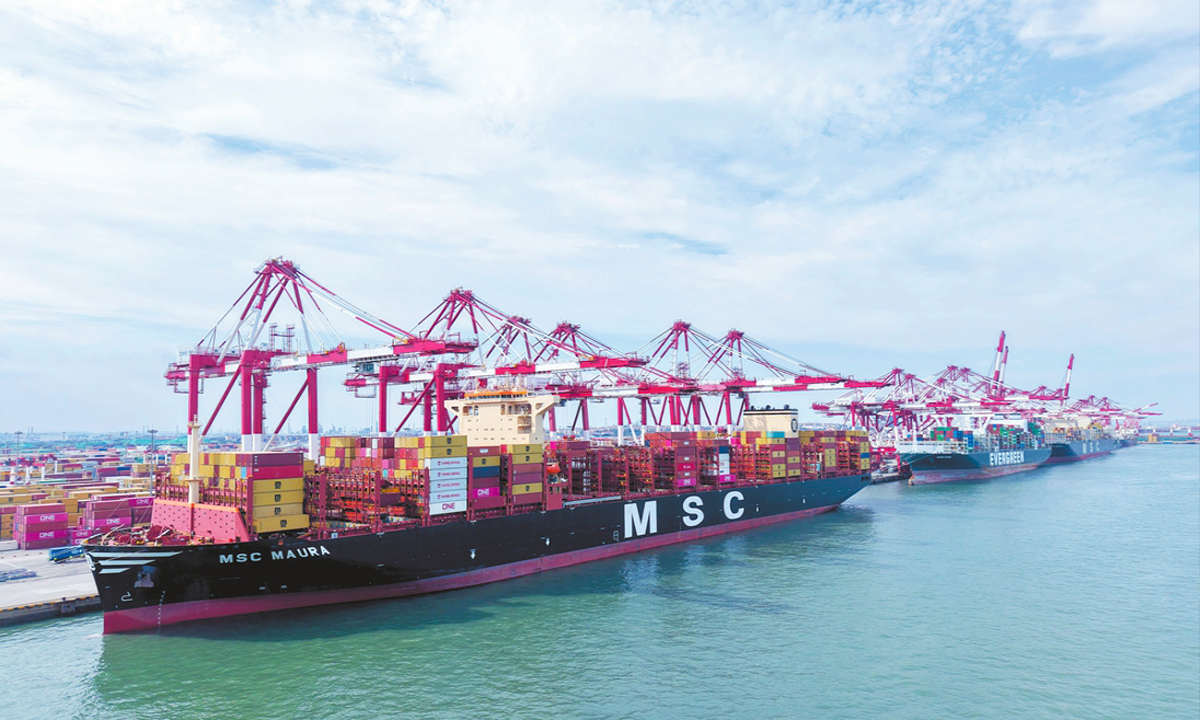
Cargo ships handle foreign trade containers at Qingdao Port in East China's Shandong Province on June 20, 2025. Photo: VCG
China's foreign trade continued to grow in the first seven months of this year, with total imports and exports reaching 25.7 trillion yuan ($3.58 trillion), up 3.5 percent year-on-year. The growth rate accelerated by 0.6 percentage points compared with the first half of the year, according to data released by the General Administration of Customs (GAC) on Thursday.
Exports stood at 15.31 trillion yuan, up 7.3 percent. Imports fell by 1.6 percent to 10.39 trillion yuan, but the pace of decline narrowed by 1.1 percentage points compared with the first half of the year.
Diversified trade flows and industrial upgrading are among the key drivers of growth as China continues to open up to the world, a Chinese expert said.
ASEAN remained China's largest trading partner, with total trade reaching 4.29 trillion yuan, up 9.4 percent, accounting for 16.7 percent of China's total foreign trade. The EU was China's second-largest trading partner, with trade totaling 3.35 trillion yuan, up 3.9 percent, making up 13 percent of total trade.
The US ranked third, with trade amounting to 2.42 trillion yuan, down 11.1 percent, accounting for 9.4 percent of the total.
China's total trade with countries involved in the joint construction of the Belt and Road reached 13.29 trillion yuan, an increase of 5.5 percent.
Due to concerns over policy shifts, businesses are actively turning to more predictable export markets with more opportunities such as ASEAN countries and the EU, Zhou Mi, a senior research fellow at the Chinese Academy of International Trade and Economic Cooperation, told the Global Times on Thursday.
Notable trade categories include mechanical and electrical products, which now account for 60 percent of exports, with exports of automatic data processing equipment and parts, integrated circuits and automobiles all growing, the GAC's data showed, highlighting the further unleashing of China's efforts to promote new quality productive forces.
"Multiple policies to stabilize foreign trade were introduced in the first half of this year—many of which actually began last year, ranging from visa facilitation to transportation. These measures provided policy buffers that played a key role in supporting this year's strong trade performance," Hu Qimu, deputy secretary-general of Forum 50 for Digital-Real Economies Integration, told the Global Times on Thursday.
In addition, global confidence in the Chinese market remains high. As China undergoes industrial upgrading, exports of high-tech products such as machinery, electronics, and automobiles has further driven trade growth, Hu said.
Moreover, imports and exports by private enterprises and foreign-invested enterprises have continued to grow, according to the GAC.
In the first seven months, private enterprises' imports and exports reached 14.68 trillion yuan, up 7.4 percent, accounting for 57.1 percent of China's total foreign trade, an increase of 2.1 percentage points year-on-year.
Foreign-invested enterprises' imports and exports totaled 7.46 trillion yuan, up 2.6 percent, accounting for 29 percent of China's total foreign trade.
Despite global headwinds, businesses are highly proactive and responsive — they quickly adapt to changing market signals, Zhou said. "This is especially true for private enterprises, which are eager to expand globally and seize international opportunities by exporting China's high-quality products to meet demand for goods that offer both quality and affordability," Zhou said.
At the same time, foreign enterprises are increasing their trade activity through China, which Zhou said was a reflection of growing confidence and momentum driven by China's continuous opening of the market environment.
With the positive foreign trade performance in the first seven months of this year, there is greater momentum for stable and sustained trade growth in the second half, contributing to global trade stability as well, said Zhou.
RELATED ARTICLES