Bilateral trade between China, Australia shows signs of improvement lately: official data
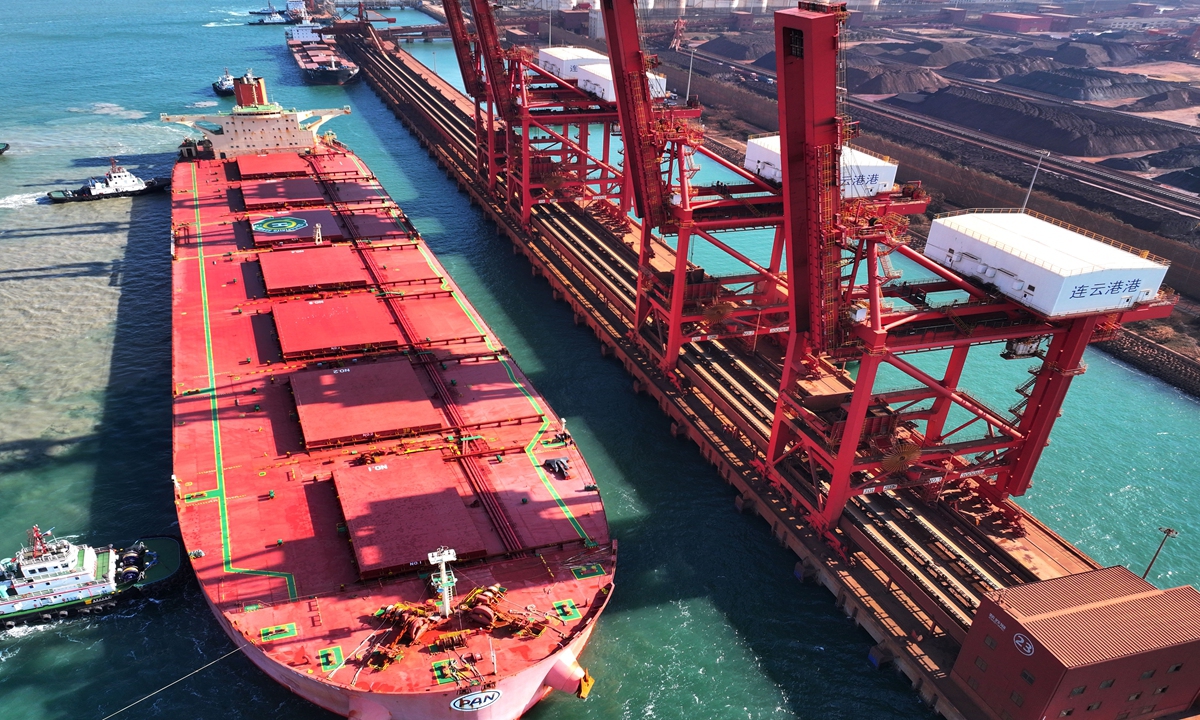
A vessel carrying about 400,000 tons of iron ore, docks at a terminal in Lianyungang, East China's Jiangsu Province on January 8, 2025. Photo: VCG
China's official data showed on Thursday that the magnitude of bilateral trade decline seen in dollar-denominated terms between China and Australia continues to narrow, amid improving bilateral relations and the gradual unleashing of economic and trade potential.
The General Administration of Customs (GAC) said on Thursday that bilateral trade between the two countries reached $17.68 billion, a negative growth of 9.7 percent in July year-on-year, compared to declines of 11.8 percent in June and 12.8 percent in May.
The bilateral data hit $113.89 billion in the first seven months of this year.
In April, the bilateral trade was negative growth of 15.7 percent year-on-year.
In terms of Chinese goods exports to Australia, there was a positive growth of 2.3 percent in July, up from 0.3 percent in June.
The warm data came after Australian Prime Minister Anthony Albanese's visit to China in July, which marked a pivotal step in advancing the steadily improving relationship between the two economies.
Over the past three years, China-Australia relations have steadily stabilized, improved and delivered tangible results through joint efforts by both sides.
Under the strategic guidance of the two countries' leaders, bilateral dialogue and exchange mechanisms have resumed across various fields, practical cooperation has deepened, and people-to-people exchanges has gained fresh momentum, reported the Xinhua News Agency in July.
GAC announced on its website on Wednesday that starting from Tuesday, fresh Australian apples that meet relevant requirements will be allowed to be imported into China.
For two years following the issuance of this announcement, Australia or its authorized personnel shall conduct quarantine inspections on 2 percent of cartons of apples imported into China, sampling a minimum of 600 fruits, 60 of which shall be dissected for inspection. If no plant quarantine issues arise within two years, the sampling number may be reduced to 1 percent of cartons, but the sampling volume shall not be less than 600 fruits, GAC said.
Also, in July, China and Australia signed a memorandum of understanding (MoU) on the implementation and review of China-Australia Free Trade Agreement, according to the Chinese Ministry of Commerce (MOFCOM).
The MOFCOM stated that since its implementation in 2015, the free trade agreement has greatly strengthened bilateral economic and trade ties, bringing significant benefits to both nations.
As the agreement approaches its 10th anniversary in 2025, the two countries will strengthen collaboration, ensure its high-quality execution, and conduct a joint review to explore potential areas for enhancement or expansion.
This effort, the MOFCOM noted, will further promote trade and investment liberalization and facilitation, offering stronger institutional support for deepening bilateral economic and trade cooperation.
Global Times
RELATED ARTICLES