ARTS / CULTURE & LEISURE
Xuzhou barbecue heat: A fusion of summer flavors and Han culture
Taste of two millennia

Traditional charcoal-grilled barbecue in Xuzhou, East China's Jiangsu Province Photo: Jiang Li/GT
This summer, travel related to the Jiangsu Football City League in East China's Jiangsu Province has surged, resulting in a year-on-year doubling of online hotel bookings in Xuzhou, Jiangsu. Its unique barbecue culture is one of the reasons that draw tourists to Xuzhou.The passion for barbecue runs deep. More than 2,000 years ago, during the Han Dynasty (206BC-AD220), scenes of people enjoying barbecue were vividly carved on Han dynasty stone reliefs. The "three essentials" of Xuzhou barbecue (skewers, grill, and dipping sauce) have been continuously passed down to this day, according to Yangtze Evening News.
"Xuzhou barbecue carries over two millennia of culinary tradition. Today, with the rise of tourism, it maintains its traditional methods while innovatively integrating into modern life, creating a unique cultural tourism experience," Chen Yongyi, head of two barbecue chain restaurants in Xuzhou, told the Global Times.
According to Chen, this historical imprint is now making a comeback in a brand-new way, becoming a shining highlight of Xuzhou's tourism.
Diverse lamb cuisine
Xuzhou barbecue is not only famous for its wide variety of lamb dishes but also for its minimalist "white skewers," which are seasoned with only salt during the grilling process. This method tests both the freshness of the meat and the chef's ability to control heat, according to Yangtze Evening News.
A classic way to enjoy is to wrap steaming hot lamb skewers in a chewy, thin flatbread and dip it lightly in sweet vinegar, resulting in a rich and layered flavor.
"Compared with many other regions, Xuzhou barbecue stands out for its diversity of ingredients. Beyond the usual meat skewers and vegetables, lamb is prepared in many creative ways, Chen said.
"Lamb heads, ribs, hooves, tails and almost every other part of lamb have been incorporated into the Xuzhou barbecue repertoire."
As night falls, Fengchu Street lights up brilliantly. Many tourists arrive by train in the early morning hours just to have an authentic taste of Xuzhou barbecue.
"This summer, to welcome the influx of visitors, we have extended business hours, launched interactive events, and hosted livestreaming tours of our shops. We also offer various dining styles to meet the needs of different customers," Chen said.
A local diner told the Global Times that Xuzhou barbecue is characterized by two distinctive styles: "gentle dining" and "bold dining."
"Gentle dining" refers to those who enjoy grilling the skewers themselves. For this, restaurants offer skewers grilled to about half-done, allowing customers to finish cooking them to their liking on small tabletop grills.
"Bold dining," on the other hand, is much simpler: some guests, especially those drinking or in a hurry, prefer to have the chef fully grill the skewers so they can be served ready to eat.
In addition to these two approaches, there's another local favorite: pairing barbecue with Xuzhou-style flatbread. Diners take a skewer of lamb, a skewer of lamb eyes, and a skewer of pork cartilage, layer them inside the flatbread, and roll it up.
Each layer is packed with meat, ensuring that every bite delivers complete satisfaction.
In many places in Xuzhou, Han cultural elements have been integrated into barbecue festivals and themed activities, such as reenactments of Han dynasty kitchen scenes, Hanfu (traditional clothing) experiences, and workshops focused on Han-style stone relief art.
These initiatives allow visitors to savor the cuisine while immersing themselves in Han cultural heritage.
The fusion of food, culture, and tourism not only invigorates the city's night economy but also brings ancient Han culture into people's lives freshly and vibrantly.
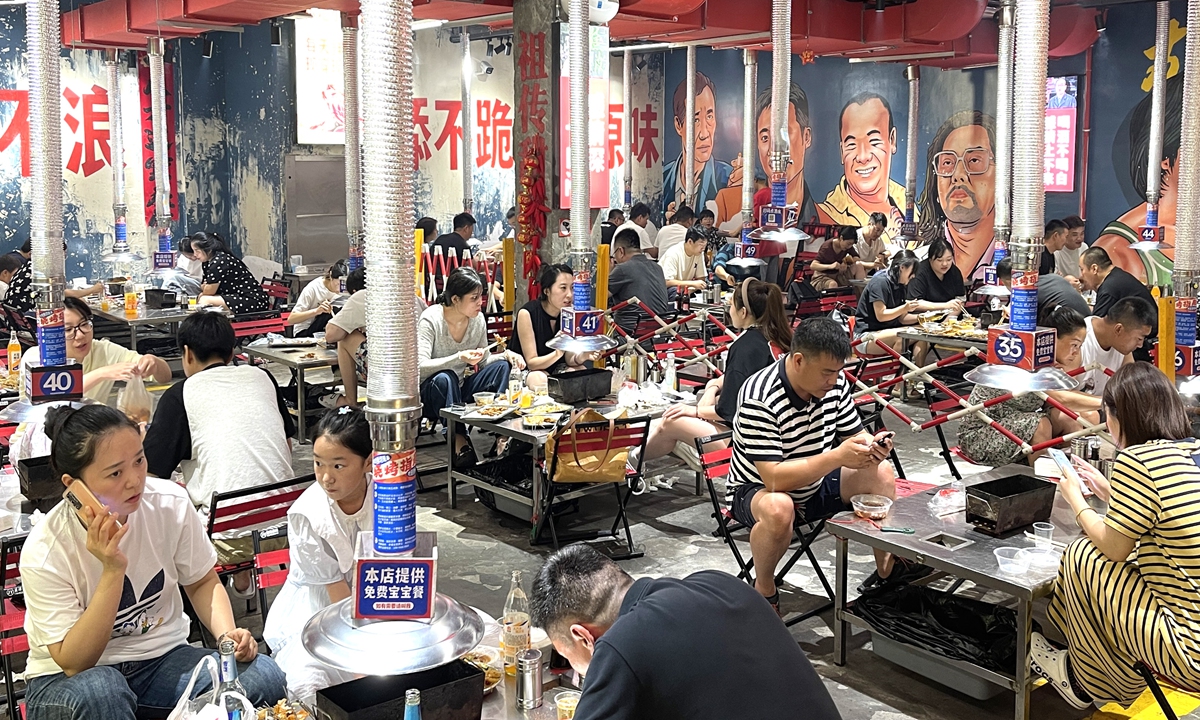
Diners enjoy barbecue at a restaurant in Xuzhou, East China's Jiangsu Province, on August 7, 2024. Photo: VCG
Root and heritageXuzhou is one of the birthplaces of Han Dynasty stone reliefs, with the Xuzhou Art Museum of Han Stone Carvings being one of the few specialized Han art museums in China, boasting a large and diverse collection of Han stone carvings.
More than 2,000 years ago, during the Han Dynasty, people already enjoyed roasting meat skewers over open flames. The "kitchen scenes" depicted on Han stone reliefs vividly captures the hearty spirit of ancient people, according to the Xuzhou Daily.
The classic combination of meat skewers, grills, and dipping sauces, the "barbecue trinity" that forms the soul of Xuzhou barbecue, is frequently depicted in Han stone reliefs unearthed in Xuzhou, revealing the local people's longstanding passion for barbecue.
The maturity of iron smelting technology during the Han dynasty made iron cooking tools widely accessible, which helped popularize barbecue as a cooking method.
A Han stone relief discovered in Tongshan district, Hanwang town, shows a detailed "kitchen scene": at the top level, one person carefully threads meat onto a U-shaped iron skewer and roasts it over the fire, while another fans the flames to keep them burning, an expressive and lively depiction, according to Xuzhou Daily.
"Han people called barbecue 'fanzhi' emphasizing the method of 'kuaizhi' - (cutting meat into small square pieces) skewering them with iron sticks, and roasting them close to the fire," Wang Deyan, chair of the Chinese Department at North China University of Technology, told the Global Times.
Wang explained that this refined technique elevated barbecue from a primitive cooking method to a banquet delicacy, becoming an indispensable part of Han Dynasty feast scenes.
In Xuzhou, as charcoal flames rise, they not only cook the food but also ignite a deep passion for tradition. This city, through its skewers of lamb, weaves together the weight of history and the lively spirit of modern life, creating a vivid symbol of the fusion between Han culture and contemporary lifestyle.
RELATED ARTICLES