US restricts submarine cable projects citing 'greater threats,' but analyst calls it baseless and harmful to global telecom networks
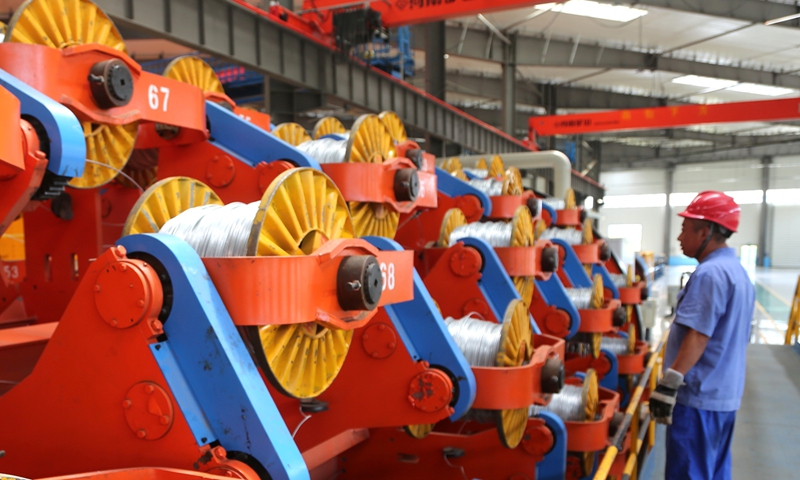
A worker produces submarine cables at a production base in Qingdao, East China's Shandong Province on August 8, 2024. The production base has been ramping up technological innovation to enhance market competitiveness in both the domestic and overseas markets. Photo: VCG
In another move that overstretches the concept of national security, the US Federal Communications Commission (FCC) on Thursday (local time) adopted new rules to unleash the buildout of secure submarine cable infrastructure, citing so-called "greater threats" from foreign adversaries like China. A telecom analyst said such a move is an extension of Washington's broader strategy to constrain China's technology sector and warned of disruptions to global network efficiency and potential blowback for the US industry.
The new rules will ensure that the US remains ready and able to deploy submarine cable infrastructure with increasing amounts of capacity to meet current and future internet and data demands, so that the US remains the unrivaled world leader in critical and emerging technologies and secures AI dominance, a FCC release claimed.
The release also revealed that the new curb aims at "streamlining investment into the US, coupled with restrictions on foreign adversaries that seek to exploit US vulnerabilities and threaten American national security," specifically highlighting countries like China as posing greater threats.
The latest measures are essentially an extension and escalation of the US policy of suppressing China's high-tech industries and curbing its manufacturing capabilities, reflecting US' deep anxiety over the country's accelerating rise in key sectors, veteran telecom industry observer Ma Jihua said.
"The US' real goal is to undermine China's industrial competitiveness and monopolize strategic sectors such as the internet and AI by controlling global submarine cable networks—an attempt to dominate the world's 'digital lifelines,'" Ma told the Global Times on Friday.
As Chinese firms have emerged as key players in the global submarine cable industry, they have increasingly become targets of US government suppression. The FCC is primarily responsible for regulating telecommunications operators, but since 2021, the commission has repeatedly targeted Chinese companies under the pretext of "national security threats."
Ma dismissed the US allegations as groundless, arguing that the core of a submarine cable is optical fiber, which is encased in multiple layers of insulation and protective materials. "As a passive transmission medium, such cables contain no complex electronic systems or chips and, cannot accommodate embedded spy devices," Ma noted.
He emphasized that Chinese companies are mainly involved in manufacturing and laying submarine cables, and are rarely responsible for the operation or maintenance of the systems. If there are any security concerns, they are more likely to arise from the operators, Ma noted.
"The construction of global submarine cable systems is typically undertaken by multinational consortia and involves collaboration among companies from various countries. China is merely one part of that system," Ma said, pointing to deep-seated US anxiety over China's industry strength.
The Report and Order portion of the item adopts a range of measures to protect submarine cables against foreign adversaries, per Thursday's report, including applying a presumption of denial for certain foreign adversary-controlled license applicants, limiting capacity leasing agreements to such entities, and more.
However, Ma argued that such restrictive measures are self-defeating.
"Submarine cables are typically globalized products, designed to enable seamless digital connectivity across the world. Any attempt to dominate or monopolize these systems would only undermine the overall efficiency of the global communications network," Ma cautioned.
He also highlighted China's strong manufacturing capacity and quality advantage in optical fiber cables, as well as its vital role in global network infrastructure.
Efforts to exclude China from the global communications ecosystem are both counterproductive and unrealistic, he warned, noting that such attempts would only worsen the already strained submarine cable supply chain and backfire the US industry.
In response to repeated US relentless allegations that Chinese repair vessels could tamper with undersea cables carrying internet traffic across the Pacific, Chinese Foreign Ministry spokesperson Mao Ning said last year that "US officials' claims are completely baseless and constitute ill-intentioned vilification of Chinese companies." She voiced firm opposition to US moves of overstretching the concept of national security and attacking and smearing Chinese companies.
"By vilifying and suppressing telecommunications companies from China and the rest of the world, the US government intends to build a global monitoring system dominated by the US with no rival and under no oversight, so as to leave a door open for its blatant eavesdropping and espionage," Mao said.
RELATED ARTICLES