China’s NEV exports in January-July see 57% growth y-o-y: CPCA
By Published: Aug 08, 2025 09:02 PM

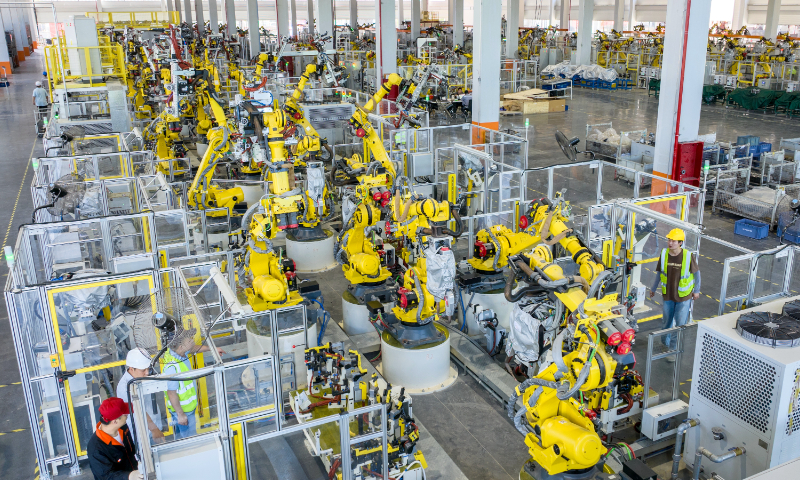
Fully automated robotic arms produce stamped body parts and axle components for new-energy vehicles (NEVs) at an auto parts manufacturing company in Huzhou, East China's Zhejiang Province, on July 1, 2025. The company can manufacture a complete set of NEV body metal parts every 60 seconds. Its 200 automated robotic arms are operating at full capacity to fulfill orders. Photo: VCG
China's new-energy vehicles (NEVs) saw robust exports in the first seven months of this year, industry data showed Friday, a sign of vibrant advancement in global sales.
The cumulative NEV exports from January to July reached 1.199 million, an increase of 57.1 percent year-on-year, according to the China Passenger Car Association (CPCA) on Friday.
In July alone, 213,000 NEVs were exported, a year-on-year increase of 120.4 percent and a month-on-month increase of 7.6 percent. They accounted for 44.7 percent of passenger car exports, an increase of nearly 20 percentage points over the same period last year, it added.
The top three car makers are BYD with the exports of 78,364 units, Chery Automobile of 28,023 units and Tesla China of 27,269 units.
As China's NEVs become more competitive in scale and experience market expansion, more and more new-energy brand products manufactured in China are exported, and their recognition overseas continues to increase, said the CPCA.
The data is in line with other official data. Statistics from Ningbo customs in East China's Zhejiang Province showed that the NEV exports totaled 107,000 units in the first half of this year, a year-on-year increase of 275 percent. Total auto exports reached 176,000 units, of which NEVs accounted for 60.8 percent.
In June alone, new-energy vehicle exports reached 2.3 billion yuan ($320 million), a year-on-year increase of 229.1 percent. This marked the second consecutive month that monthly exports exceeded 2.2 billion yuan, maintaining a high growth momentum.
China's NEV industry has achieved a leapfrog advantage, leading in both manufacturing technology and core components such as batteries, motors and electronic controls, as well as intelligent systems, Zhang Xiang, secretary-general of the International Intelligent Vehicle Engineering Association, told the Global Times.
He added that Chinese NEVs leverage economies of scale and the world's largest supply chain, offering advanced technologies and low costs for strong global competitiveness. Chinese automakers are expanding overseas, gaining brand recognition. Accessible export channels, like the Belt and Road Initiative, boost consumer acceptance and drive significant export growth, Zhang added.
China's NEV industry has been a highlight of the global auto industry, with its huge market size and strong growth potential.
In 2025, China's new-energy passenger vehicle global market share hit 68.3 percent, with June at 69.7 percent, up 2.3 percentage points year-on-year. From January to June, China's battery electric vehicle share was 64.5 percent, up 1.9 percentage points from the second quarter in 2024. Its plug-in hybrid share reached 76 percent, showing a strong performance, CPCA said on Wednesday.
RELATED ARTICLES