ARTS / FILM
Salvaging veiled history: Actor Zhu Yilong interprets righteous Chinese people in war-related film
Through the lens of truth
Editor's Note:
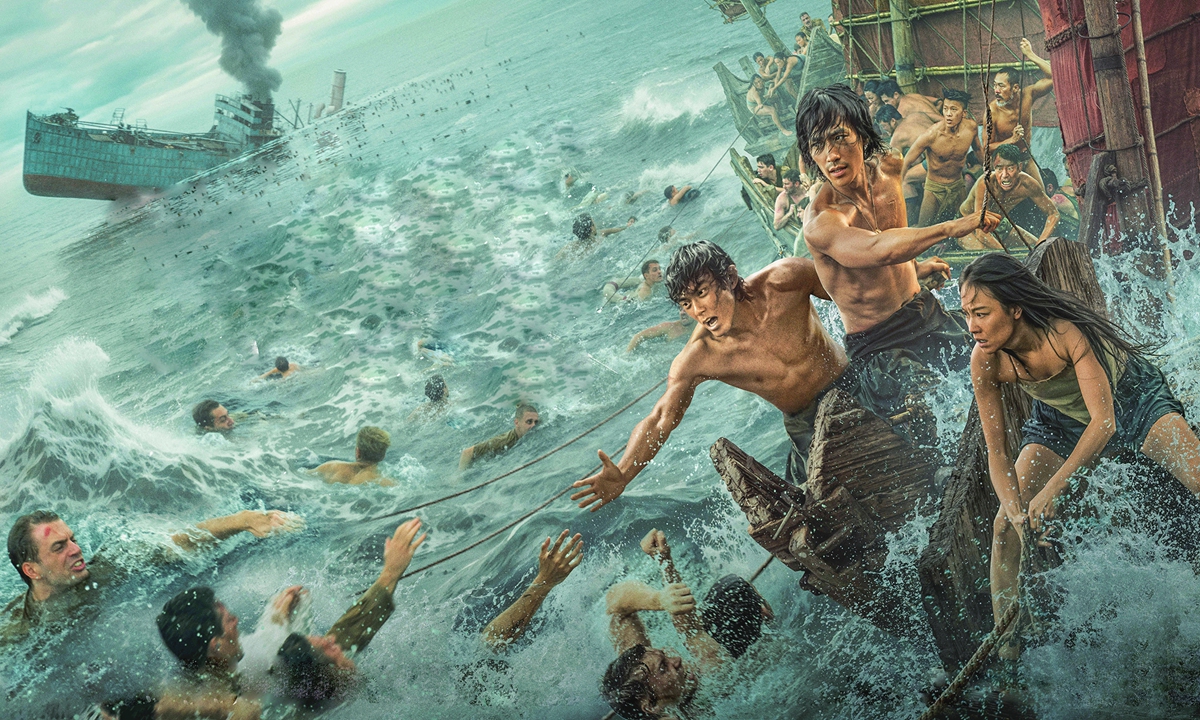
Based on the real historical event of Chinese fishermen rescuing British prisoners of war (POWs) during World War II, the film Dongji Rescue debuted on the silver screen on Friday, featuring stars such as Zhu Yilong, Wu Lei, and Ni Ni.
The film depicts how the Chinese fishermen of Dongji Island risked their lives to save stranded British soldiers from the sinking cargo vessel Lisbon Maru. Describing the film as an "effort to salvage a veiled history" while inviting audiences to "feel the kindness and compassion of the Chinese people," lead actor Zhu Yilong (Zhu) gave an interview to the Global Times (GT) reporters Niu Xiaoman and Shao Qunyu, and shared his deep reflection on this historical event and the industrial craftsmanship behind the film's making.
To portray the character "A Bi," Zhu underwent extreme free-diving training and conducted daily on-site location scouting. He told the Global Times that his love of film making is also a mode of true self-expression. When mentioning the internationalization of Chinese cinema, he placed great value on China's diverse film genres, and said that he wishes the world could see today's Chinese filmmakers for what they are creatively.

GT: What drew you to join the film? What message do you hope to convey to audiences?
Zhu: There were two key reasons. First, purely from a cinematic perspective, it's been a long time since I've encountered an industrial-scale film like this. It was a challenge.
Second, and more important, is the historical significance behind the film. It's rooted in a real historical event - what I see as the salvaging of a veiled history. The film has a slogan: "Every Chinese person can be a hero." It's precisely because of these people that our nation boasts such an enduring history, rising stronger each time. Today, we must carry forward this spirit of self-reliance.
GT: How did you understand and inhabit the role of "A Bi"?
Zhu: Initially hesitant, I later committed to the role through transforming physically into it. For example, I reshaped my physique and tanned my skin while studying his inner world as per the script. The moment I truly felt I'd become him was when I stood on Dongji Island. During daily hikes to the site, gazing at the sea until Director Fei Zhenxiang pointed to where the Lisbon Maru sank, I would suddenly feel overwhelmed by the weight of history, and feel its weight on my shoulders.
I deeply resonate with "A Bi"- flaws and all. When Director Guan Hu described him, he used two defining traits: primal fierceness and an unyielding spirit. These are the threads that run through this character.
GT: Dongji Rescue will soon premiere in multiple countries and regions worldwide. What do you hope overseas audiences will take from it?
Zhu: Humanity transcends borders. While our story is rooted in China, its core explores a universal question: How far can human goodness stretch in extreme circumstances? Regardless of people from different countries, these Chinese fishermen lived by the creed of having to rescue those stranded at sea at great personal risk. That transcendent moral choice carries a power I believe will resonate globally.
More than anything, through the film, I want the world to see the Chinese people as we are: Our innate kindness, our deep-seated sense of righteousness, also known as renyi, and our unwavering yearning for peace.
GT: From Only the River Flows to Dongji Rescue, how do you view Chinese cinema's journey globally?
Zhu: These two films represent entirely different genres.The former is an auteur cinema piece, while the latter is an industrial-scale production. This diversity is exactly what Chinese cinema needs to showcase globally: varied creative achievements and perspectives.
To be honest, I have attended many international film festivals. I observed that the global viewers often harbor limited views and perceptions on Chinese films. That's precisely why we must bring works like Dongji Rescue, a film reflecting China's industrial film prowess, to the world. Our presentation of young directors' creations that reflect contemporary realities are also valuable. The world should see today's Chinese filmmakers: What we contemplate, what we create, and how far our cinematic industrialization has progressed.
GT: With nearly 20 years in the industry, how do you view an actor's "dormant phase"? When did you feel you had matured?
Zhu: (Laughs) Nineteen years, to be exact. Looking back, those so-called "dormant phases" were actually invaluable. It was during those unseen years - working on lesser-known projects, refining my craft, and more - that the foundation was laid. All that experiences eventually fulfilled my later roles.But even now, I wouldn't call myself a "mature" actor. Every new script and character still fills me with trepidation. There is no universal formula for every role, and every role to me is a new challenge.
Now, I'm willing to work with ease to surrender myself completely to each role with fewer distractions, pure dedication, and a more relaxed state of being. In everyday life, I'm also on a journey of self-discovery. I'll describe myself as somewhat "lazy"- living in an "energy-saving mode," staying relaxed, and consciously slowing myself down to better perceive the world through awakened senses. Just because I'm not in front of the camera doesn't mean I'm not out there living what I consider a perfectly normal life.
Li Yuche also contributed to this story.
Based on the real historical event of Chinese fishermen rescuing British prisoners of war (POWs) during World War II, the film Dongji Rescue debuted on the silver screen on Friday, featuring stars such as Zhu Yilong, Wu Lei, and Ni Ni.
The film depicts how the Chinese fishermen of Dongji Island risked their lives to save stranded British soldiers from the sinking cargo vessel Lisbon Maru. Describing the film as an "effort to salvage a veiled history" while inviting audiences to "feel the kindness and compassion of the Chinese people," lead actor Zhu Yilong (Zhu) gave an interview to the Global Times (GT) reporters Niu Xiaoman and Shao Qunyu, and shared his deep reflection on this historical event and the industrial craftsmanship behind the film's making.
To portray the character "A Bi," Zhu underwent extreme free-diving training and conducted daily on-site location scouting. He told the Global Times that his love of film making is also a mode of true self-expression. When mentioning the internationalization of Chinese cinema, he placed great value on China's diverse film genres, and said that he wishes the world could see today's Chinese filmmakers for what they are creatively.
A scene from the movie Dongji Rescue Photo: Courtesy of the production company of movie Dongji Rescue
Zhu Yilong, the actor who plays “A Bi,” the protagonist of the movie Dongji Rescue Photo: VCG
GT: What drew you to join the film? What message do you hope to convey to audiences?
Zhu: There were two key reasons. First, purely from a cinematic perspective, it's been a long time since I've encountered an industrial-scale film like this. It was a challenge.
Second, and more important, is the historical significance behind the film. It's rooted in a real historical event - what I see as the salvaging of a veiled history. The film has a slogan: "Every Chinese person can be a hero." It's precisely because of these people that our nation boasts such an enduring history, rising stronger each time. Today, we must carry forward this spirit of self-reliance.
GT: How did you understand and inhabit the role of "A Bi"?
Zhu: Initially hesitant, I later committed to the role through transforming physically into it. For example, I reshaped my physique and tanned my skin while studying his inner world as per the script. The moment I truly felt I'd become him was when I stood on Dongji Island. During daily hikes to the site, gazing at the sea until Director Fei Zhenxiang pointed to where the Lisbon Maru sank, I would suddenly feel overwhelmed by the weight of history, and feel its weight on my shoulders.
I deeply resonate with "A Bi"- flaws and all. When Director Guan Hu described him, he used two defining traits: primal fierceness and an unyielding spirit. These are the threads that run through this character.
GT: Dongji Rescue will soon premiere in multiple countries and regions worldwide. What do you hope overseas audiences will take from it?
Zhu: Humanity transcends borders. While our story is rooted in China, its core explores a universal question: How far can human goodness stretch in extreme circumstances? Regardless of people from different countries, these Chinese fishermen lived by the creed of having to rescue those stranded at sea at great personal risk. That transcendent moral choice carries a power I believe will resonate globally.
More than anything, through the film, I want the world to see the Chinese people as we are: Our innate kindness, our deep-seated sense of righteousness, also known as renyi, and our unwavering yearning for peace.
GT: From Only the River Flows to Dongji Rescue, how do you view Chinese cinema's journey globally?
Zhu: These two films represent entirely different genres.The former is an auteur cinema piece, while the latter is an industrial-scale production. This diversity is exactly what Chinese cinema needs to showcase globally: varied creative achievements and perspectives.
To be honest, I have attended many international film festivals. I observed that the global viewers often harbor limited views and perceptions on Chinese films. That's precisely why we must bring works like Dongji Rescue, a film reflecting China's industrial film prowess, to the world. Our presentation of young directors' creations that reflect contemporary realities are also valuable. The world should see today's Chinese filmmakers: What we contemplate, what we create, and how far our cinematic industrialization has progressed.
GT: With nearly 20 years in the industry, how do you view an actor's "dormant phase"? When did you feel you had matured?
Zhu: (Laughs) Nineteen years, to be exact. Looking back, those so-called "dormant phases" were actually invaluable. It was during those unseen years - working on lesser-known projects, refining my craft, and more - that the foundation was laid. All that experiences eventually fulfilled my later roles.But even now, I wouldn't call myself a "mature" actor. Every new script and character still fills me with trepidation. There is no universal formula for every role, and every role to me is a new challenge.
Now, I'm willing to work with ease to surrender myself completely to each role with fewer distractions, pure dedication, and a more relaxed state of being. In everyday life, I'm also on a journey of self-discovery. I'll describe myself as somewhat "lazy"- living in an "energy-saving mode," staying relaxed, and consciously slowing myself down to better perceive the world through awakened senses. Just because I'm not in front of the camera doesn't mean I'm not out there living what I consider a perfectly normal life.
Li Yuche also contributed to this story.
RELATED ARTICLES