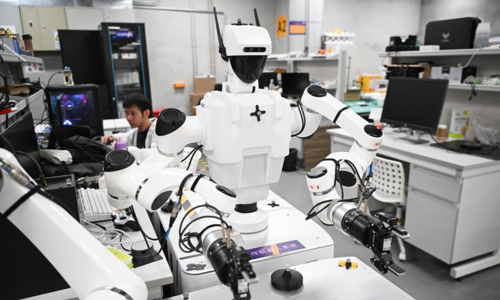
IN-DEPTH / IN-DEPTH
Next 2-3 years a rare window for Chinese humanoid robots, says American professor long focused on robotics development
Toward a Smart Future
Editor's Note:
The 2025 World Robot Conference (WRC), which launched on Friday in Beijing, highlighted the direction of future development in embodied intelligent robots - with a focus on areas like cognition, decision-making, and safety - while featuring more than 200 top domestic and international robotics firms. This year, Chinese-made robots have made a large-scale appearance, sparking a new wave of development led by humanoid robots. Professor Samuel Li Xiangming (Li) from Northeastern University in the US, who has long studied humanoid robotics in both the US and China, was among the first computer science students in China.
He witnessed the transition from IBM mainframes to microcomputers in the US and led the development of the world's first touchscreen Linux smartphone, the Motorola A760, during the golden era of mobile communications.
Li has been at the forefront of research integrating artificial intelligence (AI) with robotics. In his recently published book focusing on industrial transformation, business opportunities, and future humanoid robot trends, he uses over 40 short stories to illustrate how humanoid robots will participate in human life over the next 10 to 30 years in fields like education, eldercare, and healthcare. In an exclusive interview with Global Times reporter Yang Shasha (GT), Li reflected on his work from over 30 years ago, starting with lab robots, and provided a profound comparison of the humanoid robotics industries in China and the US.
Building on Japan's shoulders
GT: At the 2025 World Artificial Intelligence Conference held in Shanghai last month, Tesla showcased its humanoid robot, the second-generation Optimus, prompting professionals to compare the various details of US and Chinese humanoid robots. How do you assess the current development levels of humanoid robots in the two countries?
Li: I believe this year marks the "Year One" of humanoid robots. The industry is just beginning, and it's hard to say whether either the US or China is ahead. The starting gun has just gone off, and both are in the early stages, but there's no doubt that China is among the world's leading countries in the field of humanoid robots.
The US has been deeply engaged in traditional robotics for over 30 years, with strengths in physical robot manufacturing based on industries like automotive and in "robot brains" through global leadership in artificial neural networks, backed by abundant computing power. However, China is not to be outdone; DeepSeek is able to solve problems effectively. As a manufacturing powerhouse, China has irreplaceable advantages in the humanoid robot supply chain, including mechanics, electronics, and biomaterials.
For the past decade, humanoid robots have remained in labs, lacking the "brains" for independent decision-making, which limited their market penetration. In recent years, however, large-scale AI models have made qualitative leaps, leading to significant breakthroughs in humanoid robotics, moving them from labs to the market. In the US, however, many regions remain conservative. If a humanoid robot enters an ordinary household, many Americans worry about privacy concerns. In contrast, China's vast market embraces new technologies, so from this perspective, humanoid robots may develop faster in China.
GT: Morgan Stanley recently released its "Humanoid 100" list, with 35 Chinese companies included, but no Japanese companies were mentioned. Despite Japan being an early pioneer in humanoid robotics, why does it now seem so quiet in this field?
Li: The US and China's leading position in humanoid robotics owes much to Japan, which laid significant groundwork. The two countries are essentially standing on Japan's shoulders.
As early as 1969, the lab at Japan's Waseda University developed the first bipedal humanoid robot and Japan pioneered humanoid robotics research. Companies like Honda, Toyota, and many smaller Japanese firms ventured into this field, establishing a strong foundation in robot joints, motors, kinematics, and gait management. However, after Japan's industrial focus shifted, its humanoid robotics industry lost its former prominence.
US AI giants 'caught up in tussle'
GT: Tesla's third-generation humanoid robot is expected to launch this year and enter mass production in 2026, with a goal of producing 1 million units annually within five years. Elon Musk has said that by the end of this year, thousands of Optimus robots will be working in Tesla factories. During your visit to Tesla's factory, what roles did the robots play?
Li: In April, I visited Tesla's Gigafactory in Texas, where Optimus robots were already involved in tasks like rear vehicle assembly, battery installation, and quality inspections. Musk aims to take Optimus to Mars, so the robots' work in Tesla factories tests their brain-body coordination. In humanoid robotics, I believe Optimus is a leader, with key metrics like finger dexterity surpassing many manufacturers.
Tesla is one of the few US companies effectively combining large-scale AI models with physical robots, thanks to its natural advantages: Vast computing power, ample funding, self-developed battery technology, and top-tier AI talent. However, Tesla's robot mass production still relies on China, as 80-90 percent of the supply chain is located there.
GT: What is the current state of humanoid robotics research among other US companies?
Li: US AI giants like Google and Microsoft are focusing heavily on neural network research, investing vast resources to race toward Artificial General Intelligence (AGI) to dominate the AI field. This goal is generally estimated to take another two to three years, with the final 20 percent of the journey progressing slowly.
These two to three years are a golden opportunity for Chinese companies. While China may not quickly achieve breakthroughs in computing power, deploying mature large-scale models like DeepSeek onto physical robots can yield strong results. Currently, US AI giants are caught up in a tussle over AGI dominance, giving China a chance to refine its humanoid robotics industry chain and build irreplaceable advantages. Companies like Shenzhen's UBTech and Hangzhou's Unitree are innovating significantly, giving China a certain lead in this field.
At least 20 years to enter households
GT: In your book, you state that humanoid robots will disrupt global supply chains, causing manufacturing powerhouses to lose their edge. How did you reach this conclusion?
Li: Humanoid robots work at near-zero cost, eliminating the need to produce clothes, shoes, or other goods in low-cost countries. Factories staffed by robots can be built near cities to start production. In the future, such factories will likely be established close to consumers, with automation, unmanned operations, and customization meeting most needs, potentially disrupting the current global trade system.
For China, the key is to build a high-precision humanoid robotics industry chain. Once established, China's leadership in this chain will be irreplaceable. However, the window of opportunity is not very long. The most valuable opportunity is the recent two to three years of window period, during which American companies are still focused on pursuing dominance in AGI and are unable to spare resources to expand market applications. In contrast, China can put significant effort into developing market applications.
GT: How long will it take for humanoid robots to enter ordinary households?
Li: I believe that the future humanoid robot industry will be a modularized industrial chain. If you want a humanoid robot for your family, you can visit a specialty store, select its appearance, language, and skills, and the store will place an order with the factory. Three days later, your robot will be delivered.
Like today's Apple iPhone, the humanoid robotics industry will integrate many Chinese-made components. However, for humanoid robots to reach the level of today's iPhone or Xiaomi smartphones, I estimate it will take at least 20 years.
The 2025 World Robot Conference (WRC), which launched on Friday in Beijing, highlighted the direction of future development in embodied intelligent robots - with a focus on areas like cognition, decision-making, and safety - while featuring more than 200 top domestic and international robotics firms. This year, Chinese-made robots have made a large-scale appearance, sparking a new wave of development led by humanoid robots. Professor Samuel Li Xiangming (Li) from Northeastern University in the US, who has long studied humanoid robotics in both the US and China, was among the first computer science students in China.
He witnessed the transition from IBM mainframes to microcomputers in the US and led the development of the world's first touchscreen Linux smartphone, the Motorola A760, during the golden era of mobile communications.
Li has been at the forefront of research integrating artificial intelligence (AI) with robotics. In his recently published book focusing on industrial transformation, business opportunities, and future humanoid robot trends, he uses over 40 short stories to illustrate how humanoid robots will participate in human life over the next 10 to 30 years in fields like education, eldercare, and healthcare. In an exclusive interview with Global Times reporter Yang Shasha (GT), Li reflected on his work from over 30 years ago, starting with lab robots, and provided a profound comparison of the humanoid robotics industries in China and the US.
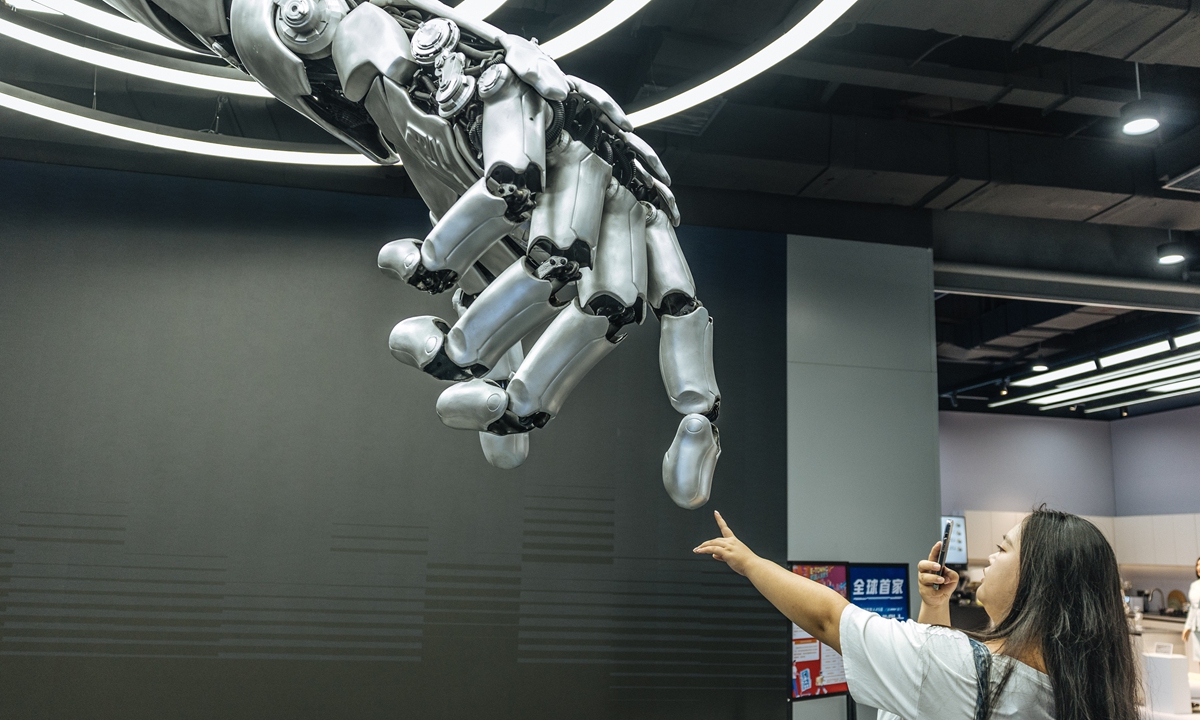
A visitor is interacting with a humanoid robot at the 2025 World Robot Conference on August 9, 2025 in Beijing. Photo: Li Hao/GT
Building on Japan's shoulders
GT: At the 2025 World Artificial Intelligence Conference held in Shanghai last month, Tesla showcased its humanoid robot, the second-generation Optimus, prompting professionals to compare the various details of US and Chinese humanoid robots. How do you assess the current development levels of humanoid robots in the two countries?
Li: I believe this year marks the "Year One" of humanoid robots. The industry is just beginning, and it's hard to say whether either the US or China is ahead. The starting gun has just gone off, and both are in the early stages, but there's no doubt that China is among the world's leading countries in the field of humanoid robots.
The US has been deeply engaged in traditional robotics for over 30 years, with strengths in physical robot manufacturing based on industries like automotive and in "robot brains" through global leadership in artificial neural networks, backed by abundant computing power. However, China is not to be outdone; DeepSeek is able to solve problems effectively. As a manufacturing powerhouse, China has irreplaceable advantages in the humanoid robot supply chain, including mechanics, electronics, and biomaterials.
For the past decade, humanoid robots have remained in labs, lacking the "brains" for independent decision-making, which limited their market penetration. In recent years, however, large-scale AI models have made qualitative leaps, leading to significant breakthroughs in humanoid robotics, moving them from labs to the market. In the US, however, many regions remain conservative. If a humanoid robot enters an ordinary household, many Americans worry about privacy concerns. In contrast, China's vast market embraces new technologies, so from this perspective, humanoid robots may develop faster in China.
GT: Morgan Stanley recently released its "Humanoid 100" list, with 35 Chinese companies included, but no Japanese companies were mentioned. Despite Japan being an early pioneer in humanoid robotics, why does it now seem so quiet in this field?
Li: The US and China's leading position in humanoid robotics owes much to Japan, which laid significant groundwork. The two countries are essentially standing on Japan's shoulders.
As early as 1969, the lab at Japan's Waseda University developed the first bipedal humanoid robot and Japan pioneered humanoid robotics research. Companies like Honda, Toyota, and many smaller Japanese firms ventured into this field, establishing a strong foundation in robot joints, motors, kinematics, and gait management. However, after Japan's industrial focus shifted, its humanoid robotics industry lost its former prominence.
US AI giants 'caught up in tussle'
GT: Tesla's third-generation humanoid robot is expected to launch this year and enter mass production in 2026, with a goal of producing 1 million units annually within five years. Elon Musk has said that by the end of this year, thousands of Optimus robots will be working in Tesla factories. During your visit to Tesla's factory, what roles did the robots play?
Li: In April, I visited Tesla's Gigafactory in Texas, where Optimus robots were already involved in tasks like rear vehicle assembly, battery installation, and quality inspections. Musk aims to take Optimus to Mars, so the robots' work in Tesla factories tests their brain-body coordination. In humanoid robotics, I believe Optimus is a leader, with key metrics like finger dexterity surpassing many manufacturers.
Tesla is one of the few US companies effectively combining large-scale AI models with physical robots, thanks to its natural advantages: Vast computing power, ample funding, self-developed battery technology, and top-tier AI talent. However, Tesla's robot mass production still relies on China, as 80-90 percent of the supply chain is located there.
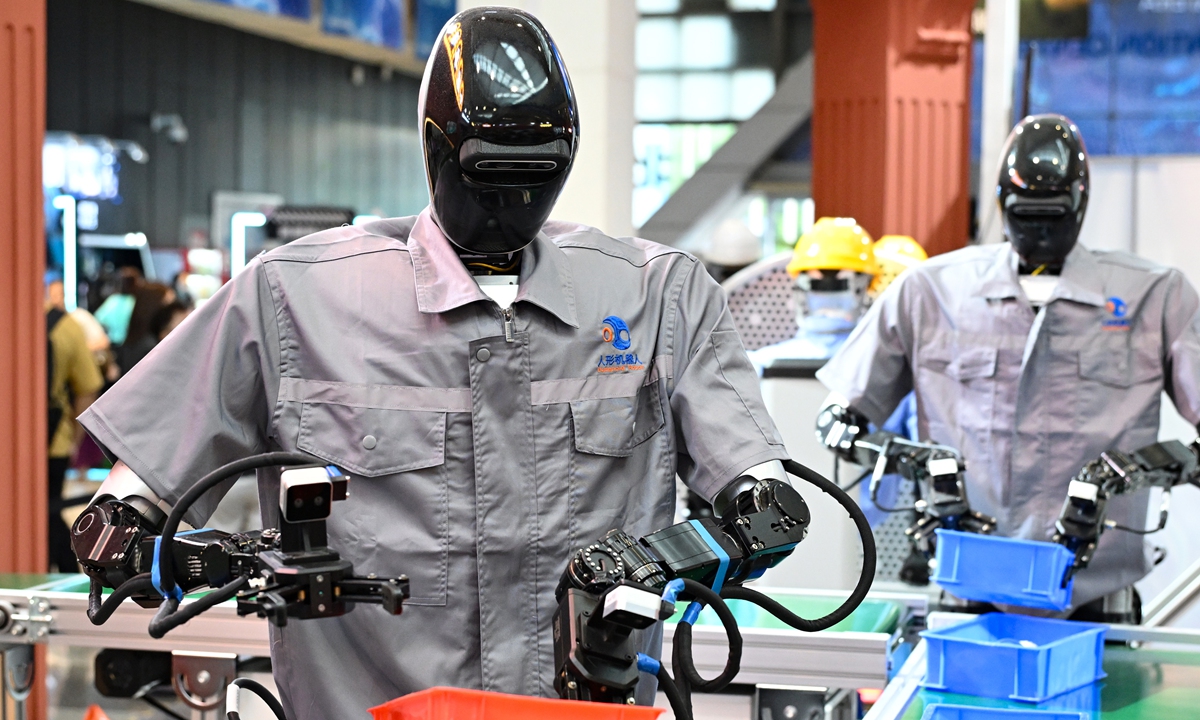
A humanoid robot demonstrates logistics sorting at the 2025 World Artificial Intelligence Conference on July 26, 2025. Photo: VCG
GT: What is the current state of humanoid robotics research among other US companies?
Li: US AI giants like Google and Microsoft are focusing heavily on neural network research, investing vast resources to race toward Artificial General Intelligence (AGI) to dominate the AI field. This goal is generally estimated to take another two to three years, with the final 20 percent of the journey progressing slowly.
These two to three years are a golden opportunity for Chinese companies. While China may not quickly achieve breakthroughs in computing power, deploying mature large-scale models like DeepSeek onto physical robots can yield strong results. Currently, US AI giants are caught up in a tussle over AGI dominance, giving China a chance to refine its humanoid robotics industry chain and build irreplaceable advantages. Companies like Shenzhen's UBTech and Hangzhou's Unitree are innovating significantly, giving China a certain lead in this field.
At least 20 years to enter households
GT: In your book, you state that humanoid robots will disrupt global supply chains, causing manufacturing powerhouses to lose their edge. How did you reach this conclusion?
Li: Humanoid robots work at near-zero cost, eliminating the need to produce clothes, shoes, or other goods in low-cost countries. Factories staffed by robots can be built near cities to start production. In the future, such factories will likely be established close to consumers, with automation, unmanned operations, and customization meeting most needs, potentially disrupting the current global trade system.
For China, the key is to build a high-precision humanoid robotics industry chain. Once established, China's leadership in this chain will be irreplaceable. However, the window of opportunity is not very long. The most valuable opportunity is the recent two to three years of window period, during which American companies are still focused on pursuing dominance in AGI and are unable to spare resources to expand market applications. In contrast, China can put significant effort into developing market applications.
GT: How long will it take for humanoid robots to enter ordinary households?
Li: I believe that the future humanoid robot industry will be a modularized industrial chain. If you want a humanoid robot for your family, you can visit a specialty store, select its appearance, language, and skills, and the store will place an order with the factory. Three days later, your robot will be delivered.
Like today's Apple iPhone, the humanoid robotics industry will integrate many Chinese-made components. However, for humanoid robots to reach the level of today's iPhone or Xiaomi smartphones, I estimate it will take at least 20 years.
RELATED ARTICLES