IN-DEPTH / IN-DEPTH
Experiencing the future at 2025 WRC: How next-generation robots are reshaping our life?
Toward a Smart Future
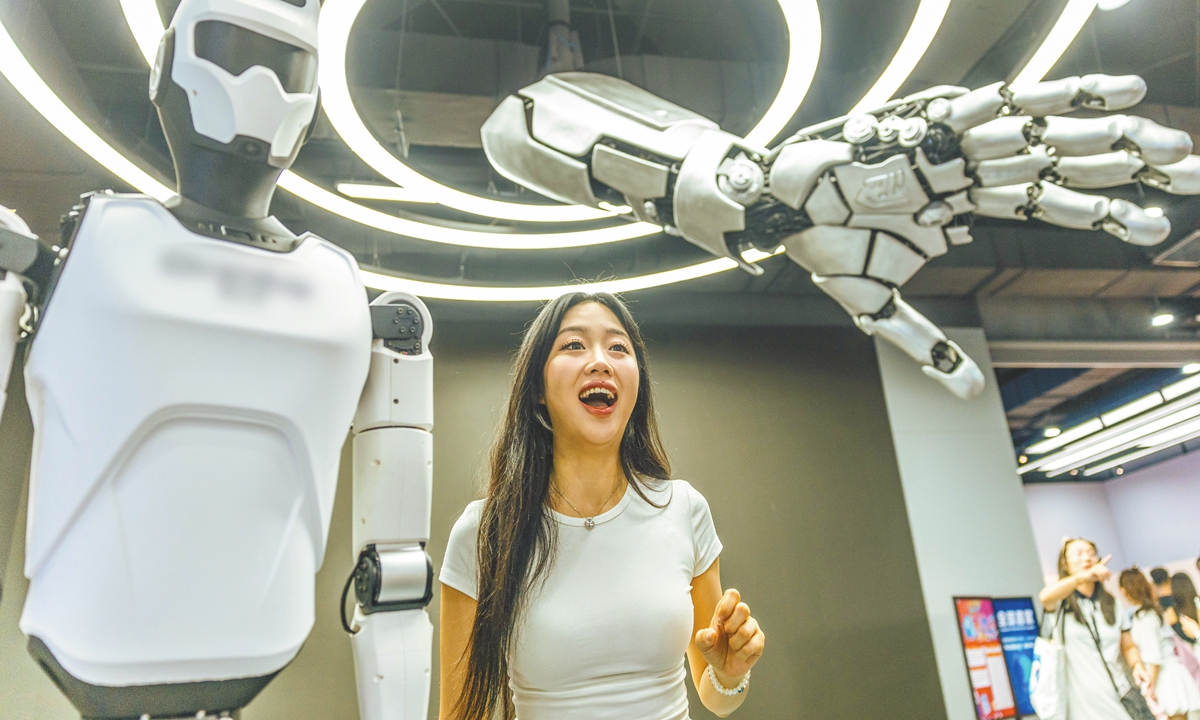
A visitor is interacting with a humanoid robot at the 2025 World Robot Conference on August 9, 2025 in Beijing. Photo: Li Hao/GT
The rapid advancement of AI and robotics has made robot waiters, dancers, marathon runners, and even combatants commonplace. But beyond these eye-catching displays, what roles can robots truly play in our daily lives and workplaces? At the 2025 World Robot Conference (WRC), which opened in Beijing on Friday, Global Times reporters witnessed firsthand how robots with diverse skills transitioning from the stage into daily life, poised to increasingly transform future.
This year's WRC set a new benchmark, featuring over 1,500 exhibits from more than 200 leading domestic and international robotics companies, including more than 100 new product debuts. Notably, 50 humanoid robot manufacturers showcased their latest innovations and industry solutions - the highest number ever seen at similar events.
Humanoid robots take center stage
Entering the 2025 WRC, what was most striking to many visitors was the microcosm of a futuristic world filled with robots. Robots weaving through crowds, robotic dogs promoting the event, humanoid robots demonstrating unique abilities in various simulated scenarios, various dexterous robotic hands and arms... the atmosphere was rich with sci-fi allure.
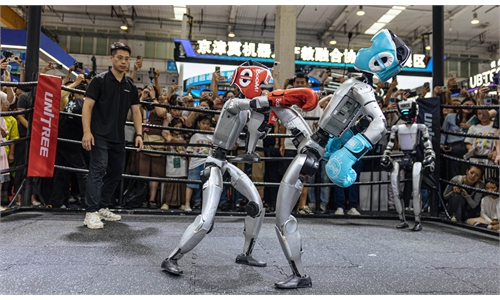
Chinese robot firm Unitree showcased its G1 robot and R1 humanoid robots at the conference. The G1 combat robot, for instance, showed its near-human athletic coordination with advanced dynamic balance algorithms. Robot company Accelerated Evolution presented its T1 and K1 robots, which recently won the RoboCup 2025 in Brazil.
The Beijing-based National and Local Co-built Embodied AI Robotics Innovation Center exhibited its Tien Kung version 2.0, which took to the stage as host during the opening ceremony of the conference. A director at the center told the Global Times that Tien Kung possesses precise perception and autonomous task planning capabilities in complex environments, based on the center's independently developed full-body control and autonomous navigation system. "In the future, it will be able to perform environmental perception and task planning in various application scenarios, including factories, special operations, and households," said the director.
Dexterous robotic hands
The 2025 WRC also featured various dexterous robotic hands.
At the booth of Shenzhen-based Cyborg Robotics, a robotic hand demonstrated its ability to grasp heavy objects and perform intricate finger movements. A Cyborg Robotics director explained that, traditional industrial robots lack the dexterity for gripping actions, while this robotic hand can achieve a bionic structure similar to that of a human. "That enables it to perform delicate tasks like flipping switches or lifting heavy boxes - tasks that traditional robots cannot accomplish," the director told the Global Times.
At the Pasini Perception Technology booth, multi-dimensional tactile humanoid robot Tora gently picked up packages from a conveyor belt. After sensing relevant data through its "hands," Tora sorted different packages into various bins. The increasing diversity of application scenarios for humanoid robots has led to the integration of more perceptual capabilities into the "dexterous hands," a representative at the booth told the Global Times.
'Non-typical' robots
The 2025 WRC featured many "non-typical" robots as well.
At the Hanwang Technology booth, various bionic robotic birds were showcased, capable of sustained flapping flight in the air. These bionic birds mimic different species, including magpies, bald eagles, golden eagles, and peregrine falcons.
Zhu Deyong, Hanwang Technology's president, said that these bionic birds can be used for various educational activities and, after modification, can play significant roles in counter-terrorism and security reconnaissance. The appearance and flight patterns of these bionic birds closely resemble those of real birds, making them difficult to distinguish from the ground, which is crucial for covertly monitoring ground targets, Zhu said.
Hanwang Technology is developing robots with olfactory capabilities, according to Zhu.
While robots have made significant visual, tactile, and auditory advancements, progress in taste and smell has been limited. "In the future, we will equip robotic dogs with olfactory devices, enabling them to identify drugs like real narcotics dogs, or track fugitives like hunting dogs."
From personal services to industrial applications
Many industry insiders dubbed 2024 the "year of the humanoid robots." But at that time, humanoid robots were largely in the concept validation stage, often perceived as mere showcases of technology.
However, many of the robots exhibited at the 2025 WRC are gearing up for practical "workplace" applications.
In the field of industrial inspection, particularly for large and complex components such as automobile bodies, aircraft parts, and heavy machinery, high-precision, large-scale, automated inspections have long relied on skilled technicians, facing bottlenecks in efficiency and consistency, the Global Times learned.
At the conference, Hexagon showcased its smart factory automation inspection solutions, featuring its first humanoid robot AEON. The robot can precisely reach every corner of large components to perform automated high-speed inspections and surface scans, largely replacing manual labor and enhancing automation levels.
Robots will play an increasingly important role in society, said Hao Jian, executive president of Hexagon's manufacturing intelligence Greater China. He noted that China's industrial robots have achieved a global leading advantage in terms of both production capacity and technology, and the country has the most complete industrial system and rich industrial application scenarios in the world. "We believe that in the near future, industrial robots will move out of laboratories and into factories, becoming a driving force for productivity," he told the Global Times.
At 2025 WRC, UBTECH showcased the Walker S2, the world's first humanoid robot capable of autonomous battery swapping. It can complete the battery swapping process in just three minutes, and enables 24/7 uninterrupted operation, providing a critical solution for industrial-grade continuous work, according to the company.
Humanoid robots are recognized as the next disruptive product following computers, smartphones, and new energy vehicles, with their impact permeating all aspects of production and life, Jiao Jichao, vice president and head of UBTECH's research institute, told the Global Times. Jiao said that in the industrial sector, the penetration rate of robots will largely increase, especially in automotive manufacturing, where humanoid robots will gradually become important members of production lines, handling tasks such as material handling, product assembly, and quality inspection.
In the future, humanoid robots are expected to find applications in commercial settings and other fields, leveraging embodied intelligence technology to better understand customer needs and provide more personalized services.
China's domestically-made robots are gaining popularity overseas due to their technological advantages, said industry insiders reached by the Global Times. The international competitiveness of domestic industrial robots is increasing, and now domestically-made robots are being widely exported to various parts of the world, said Zhang Lei, technical director of SIASUN Robot & Automation Co Ltd. "As Chinese manufacturing expands overseas, we are also bringing Chinese robotic solutions with us, where we have significant advantages in ecology, supply chain, and cost-effectiveness," Zhang said.
Brain-control technology integrates with robotics
Recently, seven Chinese ministries, including the Ministry of Industry and Information Technology and the National Development and Reform Commission, issued guidelines to promote brain-machine interface (BMI) innovation. Key breakthroughs should be achieved by 2027 to establish advanced technical, industrial, and standard systems.
At the 2025 WRC, numerous BMI technologies and devices were showcased. Shanghai Shuli Intelligent Technology Co Ltd, for instance, displayed multimodal BMI systems that aid in medical diagnosis and rehabilitation. These systems decode patients' motor intentions via high-precision electroencephalographic (EEG) algorithms, driving exoskeleton robots for limb training.
The company's founder, Wang Wei, noted that BMI has transitioned from labs to clinical applications, entering a critical industrialization phase.
Xi'an Jiaotong University Professor Xu Guanghua, specializing in BMI and rehabilitation robotics, highlighted rapid domestic progress: Leading invasive BMI trials and non-invasive expansions beyond rehab, bolstered by national policies. His research focuses on brain-control-robot integration for patient training.
Numerous challenges ahead
Despite advancements, robots, especially humanoids, face challenges.
Zhao Mingguo, a professor in the Department of Automation at Tsinghua University, views the field as early-stage, with logistics as a prime application. Challenges include low power density, AI's data or compute reliance, perception or cognition gaps, motion precision, and decision-making in complex environments.
Li Chaoyi, who is in charge of global market for Accelerated Evolution Technology Co Ltd, remains optimistic, citing China's leading position in humanoid research via events like the 2025 RoboCup, fostering international collaboration. He believes that open-source exchanges accelerate progress, with joint efforts driving industry evolution through deeper explorations.
RELATED ARTICLES