Australian media raises alarm over US Antarctic science cuts amid China-Russia expansion; expert cautions against ‘unhealthy’ anxiety undermines global collaboration
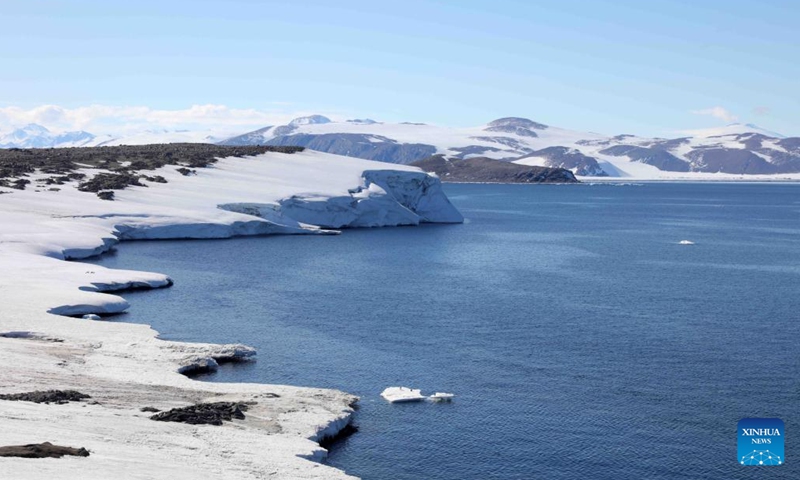
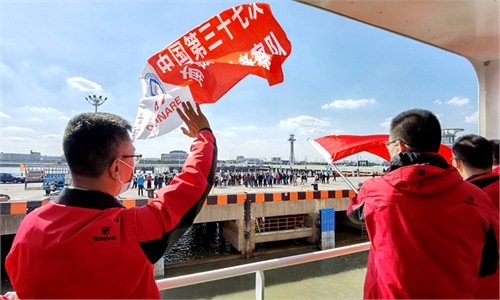
This photo taken on Dec. 27, 2024 shows a view of the scenery near China's Qinling Station in Antarctica. Chinese research icebreaker Xuelong 2, or Snow Dragon 2, and cargo vessel Yong Sheng, which are on China's 41st Antarctic expedition, arrived at China's Qinling Station in Antarctica on Dec. 25 and carried out unloading operations. (Xinhua/Huang Taoming)
Australia's ABC News claimed on Sunday that as the US cuts key science programs, Antarctic research is under threat and "could create a void for China and Russia to fill." A Chinese expert refuted this view and told the Global Times that Antarctic research requires global collaboration, and that Australian media's "unhealthy" anxiety toward China's transparent and open cooperation is detrimental to scientific progress.
"According to the Antarctic Treaty, any country has the right to conduct scientific research in Antarctica," Lü Xiang, a research fellow at the Chinese Academy of Social Sciences, told the Global Times. He noted that the continent's vast area means its coverage remains limited, and the overall state of Antarctic research today is one of insufficiency rather than excess.
ABC News cited remarks by Jeff McGee, a professor of international law at the Institute for Marine and Antarctic Studies. He said that if there were a dwindling of Antarctic science and logistics capacity from the US, the most obvious countries that might try to fill the void are countries like China and perhaps even Russia.
"China and even Russia have increased their investment in the rapidly warming frozen continent," the report said, noting that China now has five permanent research stations and plans for a sixth, and for the first time ever has overtaken the US in the number of research papers published in the past year.
The report cited a study published through the University of the Arctic, involving scientists from Umea University in Sweden and the University of Tasmania, found that globally the number of Antarctic and Southern Ocean publications peaked in 2021, then fell every year to 2024.
"One of those countries seeing a decline in publications was Australia, along with the US, which has been overtaken by China as the leader in published papers for the first time," said in the report.
The report also said that Russia has been increasing its presence in Antarctica, upgrading and reopening stations and building a runway.
Meanwhile, the US was flagging in its investments, according to the New York Times in July. The report said that the National Science Foundation — the primary agency that funds overseas activities in both Antarctica and the Arctic — is proposing iceberg-size research cuts to polar science in 2026. Around 70 percent of the money currently in that pot for both poles could vanish.
"The US has been doing a steady retreat from activities in Antarctica," said Bill Muntean, who was the head of the US delegation to the Antarctic Treaty Consultative Meeting in 2022 and 2023, and is now with the Center for Strategic and International Studies. "It's not closing any stations, but it's not repairing them or building them in an expeditious manner, and it has been reducing some of its logistics capacity," the New York Times reported.
The Antarctic Treaty was signed in Washington on December 1, 1959 by 12 countries and entered into force in 1961. The total number of parties to the treaty is now 56. China acceded to the treaty in 1983 and became a consultative party in 1985, the Xinhua News Agency reported.
McGee also said that "Antarctica is governed by this treaty system." He added that when Antarctic Treaty meetings occur, the countries that do the most science and have the strongest Antarctic logistics generally have the most weight.
Lü stressed that the US' decision to cut Antarctic research funding is its own sovereign choice. As a major Southern Hemisphere country close to Antarctica, Australia possesses natural advantages and significant scientific capabilities and should be leveraging these strengths to enhance research efforts instead of "selling anxiety."
"If claims such as 'fill the void' truly represent Australia's scientific community, then the notion of scientific research fairness is called into question," he added.
Besides hyping up the supposed 'influence,' ABC News mentioned the "dual-use technologies," claiming that the concern is that this equipment might be used not only for scientific purposes but also potentially for communication with satellites, and that such communications might have military or surveillance applications.
This is the same old hype repeated. In response to media inquiries over China's fifth Antarctic station, and a US think tank's 2023 claim that the station is well positioned to collect signals intelligence over Australia and New Zealand, as well as telemetry data on rockets launched from Australia's new Arnhem Space Centre, a Chinese Foreign Ministry spokesperson stated in February 2024 that as a consultative party to the Antarctic Treaty, China always ensures that its activities are consistent with the stipulations of the Antarctic Treaty System.
"China's new Antarctic station is built and operated in full compliance with international rules and procedures. The station will contribute to humanity's scientific understanding of the Antarctic, provide a platform for joint scientific exploration and cooperation between China and other countries, and help advance peace and sustainable development in the region," the spokesperson said.
RELATED ARTICLES