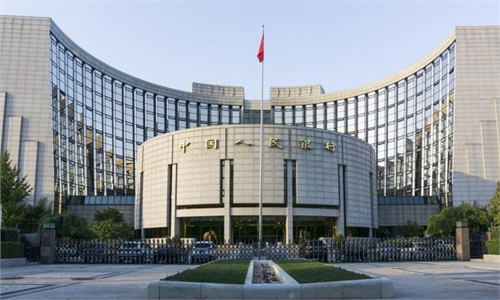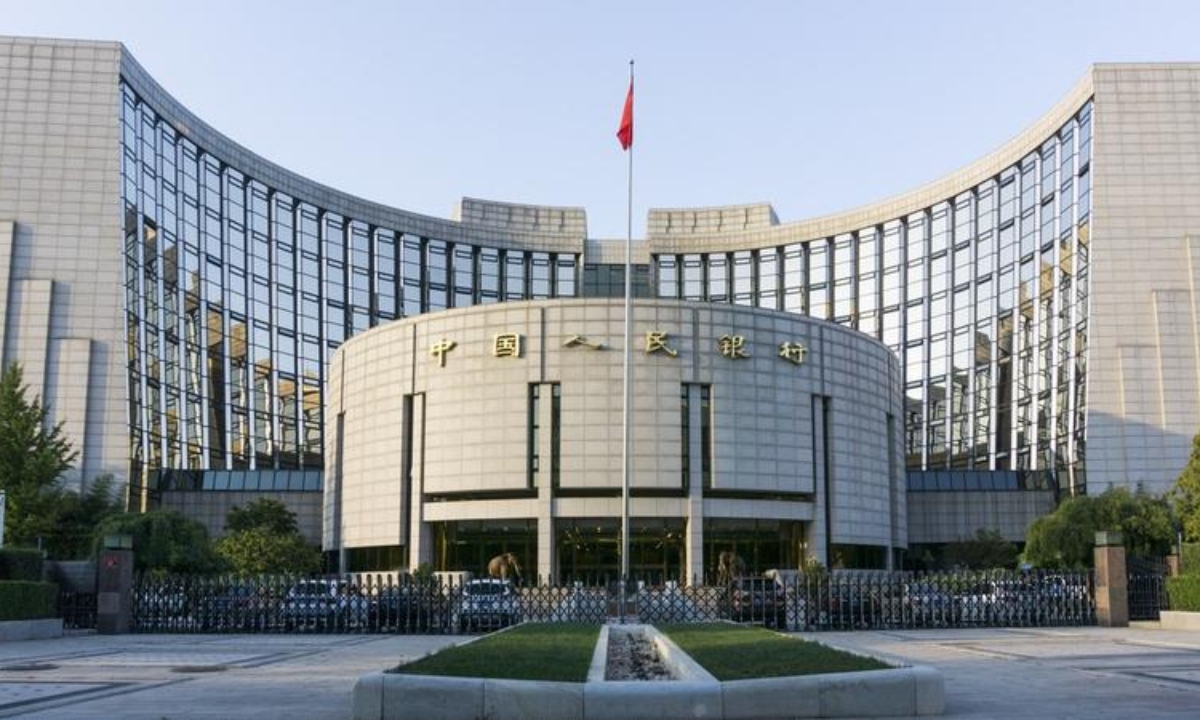
The headquarters of the People's Bank of China in Beijing Photo: IC
The People's Bank of China (PBC), the country's central bank, conducted seven-day reserve repo operations worth 112 billion yuan ($15.59 billion) on Monday, as the central bank steps up implementation of a moderately loose monetary policy in the second half of the year to bolster the economic growth.
In addition, the PBC launched a 700-billion-yuan outright reverse repo operation starting from August 8 to maintain ample liquidity in the country's banking system. The operation will last three months, according to the PBC website.
Outright reverse repo operations, a tool the central bank introduced in October 2024 to manage liquidity in the banking system, are carried out once each month with a tenor of no more than a year.
The latest moves are part of the central bank's efforts to step up its implementation of a moderately loose monetary policy and boost support for the upward and stable growth of the real economy, Xi Junyang, a professor at the Shanghai University of Finance and Economics, told Global Times on Monday.
The current short-term liquidity remains ample, Xi Junyang said, noting that the central bank may continue to leverage tools such as medium-term lending facility (MLF) and outright reverse repo operations for precise adjustments in the second half of the year to stabilize market expectations and facilitate credit expansion.
At a mid-year meeting held on August 1, the central bank pledged to step up its implementation of a moderately loose monetary policy and strengthen support for sci-tech innovation and consumption in the second half of the year.
The PBC said it will continue deploying a mix of monetary policy tools to ensure ample liquidity, support reasonable credit growth and strengthen the transmission of monetary policies. Efforts will also be made to defuse local government debt risks, and to enhance risk monitoring and macro-prudential oversight, according to the PBC.
As of the end of June, loans granted in the technology, green development and elderly care sectors have risen by 12.5 percent, 25.5 percent and 43 percent, respectively, year-on-year, official data showed.
Strong policy support has made foreign financial institutions increasingly bullish about China's economic growth prospects, with major foreign financial institutions such as UBS and Goldman Sachs raising their 2025 full-year GDP growth forecasts for China.
Overall, China's economy has maintained strong resilience, while the country's recently released manufacturing PMI generally aligning with seasonal patterns when analyzed on a month-on-month basis, Cheng Yu, head of research at Allianz Global Investors Fund, according to a note sent to the Global Times.
RELATED ARTICLES