US Treasury Secretary’s ‘baseless’ claim labeling China as the most imbalanced economy is politically driven act that distorts facts: experts
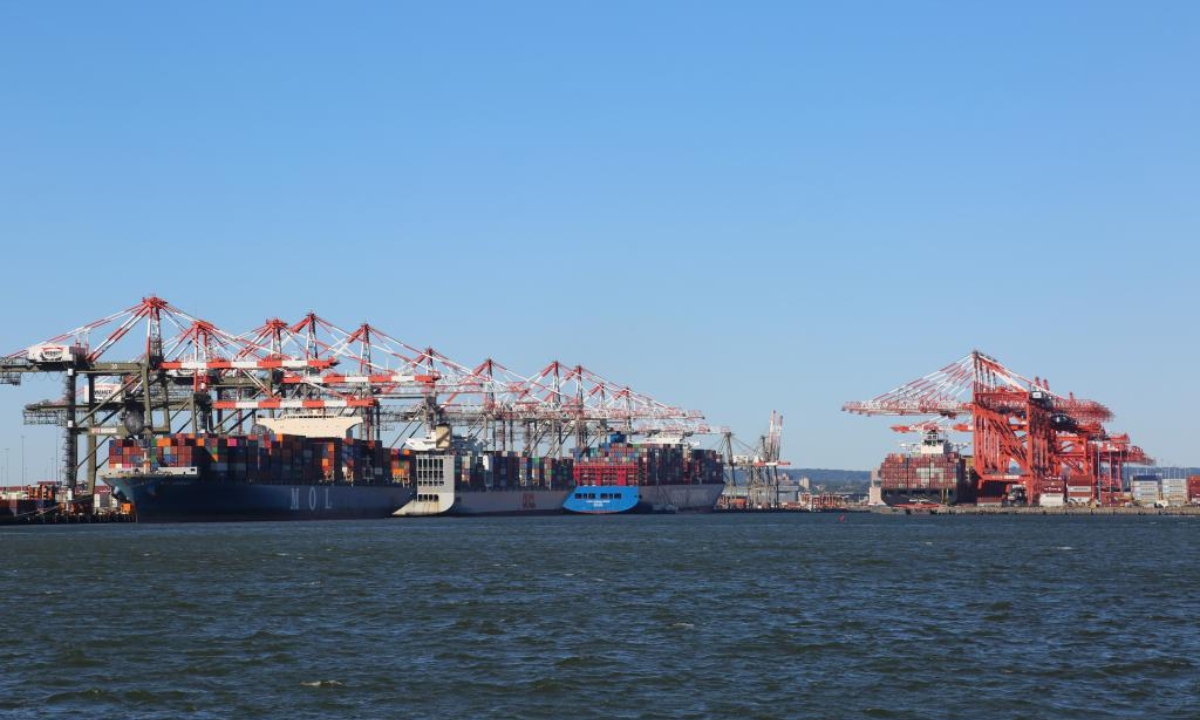
Containers are seen in the process of logistics operations at Port Newark Container Terminal and Maher Terminal owned by the Port Authority of New York and New Jersey in Bayonne, New Jersey, the US. File photo: Xinhua
Chinese experts on Monday criticized US Treasury Secretary Scott Bessent's baseless allegations labeling China as "the most imbalanced economy" and a "new" economic and military rival, calling the rhetoric a biased narrative that distorts China's economic contributions and global role. They highlighted that such politically motivated labeling lacks a factual basis and points to the US as the true instigator of protectionism, disrupting global trade stability.
During a recent exclusive interview with Nikkei, in response to a question that appear to shift blame to China, Bessent claimed that "China is the most unbalanced, or imbalanced, economy in the history of the modern world," Nikkei Asia reported on Monday. He attempted to find fault with China's advantage in manufacturing, asserting that "a lot of the production is below cost."
Bessent went on to compare China's economic model unfavorably with Western economies and so-called Asian democracies, promoting the narrative that "China is new because it's the biggest economic rival and the biggest military rival" and thus "difficult to deal with."
Gao Lingyun, a Research Fellow at the Institute of World Economics and Politics of the Chinese Academy of Social Sciences, rebutted that arbitrarily labeling other countries is a familiar political tactic of the US, devoid of factual grounding or economic logic.
"Unfounded accusations by the US typically ignore the specific national context and economic structure of the target country, instead serving a 'US-first' political agenda," Gao told the Global Times on Monday.
Gao highlighted that China's economic achievements and contributions to the global economy are self-evident. He stressed that China has consistently pursued openness based on its own characteristics and actively promoted cooperation with countries worldwide.
"In contrast, the US has been 'erecting walls' through tariffs and restrictive measures, thereby hindering globalization," according to Gao.
According to official data, since 2010, China's manufacturing value added has consistently ranked first globally, accounting for about 30 percent of the world's total. With the high-quality development push, a number of high-end, intelligent, and green new pillar industries are rapidly emerging.
Gao underscored that China's advances in manufacturing and economic development owe to efficient supply chains and sustained innovation rather than the so-called unsustainable subsidies alleged by the US.
That may be precisely what provokes deep anxiety in the US over how it views China's economy, Hu Qimu, Deputy Secretary-General of the Forum 50 for Digital-Real Economies Integration, told the Global Times on Monday.
"Unlike China's high-quality, innovation-driven growth, the US is grappling with severe industrial decline. Also, its financial capital can no longer siphon off profits from Chinese industries as it once did, leading to baseless accusations of so-called 'Chinese overcapacity,'" Hu noted.
Hu pointed out that China's production capacity supplies the world with high-quality, affordable goods, helping to curb global inflation, and is entirely allocated according to market principles—evidenced by the prosperity of China's private sector.
By the end of May, the number of private enterprises in China had surpassed 58 million—a 5.2 percent year-on-year increase—and they continue to strengthen their presence in strategic emerging industries such as new energy and high-end equipment manufacturing, becoming vital drivers of industrial upgrading and economic stability.
Bessent also insinuated in the interview that China's rising capacity poses a threat to countries like Japan and South Korea.
However, both experts faulted the US for intensifying protectionism through tariffs and over-subsidization, undermining global economic stability.
US industrial subsidies have only escalated. In 2022, the US government enacted the CHIPS and Science Act and the Inflation Reduction Act, allocating more than $1 trillion for domestic industries.
Gao believes the US aims primarily to suppress China while rallying allies such as Japan and South Korea to exert joint pressure.
Gao noted that "over time, those nations will come to realize that maintaining normal economic and trade cooperation with China best serves their fundamental interests, rather than joining a bloc aimed at confrontation."
RELATED ARTICLES