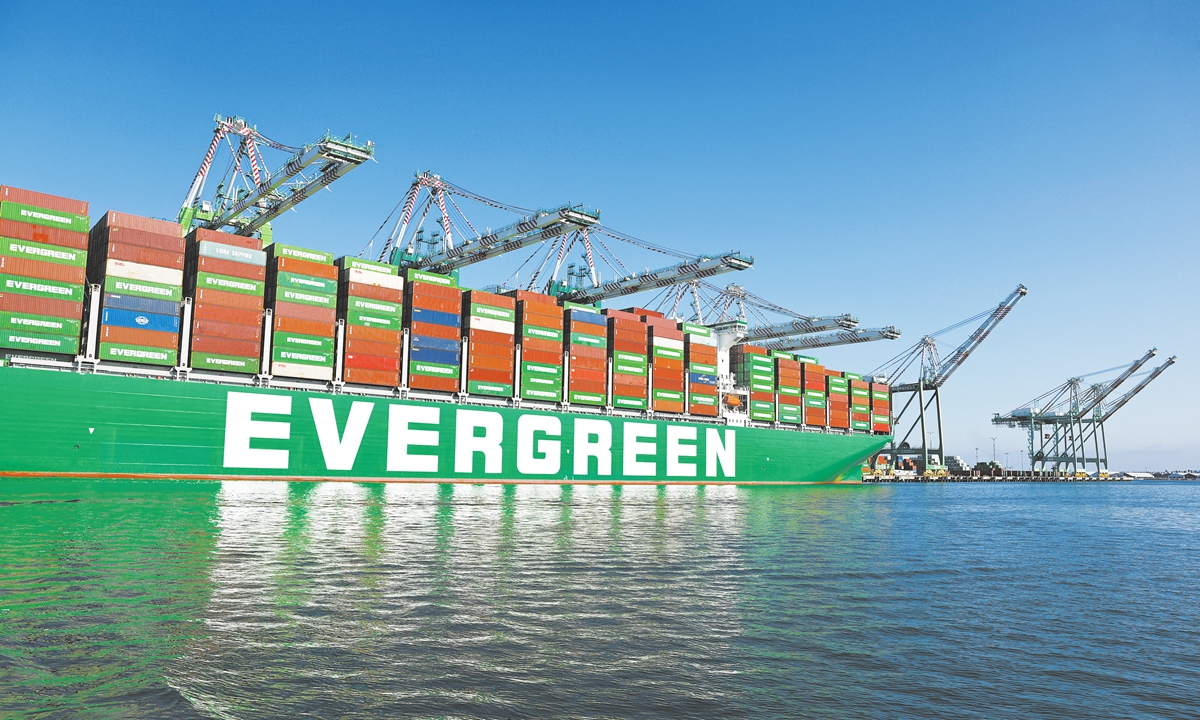
A container ship docks at the Port of Los Angeles in Los Angeles, California, the US, on June 25, 2025. Photo: VCG
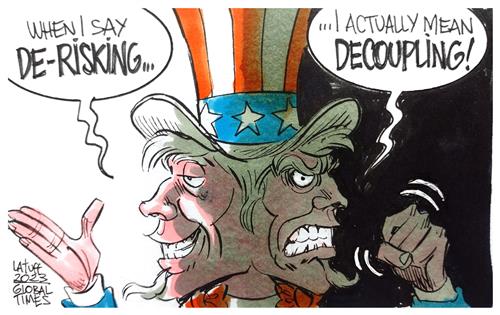
Recent economic and trade talks between China and the US have produced positive outcomes, reflecting a rational, pragmatic, and mutually respectful approach by both sides to addressing trade frictions. While uncertainties remain regarding future negotiations, the current progress is conducive to averting the risk of full economic "decoupling" between the world's two largest economies and preventing a potential hard landing for the global economy.
A critical factor behind the substantial progress is the US' deep reliance on Chinese imports, which are worth more than $400 billion annually. These products include not only critical mineral resources but also a wide range of essential intermediate goods vital to US industries and consumer markets. As such, any attempt to sever these supply chains would severely disrupt the normal functioning of the US economy, highlighting the fact that unilateral efforts to force a "decoupling" from China are not only unrealistic but will ultimately backfire on the US itself.
From a long-term perspective, a complete economic "decoupling" between China and the US remains highly improbable due to their deeply intertwined economic systems. However, trade frictions are likely to persist and may become a lasting feature of bilateral relations. The US government must recognize that tariff wars, while politically expedient, produce no winners. They fail to address the underlying causes of the US' trade deficit, such as domestic consumption patterns, insufficient manufacturing investment, and global supply chain dynamics.
In fact, the US' trade deficit in goods is both an inevitable outcome of structural issues in the US economy and a reflection of the two countries' comparative advantages and the international division of labor. It is also driven by factors such as the US' long-standing export controls on high-tech goods to China, and unilateral trade restrictions. Ignoring these root causes and relying solely on unilateral tariff measures is a strategic misstep.
In a global economy increasingly pulling back from globalization, some US policymakers increasingly favour "economic security" over "economic efficiency" in their decision-making. The current and the previous US administrations have also repeatedly used industrial interventions, such as massive semiconductor subsidies, aimed at reducing economic dependence on China in the name of "national security."
But this misguided approach risks undermining America's global credibility and leadership. Historical evidence demonstrates that the US' core strength lies in its open and inclusive economic system. Deviating from these principles will hinder the nation's long-term prosperity and will not "Make America Great Again."
Protectionist policies are also facing significant backlash. Tariffs aimed at boosting domestic sales, creating local jobs, reshoring companies, and reviving manufacturing represent a fundamentally anti-globalization strategy. These actions have reduced economic efficiency and heightened inflation, directly harming American consumers and industries. Meanwhile, while US tariffs may create short-term pressures for China, they would inadvertently spur China to accelerate its industrial upgrading and economic transformation, ultimately frustrating US' policy goals.
Facing US pressures, China has consistently remained calm and rational in its responses, employing resolute yet strategic countermeasures. These actions have clearly proved the ineffectiveness of US' maximum pressure tactics and compelled Washington to engage in equal-footed dialogue to resolve disputes.
Also, in sharp contrast to the US' protectionist turn, China has demonstrated remarkable strategic composure and a sense of global responsibility amid global challenges. China remains a steadfast advocate for economic globalization, recently rolling out a series of proactive opening-up measures, advancing regional economic and trade liberalization, and deepening cooperation with countries in the Global South. These efforts have made significant contributions to preserving a fair and stable international trade order.
Domestically, China is vigorously pursuing strategies to expand internal demand, a policy priority the Chinese government has reinforced in recent years. China's vast domestic market, ongoing urbanization, green and digital transformations, and the rapid growth of service consumption provide substantial room for expanding domestic demand, with the potential to reduce foreign trade dependence by 10-15 percentage points in the future.
In the long run, the Chinese economy still holds growth resilience and potential. The confidence derives not only from its enormous market scale but also from its comprehensive industrial system, ample policy flexibility, diverse tools, and strong execution capacity. At the same time, the country is making all-out efforts to expand vibrant trade links across the globe, particularly with developing nations, under frameworks such as the Belt and Road Initiative. As China continues to open up, its ability to withstand risks has significantly strengthened, supported by innovative measures in macroprudential policy. By prioritizing high-quality development, China steadfastly counters the global uncertainties with the certainty of its own progress.
Looking ahead, China will continue to play a constructive role in stabilizing global trade and promoting global economic development. Specifically, it will steadfastly safeguard the WTO-centered multilateral trading framework, advocate for reforms of the international monetary system, contribute to global growth and rebalancing through expanded domestic demand, support enterprises in diversifying trade, and steadily advance the internationalization of the yuan to play a greater role in the global financial safety net.
In today's volatile global landscape, healthy and stable China-US economic relations are vital for both countries, but also for the global economy. China will continue engaging in international cooperation with openness while injecting stability and certainty into the world economy through its high-quality development. For the US, reassessing its economic policies and abandoning zero-sum mentality represents the only path toward mutual benefit and win-win outcomes. Through dialogue and collaboration, both countries can tackle global challenges and foster a more balanced and prosperous global economy.
The article was based on an inclusive interview conducted at the 2025 Tsinghua PBCSF Global Finance Forum with Zhang Liqing, professor of Economics and director of Center for International Finance Studies and Former Dean of the School of Finance at Central University of Finance and Economics in Beijing. bizopinion@globaltimes.com.cn

Zhang Liqing Photo: Courtesy of Tsinghua PBSCF
RELATED ARTICLES