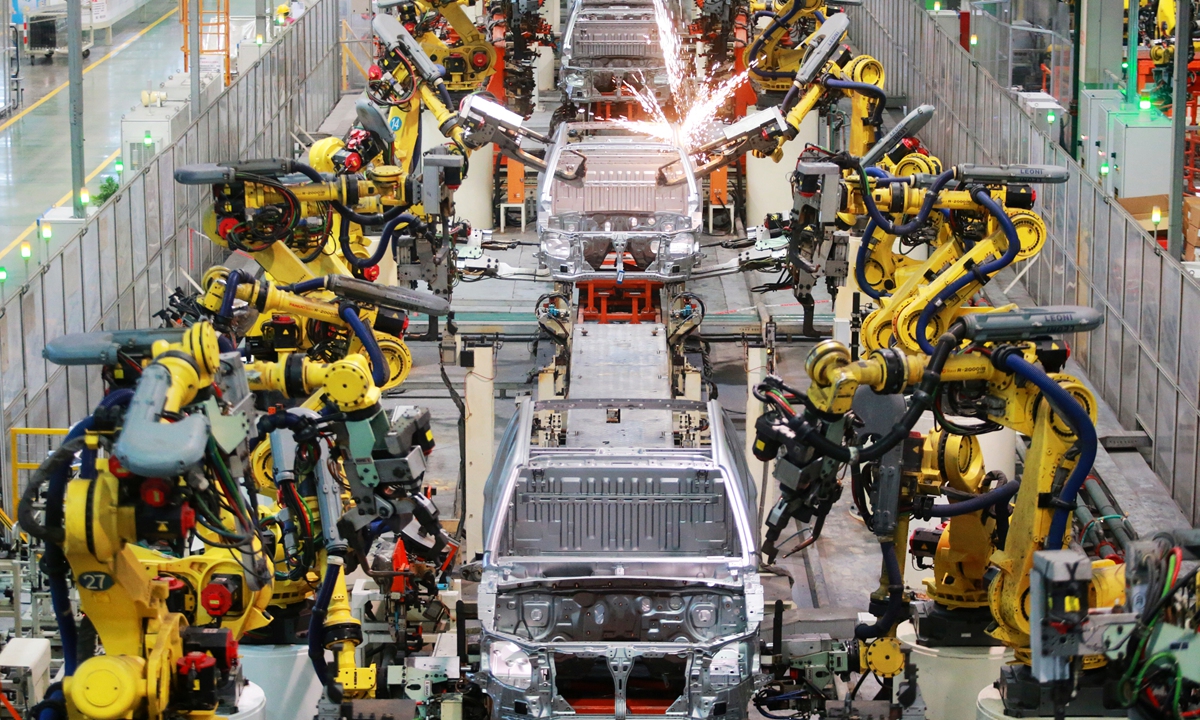
Intelligent welding robots perform precise and efficient welding operations at an automobile manufacturing enterprise in Jiangdu High-Tech Industrial Development Zone, Yangzhou, East China's Jiangsu Province on May 23, 2025. Photo: VCG
The Geneva talks in May and the first meeting of the China-US economic and trade consultation mechanism in June have produced meaningful progress helping not only ease current trade tensions but also stabilize global markets. These outcomes create a foundation for future dialogue.
The key to reaching these agreements lies in the recognition of economic losses caused by trade frictions initiated by the US. This reality has renewed realization of the value of cooperative, win win outcomes. As the world's two largest economies, China and the US benefit each other, and the global economy, by maintaining stable bilateral relations.
While uncertainties remain, recent negotiation outcomes offer hope for a de-escalation in China-US trade relations, including relatively lower trade costs, export recovery, and renewed investment confidence. In the medium to long term, the consultation mechanism established in Geneva is poised to provide a framework for ongoing communication and joint risk management. However, challenges such as geopolitical volatility, unpredictable US policies, and tech barriers targeting China still pose risks.
Given these dynamics, underscoring the necessity of China-US economic cooperation has become more crucial than ever. On one hand, stable trade relations help anchor global market expectations and facilitate trade and investment. On the other hand, the two economies are deeply interdependent, with strong complementarity and shared interests. There is vast potential for collaboration in areas such as services trade, two-way investment, climate change, public health, and energy transition, particularly in artificial intelligence (AI) and clean energy, where technological synergies could drive global progress and industrial upgrading.
Looking ahead, China US trade relations will be shaped by structural economic shifts, technological disparities, supply chain realignment, global demand fluctuations, and monetary policy changes. The Chinese economy continues to grow at a relatively fast pace, with ongoing industrial upgrades and improving innovation capabilities, while the US faces slowing growth but retains technological advantages. The two sides have complementary needs in trade, while also facing competition in high-tech sectors. Technology-driven changes will accelerate supply chain realignment and industrial restructuring, impacting bilateral trade dynamics. At the same time, the rise of emerging markets may divert trade flows and recalibrate global supply chains.
In this context, if the US persists in using tariffs as its primary "weapon" against China, it risks long-term failure as it will not curb China's development in the long term. Instead, such measures could spur China to diversify its markets, boost independent innovation, and hasten industrial upgrading. At the same time, high tariffs would also harm the US economy by raising business costs, negatively affecting consumers, fueling domestic inflation, and undermining international competitiveness. Unilateral tariff use breaches multilateral trade rules, disrupts supply chains, and may provoke international backlash, potentially isolating the US politically and economically.
By contrast, China has shown strategic resolve in the face of rising global trade protectionism. While firmly countering unfair tariffs, China upholds multilateralism, promotes free trade, and deepens international cooperation, while remaining committed to higher-level opening-up. Leveraging its vast domestic market, China has implemented proactive measures to boost consumption and investment, solidifying its economic foundation. Structural reform, and innovation-driven growth have further strengthened economic resilience, ensuring long-term economic stability.
Confidence in China's economy rests on decades of reform and opening up, during which it has actively integrated into global labor division and built robust industrial and supply chain networks. With sustained economic growth and an expanding consumer market, China continues to attract foreign investment and drive global economic growth.
By 2025, China has emerged as a linchpin of global trade stability. Buoyed by strong economic fundamentals and technological prowess, China will further integrate global supply chains, serving as a key engine of global economic growth and advocating for an open world economy. China also actively supports reforms in global governance, advocating a fairer and more equitable international economic order.
Looking to the second half of 2025, China's foreign trade and economy will maintain strong resilience, supported by a range of policy tools to navigate internal and external pressures and meet growth targets. Priorities include stabilizing trade, promoting investment, diversifying exports, and scaling up high tech manufacturing through targeted policies.
Domestic consumption is set to grow via stimulus measures aimed at upgrading demand, while innovation-driven growth and industrial optimization will be prioritized, particularly in AI and digital economy sectors. Financial reforms will ensure moderately loose monetary policies, maintain ample liquidity, and provide greater support for venture capital, bank credit, insurance, and capital markets.
These efforts position China for steady growth in the second half of the year. The resilience of foreign trade is set to improve, innovation-led expansion will become more prominent, and structural upgrades will continue to gain traction, fueling strong development momentum. As domestic demand continues to be unlocked, competitiveness in high-end manufacturing rises, and the digital economy gains pace, China's ability to withstand external shocks, such as US tariffs, and its endogenous growth drivers will be further reinforced.
By diversifying markets, enhancing self-reliance in supply chains, and expanding exports of high-value-added products, China will significantly bolster its role and influence across the global trade system, providing a more robust foundation for navigating the complex international environment.
On the global stage, guided by the principle of peaceful development, China actively engages in global governance and advocates for building a community with a shared future for mankind. This approach has gained broad recognition and support from the international community, further reinforcing the global foundation for China's strategic stability and development trajectory. At the same time, it contributes to building a more balanced, inclusive international order and offers practical alternatives for global cooperation amid rising geopolitical tensions.
The article is based on an exclusive interview with Tian Xuan, president of the National Institute of Financial Research at Tsinghua University. bizopinion@globaltimes.com.cn

Tian Xuan Photo: Courtesy of Tian Xuan
RELATED ARTICLES