China, ASEAN fully complete negotiations on CAFTA 3.0
Move sends a strong signal in support of free trade and open cooperation
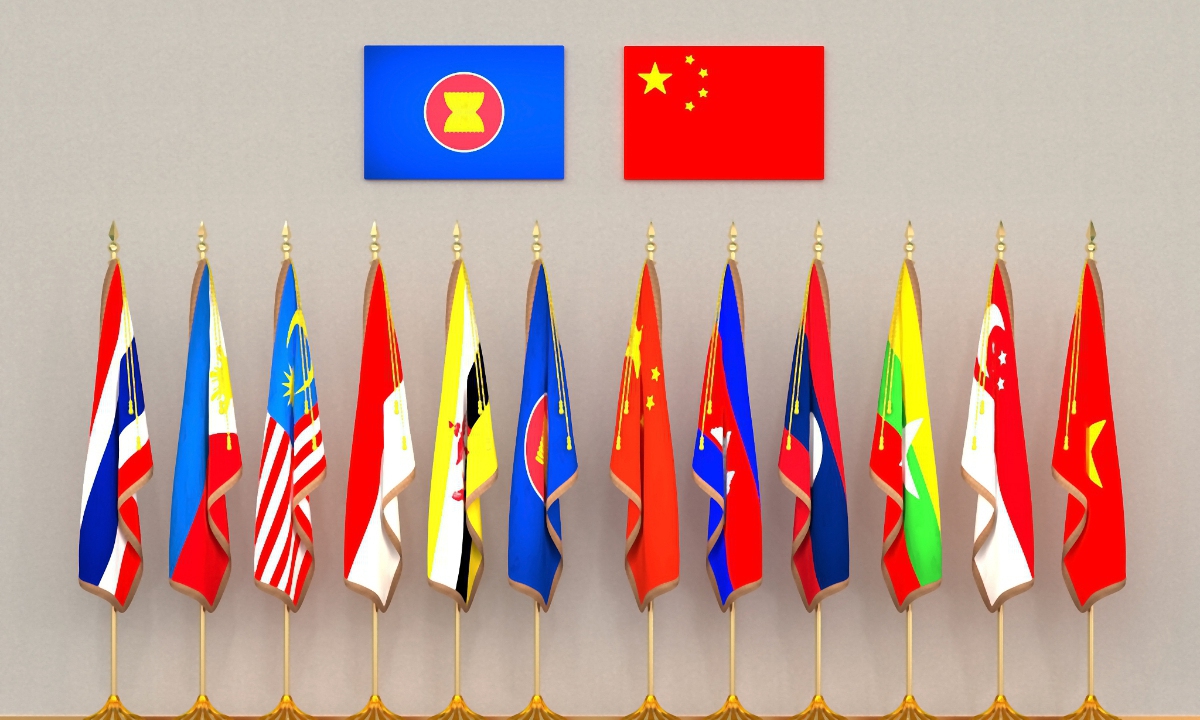
China ASEAN Photo:VCG
Chinese and ASEAN economic and trade ministers held a special meeting via video link on Tuesday, during which they announced the full conclusion of negotiations for version 3.0 of the China-ASEAN Free Trade Area (CAFTA), the Chinese Ministry of Commerce (MOFCOM) said in a statement on Wednesday.
Negotiations on the CAFTA 3.0 started in November 2022. After nine rounds of formal negotiations in nearly two years, the talks were substantively concluded in October 2024. Under the full coordination and joint efforts of economic and trade ministers from participating countries, negotiations have been fully completed, taking a crucial step toward the signing of the upgraded protocol, according to the MOFCOM statement.
The CAFTA 3.0 will send a strong message of upholding free trade and open cooperation. China and ASEAN are each other's largest trading partners and key investment partners, both being steadfast supporters of economic globalization and multilateralism. As a priority in bilateral economic and trade cooperation, the development of the CAFTA 3.0 represents a landmark achievement in jointly upholding and advancing free trade, the MOFCOM said.
Amid significant challenges facing the global economy and trade, the conclusion of the negotiations aligns with the global development trend, demonstrates the strong vitality of free trade and open cooperation, injects greater certainty into regional and global trade, and plays a driving and demonstrative role for countries to uphold openness, inclusiveness and mutually beneficial cooperation, the ministry said.
Closer regional cooperation
The CAFTA 3.0 will create an inclusive, modern, comprehensive, and mutually beneficial free trade agreement, MOFCOM said. It includes nine new chapters including digital economy, green economy and supply chain connectivity. These additions will enable both sides to advance broader and deeper regional economic integration under new circumstances, significantly promote the deep integration of industrial and supply chains, and hold pioneering significance.
Moreover, the upgraded deal will strongly advance the building of a China-ASEAN community with a shared future. Through the CAFTA 3.0, the two major developing economies will expand mutual opening-up and comprehensively expand cooperation in emerging fields and new quality productive forces. This will provide critical institutional guarantees for building a China-ASEAN mega market and deliver sustained momentum for advancing the China-ASEAN community with a shared future and will foster enduring common prosperity and development, the MOFCOM said.
In the next step, the two sides will actively advance their respective domestic signing and ratification procedures to formally sign the upgraded protocol of the CAFTA 3.0, according to the MOFCOM.
"The conclusion of the negotiations will further strengthen the institutional arrangements for economic and trade cooperation between China and ASEAN, and consolidate the foundation for promoting cooperation through rules. This is not only an objective requirement in the process of cooperation development, but is also a guide and guarantee for cooperation to move forward steadily," Ma Jianchun, chairman of the China Society for World Trade Organization Studies, told the Global Times on Wednesday.
Huo Jianguo, a vice chairman of the China Society for World Trade Organization Studies in Beijing, said that a highlight of the CAFTA 3.0 is the inclusion for the first time of three emerging areas, the digital economy, the green economy and supply chain connectivity, all areas with great potential for cooperation between the two sides.
Huo added that the two sides have established standard technical regulations and compliance assessment procedures in their respective foreign free trade practices, requiring China and ASEAN to mutually reference and align standards within their respective management systems to promote institutional integration. This not only elevates the institutionalization of cooperation but also aligns with China's current advocacy for institutional opening-up, Huo said.
"The CAFTA 3.0 also lays the foundation for China and ASEAN to build a higher level of economic cooperation at the legal system level, and also accumulates experience for the Chinese side to promote docking with other international standards such as the CPTPP," Huo told the Global Times.
At the same time, cooperation with ASEAN countries is also hedging the negative impact of the tariff uncertainty on international trade with the certainty of cooperation between us, Ma said.
Marshall Mills, the IMF's senior resident representative in China, said during an interview with the Global Times that the likely headwinds from heightened trade tensions and tariffs make it even more important for Asian countries to foster more balanced growth and resilience, and regional integration could help insulate economies from global shocks.
Moreover, strengthening cooperation between China and ASEAN members is an important part of the process of promoting the building a community with a shared future with neighboring countries and striving to open new ground for China's neighborhood work, Ma noted.
Promoting multilateralism
During the special meeting, China's Minister of Commerce Wang Wentao said that recently, certain economies have recklessly imposed so-called "reciprocal tariffs" and practiced economic bullying, severely undermining the international trade system and creating significant uncertainties for the global economy.
Such practices run counter to economic laws and violate market principles. China firmly rejects and resolutely opposes these actions. China consistently maintains that trade wars and tariff wars have no winners, unilateralism and protectionism lead nowhere, and extreme pressure and threats are not the right approach to engage with other countries, Wang said.
Wang said that China is willing to work with ASEAN to maintain the stability and smooth flow of the global industrial chain and supply chain, in order to make greater contributions to promoting the development and revitalization of both sides and safeguarding international justice, the MOFCOM said.
The ASEAN economic and trade ministers said that unilateralist measures had impacted the global economy, lowered the confidence of global enterprises, and dealt a severe blow to developing countries, especially the least developed countries. Collective action to safeguard the multilateral trading system and free trade should be supported, and the mechanism of the WTO should be used to engage constructively and seek cooperative solutions to address global trade concerns, according to the MOFCOM.
ASEAN secretary-general Kao Kim Hourn said that global trade is currently at a critical crossroads, and it is imperative to promote open, fair, and rules-based global trade to address the rising tide of protectionism. All parties must collaborate with foresight, firmly support openness and inclusiveness, continuously advance regional economic integration, and deepen the ASEAN-China partnership to achieve high-quality common development. This includes cooperation in smart manufacturing, strengthened connectivity, and green transformation, ensuring mutual benefits for all nations.
Ma said that China-ASEAN cooperation sends a clear and important signal to the world that multilateralism and free trade are always the key to global development.
RELATED ARTICLES