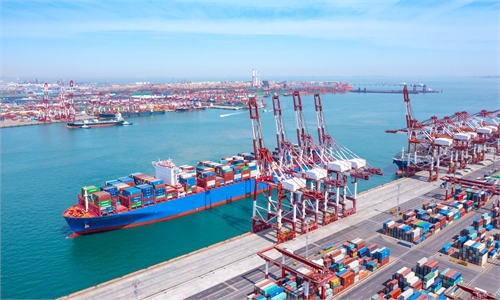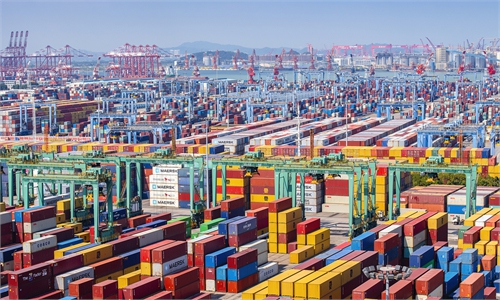
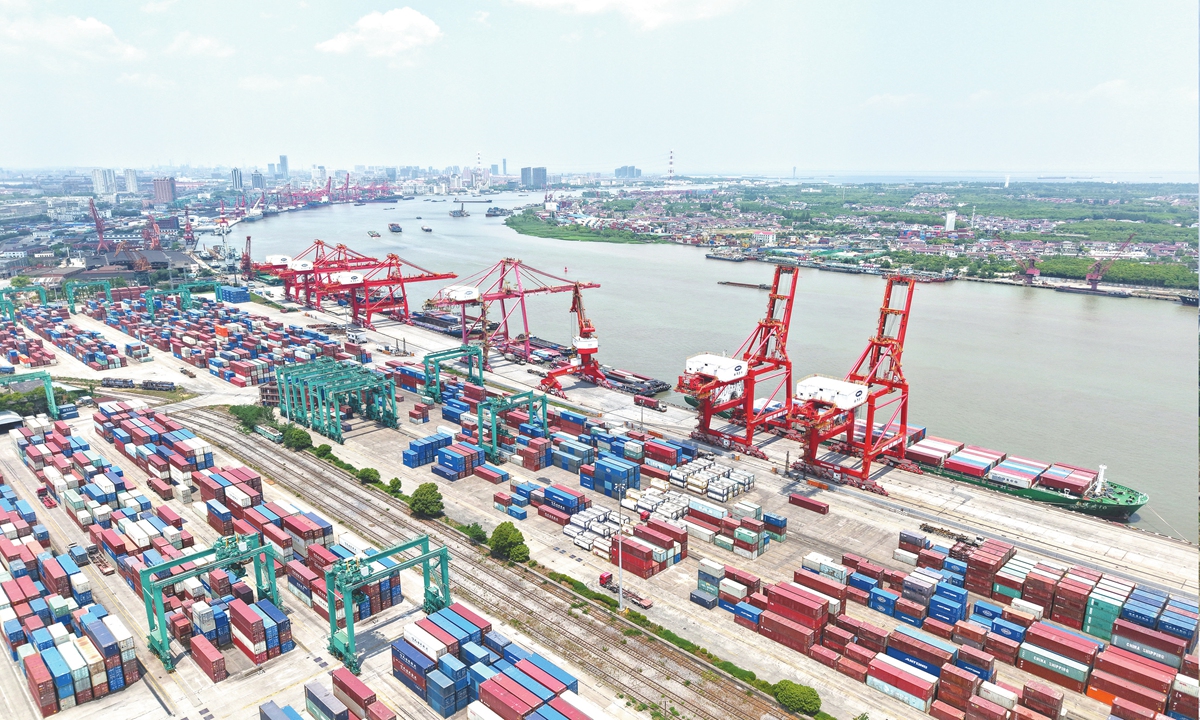
A view of the Shanghai Port on May 14, 2025 Photo: VCG
Following the two-day economic and trade meeting in Geneva, China and the US announced a landmark joint statement on May 12 to roll back the bulk of tariffs on each other's goods and pause some tariffs for 90 days, and establish a forward-looking mechanism for continued economic dialogue. The 90-day trade détente is widely seen as positive for global businesses and markets.
An immediate result of the tariff pause was a wave of restocking surge across the Pacific. Import orders from the US quickly rebounded, and shipping routes to the US have started to see a sharp increase in demand, according to media reports.
Just days into the 90-day period, the market has already responded with unusually strong activity - a telling sign of the mutually beneficial nature of China-US economic and trade ties. And the stability of the trade relationship between the world's two largest economies not only supports growth on both sides, but also helps ease pressure and restore confidence in the global economy that has been plagued by trade uncertainties.
While the tariff suspension has brought relief to the business communities in both countries and the world at large, it is time to reflect on the negative impacts that the US tariffs have had on both economies. Trade war produces no winners, and the market's positive response to the China-US trade agreement is evidence of how tariffs have been holding back normal trade. The US' arbitrary and unilateral tariff increases have, in effect, distorted the natural workings of the market.
Since the establishment of diplomatic ties, economic and trade cooperation between China and the US has developed and deepened to benefit both countries, forming a pattern of mutual interdependence. The high degree of complementarity between the two countries' economic structures is a natural outcome of international division of labor and comparative advantages under globalization.
In 2024, the bilateral goods trade volume between China and the US reached $688.28 billion, with services trade also seeing significant growth, reaching $66.86 billion. US goods exports to China amounted to $143.55 billion, representing a 648.4 percent increase since 2001 - far outpacing the growth of US exports to the rest of the world during the same period. The US is China's top export destination and second-largest import source by country, while China ranks as the US' third-largest export destination and second-largest import supplier, according to a white paper on China-US economic and trade issues released by China in April.
It is important to point out that China-US economic and trade relations are not just about surpluses and deficits in goods trade.
US official data showed that in 2023, the US registered a surplus of $26.57 billion in service trade - a notable advantage for the US. Furthermore, in 2022, the sales revenue of the US-owned enterprises in China reached $490.52 billion, significantly exceeding the $78.64 billion in sales revenue generated by Chinese-owned enterprises in the US. The gap of $411.88 billion underscores the more pronounced advantage of American enterprises in multinational operations, according to the white paper.
Cooperation between the two countries has created a significant number of jobs in the US, generated abundant business opportunities and profits for companies on both sides, promoted industrial upgrading in the US, and brought tangible benefits to American consumers.
Together, the two countries account for over one-third of the world's economic output and nearly one-quarter of its population, with bilateral trade making up about one-fifth of global trade. The economic and trade relationship between China and the US is not only vital to both nations but also plays a crucial role in global economic stability and development.
The recent agreement reached by China and the US is undoubtedly a positive development for global trade, yet Chinese exporters remain cautious about uncertainty of US tariff policy. In response, many Chinese exporters have begun making strategic adjustments.
In particular, companies that rely heavily on the US market are exploring two key pathways: diversifying into broader international markets, and expanding their presence in the domestic market under China's "dual circulation" development initiatives. Local governments have also moved quickly to introduce policies that support exporters in expanding into the domestic market.
The world is undergoing profound changes unseen in a century, and the trajectory of China-US relations bears heavily on the shared future of humanity. There is a broad international consensus hoping to see the relationship stabilize and improve. With extensive common interests and vast potential for cooperation, China and the US should work together to expand areas of collaboration and deliver greater certainty and stability to the global economy.
The author is a senior research fellow at the China Association of International Trade. bizopinion@globaltimes.com.cn
RELATED ARTICLES