China’s automobile exports rise to 575,000 units in July, up 22.6% year-on-year
Chinese vehicles retain competitive edge in global market: expert
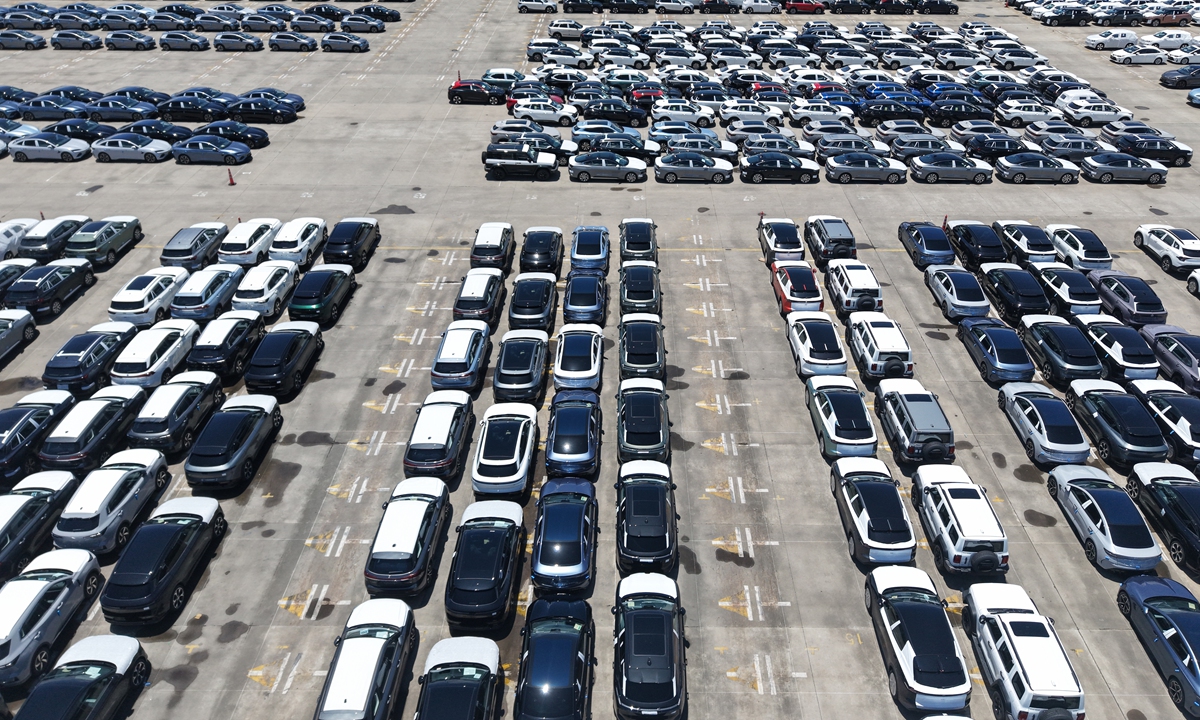
A large number of new-energy vehicles waiting to be exported are parked at Shanghai Port on August 11, 2025. Photo: VCG
China's automobile exports hit 575,000 units in July, with new-energy vehicles (NEVs) driving the growth, data from the China Association of Automobile Manufacturers (CAAM) showed on Monday.
Total shipments in the first seven months stood at 3.68 million units, up 12.8 percent year-on-year. NEVs remained the main growth engine, with exports exceeding 225,000 units in July, up 10 percent from June and more than doubling year-on-year, according to the CAAM.
Domestic NEV output and sales stood at about 1.24 million and 1.26 million units in July, up 26.3 percent and 27.4 percent year-on-year, respectively, accounting for 48.7 percent of all new car sales. From January to July, China produced more than 8.23 million NEVs and sold 8.22 million, up 39.2 percent and 38.5 percent, respectively, making up 45 percent of the country's total new car sales.
The robust NEV sales came against a broader backdrop of steady market expansion. In July, total vehicle output and sales both exceeded 2.59 million unites, rising 13.3 percent and 14.7 percent year-on-year, respectively, despite a month-on-month slowdown. In the first seven months, production and sales grew 12.7 percent and 12 percent, respectively, the CAAM data showed.
The CAAM attributed July's strong passenger car sales to the continued impact of the vehicle trade-in program, progress in the industry-wide campaign to address "involution," and the steady rollout of new models, all of which supported stable market performance and year-on-year growth.
The trade-in program, launched in 2024 with 150 billion yuan ($20.6 billion) in ultra-long-term special treasury bonds, supports the replacement of cars, home appliances, home renovations, and electric bicycles, according to the National Development and Reform Commission (NDRC).
The 2025 budget was doubled to 300 billion yuan, expanding to include scrappage of vehicles meeting China IV emission standards, as well as purchases of new digital products such as smartphones, the NDRC noted.
In 2024, the trade-in program generated more than 1.3 trillion yuan in sales across the five key product categories, according to the report. In 2025, the policy has continued to deliver results, with combined sales of automobiles, home appliances, smartphones, home renovation, and electric bicycles surpassing 1.6 trillion yuan as of the end of June, exceeding the full-year figure in 2024, official data showed.
In an earlier report, the China Passenger Car Association (CPCA) commented that, amid mounting external pressures and overlapping domestic challenges, strong counter-cyclical measures have supported both the economy and the vehicle market.
The association noted that makers of passenger NEVs posted solid overall performances in July, with BYD consolidating its lead among domestic brands through a dual focus on battery-electric and plug-in hybrid models.
As Chinese automakers advance a "multi-track" strategy in the NEV sector, the market base has continued to expand, with 19 manufacturers posting monthly wholesale NEV sales of more than 10,000 units in July — two more companies than a year earlier and one more than in June, the CPCA said.
Cui Dongshu, secretary-general of the CPCA, told the Global Times on Monday that the resilience of China's NEV market is underpinned by generous trade-in and scrappage subsidies, which have stimulated strong replacement demand and accelerated the renewal of China's large vehicle stock.
"Stronger model competitiveness and declining prices have improved market acceptance, while 'price parity between gasoline and electric cars' - and in many cases, cheaper EVs - has sped up the shift from fuel-powered to electric vehicles," Cui said.
He added that China's NEV sector benefits from a durable industrial chain advantage in an increasingly competitive global market, even as policies and markets in Europe and the US remain unstable.
"We expect the share of NEVs in the domestic market to stay above half in the coming years, becoming a long-term trend, given their superior driving experience and intelligent features compared with gasoline cars," Cui said.
RELATED ARTICLES