From high-tech factory to scenic spot
Industrial tourism opens up new space for cross-industry integration: expert
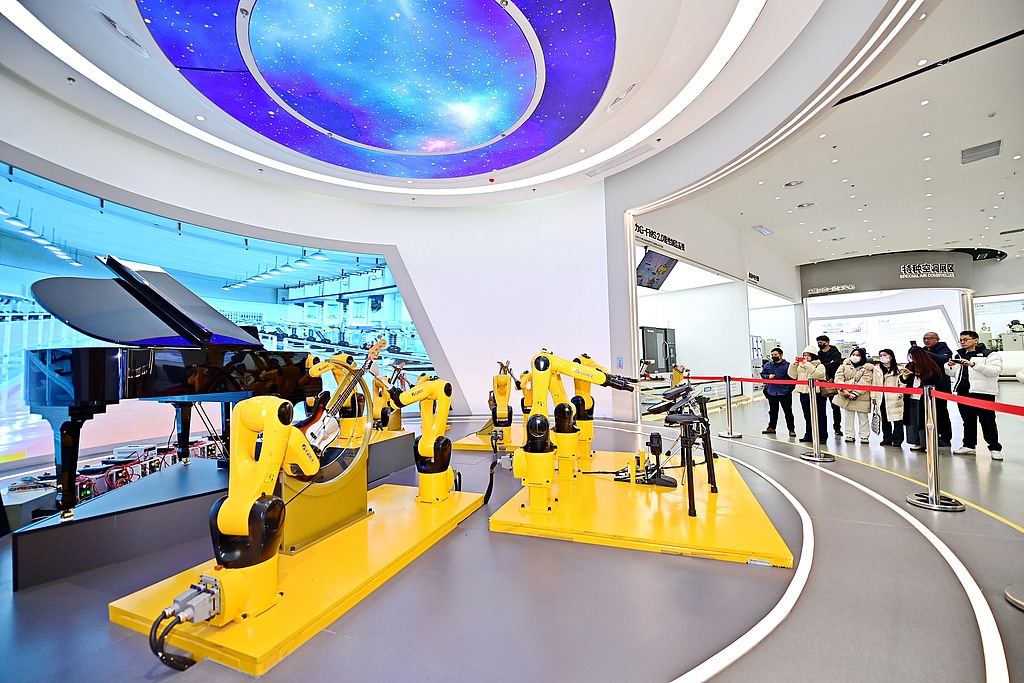
Visitors watch a live performance by an industrial robot band at the industrial tourism exhibition hall of a home appliance company in Ganzhou, East China's Jiangxi Province, on February 21, 2025. Photo: VCG
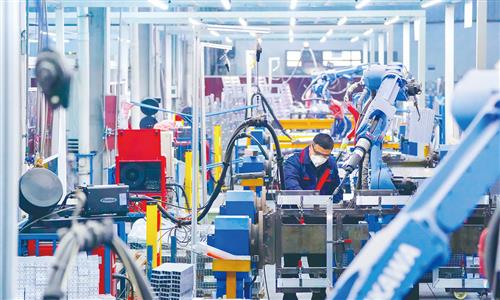
Stepping into the seamless steel tube plant of BAOTOU & STEEL (GROUP) CO, visitors are greeted by a hundred-meter-long automated production line performing a stunning symphony of modern industry. Red-hot steel billets, at 1,100 C transform into gleaming seamless steel tubes amid the roar of rolling mills, presenting a manufacturing marvel in motion.
As the world's largest seamless steel tube production base, the facility produces 2 million tons of steel tubes annually, with products used in iconic landmarks such as the Bird's Nest stadium and Beijing Daxing International Airport. A student from the High School Affiliated to Renmin University of China wrote in his study tour notes: "The concept of 'the pillars of a great power' from textbooks became tangible amidst the heat waves of the steel tube production line."
According to a statement sent to the Global Times, the company said that in the first seven months of this year, the site welcomed 19,000 visitors, and 80 percent of them primary and secondary school students from across the country.
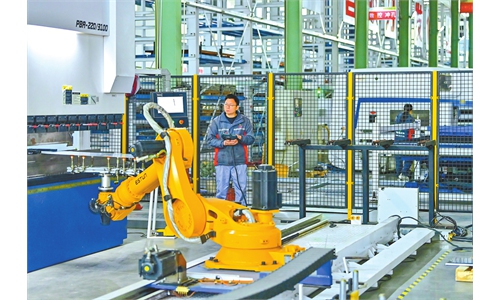
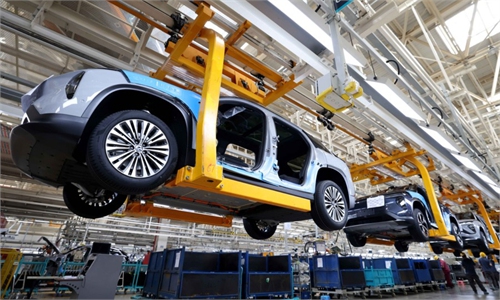
Once filled with the roar of machines and off-limits to outsiders, factory workshops are now becoming popular destinations for tourists. From cutting-edge modern assembly lines brimming with technological flair to educational study tour classrooms, industrial tourism is emerging as a trendy new travel option, showcasing a fresh landscape of cross-industry integration.
Booming tech tours
At the AG600 final-assembly plant in Zhuhai, host city of China's premier airshow, a steady stream of visitors was filing through the country's only large special-mission aircraft production line that is open to the public, witnessing the vigorous growth of China's aviation industry and the shift from "Made in China" to "high-tech manufacturing in China."
China's domestically developed AG600 "Kunlong" amphibious aircraft, a milestone that equips China with the technological and industrial capacity to independently develop large amphibious aircraft, can swiftly shuttle between water sources and fire sites, making it a powerful tool for forest firefighting.
According to a statement by Aviation Industry Corporation of China General Huanan Aircraft Industry Co sent to the Global Times, the final-assembly line integrates the functions of visiting and learning about the large aircraft assembly process, aviation science education, aviation culture dissemination, and patriotic education, comprehensively showcasing the development of China's independently developed large amphibious aircraft.
The line attracts roughly 40,000 visitors a year, with open-day slots almost booked out to a crowd dominated by the young, Xinhua News Agency reported.
The Xiaomi car factory in the Beijing Economic-Technological Development Area, spanning 718,000 square meters, is also open to the public for technology exhibits and production-line observation, a Xiaomi employee surnamed Wang told the Global Times.
As of Tuesday, a total of 70,318 people had applied to tour the factory, according to the company's official registration website.
Similarly, at LONGi Green Energy Technology Co.'s research base in Xi'an, Shaanxi Province, the world-leading solar company has launched an immersive, future-technology-themed study tour that is gaining popularity.
The company told the Global Times that tourists can visit a "zero-carbon house," to experience technologies such as solar power generation, natural lighting, and intelligent energy management, feeling the important role of green technology in promoting a better life.
"Industrial tourism is a typical example of the integration of the secondary and tertiary industries. As a new form of tourism, it can fully leverage manufacturers' existing industrial resources, turn production scenes into tourism products, and open new growth points," Wang Peng, an associate research fellow at the Beijing Academy of Social Sciences, told the Global Times on Tuesday.
Meanwhile, visitors gain a more intuitive and in-depth understanding of industrial production. While enriching their knowledge, they also experience firsthand the tremendous strength of China's industrial development, and the entrepreneurial spirit of the builders, who fear no hardship and strive tenaciously, is also promoted, Wang noted.
Enormous potential
More Chinese cities are making industrial tourism a new engine for growth. In February, Beijing vowed to create five national industrial-tourism demonstration bases by 2027 and become a leading destination by 2029, according to Xinhua.
The city's tourism blueprint includes opening high-level autonomous driving scenarios, rocket institutes, low-altitude economy, and green energy routes, while inviting research institutes to grant public access to select labs and assembly halls.
Local governments are also looking to outfit industrial tourism itself with next-gen stagecraft: Shanghai is set to weave large language models, the metaverse and blockchain into richer cultural narratives, while Hunan Province in Central China will deploy AR, VR, AI, 5G, 3D cinema, and holography to build fully immersive worlds, Xinhua reported.
Data from ChinaIRN.com shows that industrial tourism accounts for about 10-15 percent of global tourism revenue, while China's current share is under 5 percent, indicating enormous room for growth.
On social media platforms, many residents now treat factory tours as a new weekend pastime, sharing the factory environment, lunch breaks, and souvenirs. According to Xiaohongshu, over the past year, searches for the keyword "factory" under the topic of travel have more than doubled year-on-year.
"Industrial tourism, combined with study tours, not only expands new tourism scenarios and experiences, but also offers manufacturers a path to create cultural IP and engage in in-depth dialogue with users, opening up a new space full of imagination for industrial transformation and upgrading and the integration of culture and tourism," Wang noted.
Moreover, as study tours become popular during the ongoing summer vacation, the new business model also meets the diverse and personalized demand of consumers, which will inject fresh vitality into domestic consumption, Wang said.
RELATED ARTICLES