ARTS / CULTURE & LEISURE
‘No official response’ from Japan for return of Nanjing stones
Request helps reveal truth: director of museum
By Published: Aug 12, 2025 10:47 PM

Nanjing City Wall Photo: VCG
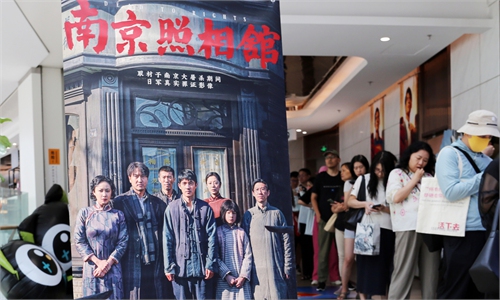
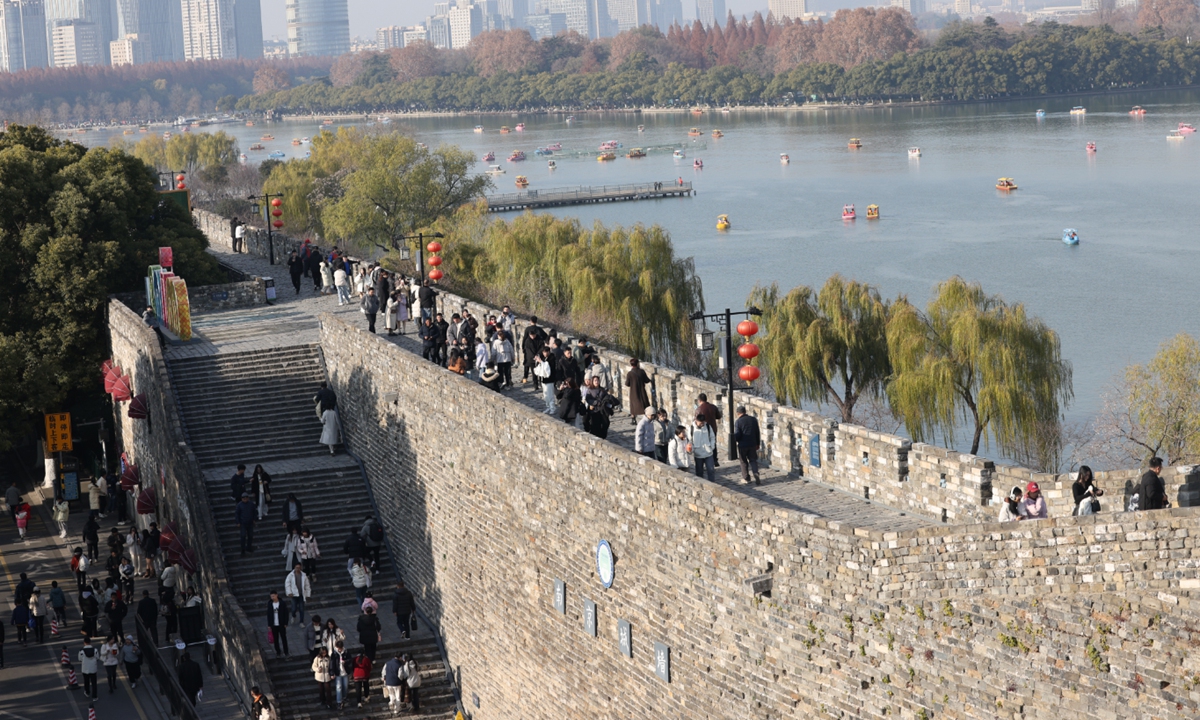
The Chinese war film Dead to Rights is currently enjoying box-office success, having grossed over 2.3 billion yuan ($320 million). Amid the film's acclaim, audiences have focused on a particular detail: the Japanese army's theft of bricks from Nanjing's Ming Dynasty (1368-1644) City Wall, intending to transport them to Japan for the construction of the "Hakkō Ichiu" Tower. In a pivotal scene, a Chinese defender, undaunted by death, uses one of these stolen bricks to fight back - an act that has resonated strongly with viewers. This scene in the film is, in fact, based on true historical event and has once again drawn public attention to that period of history.Completed in 1940, the "Hakkō Ichiu" Tower still stands in the Miyazaki prefecture, Japan. With a height of around 36 meters, its base incorporates more than 370 stones forcibly taken from buildings across various countries, including 238 from China, among which four are from Nanjing itself, according to the China News Service.
Wu Xianbin, director of the Nanjing folk Anti-Japanese War museum, has led delegations to Japan to demand the return of Nanjing's stones from the "Hakkō Ichiu" Tower, delivering open letters to Miyazaki authorities since 2015. He told the Global Times on Monday that there has yet to be any official response from Japan. During his most recent visit to Miyazaki in 2024, he was only able to bring back replicas of the stones.
Wu stated that after World War II, Japan was required to dismantle the tower. However, to evade responsibility for the war, authorities in Miyazaki removed the large characters for "Hakkō Ichiu," a war slogan roughly meaning "All the world under one roof," from the front of the tower in an attempt to erase its association with war. As a result, the tower was preserved and was later even rebranded as the "Tower of Peace."
To uncover the historical truth, Wu traveled to Miyazaki prefecture in October 2015 to investigate the Nanjing stones plundered during the Japanese invasion of China. He found that the most famous piece, the Qilin Stone, was placed on the base in front of the tower's facade. Although the head of a qilin, an auspicious creature in Chinese mythology, that was carved on the stone was damaged, a line of small characters on its left side clearly bore the inscription "Nanjing."
Although the Japanese authorities evaded the issue and refused to return the stones at that time, the historical truth regarding the tower was included in examinations of some Japanese middle schools in 2018, according to Wu.
Wu emphasized that the outcome is less important than the process.
"Through the act of demanding the return of the stones, we have helped more people understand the crimes symbolized by the tower. Its supposed representation of 'peace' today is nothing but a fraud," he said.
Besides demanding the stones' return, for over a decade, Wu has traveled between China and Japan one or two times every year. Sometimes he goes to collect physical evidence of the Japanese invasion of China, and sometimes he takes historical materials and pictures from his museum to Japan.
Wu also donated a set of books on the Nanjing Massacre to Ritsumeikan University in Japan on July 26. He noted that through books, Japanese people can better study the history of the Nanjing Massacre, better defend historical truth, and maintain world peace.
With the wide release and popularity of Dead to Rights, public attention has once again turned to the "Hakkō Ichiu" Tower.
Wu expressed high praise for the film, stating, "This film has made great progress in artistic form and has a unique way of storytelling. It is one of the best World War II films I have seen in recent years." Wu also noted that it is the duty of museums - and indeed of every Chinese - to remember the history of the War of Resistance against Japanese Aggression (1931-45) and to speak the truth about the past.
RELATED ARTICLES