China-made Christmas goods in peak shipment season
From Yiwu to Chenghai, exporters run at full tilt to meet festive demand from diverse markets
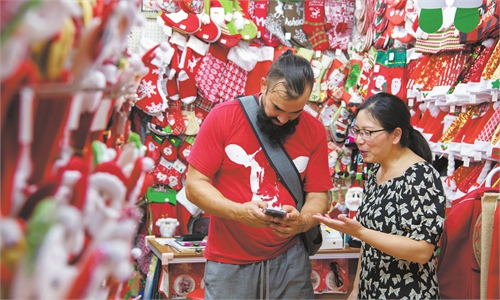
A foreign buyer selects Christmas decorations at the Yiwu International Trade Market in Yiwu, East China's Zhejiang Province on May 13, 2025. Many foreign merchants have flocked to the "world's capital of small commodities" to place orders, indicating strong overseas demand for Chinese goods. Photo: VCG
With a surge of overseas orders placed in the spring, local factories in Yiwu in East China's Zhejiang Province and Chenghai in Shantou, South China's Guangdong Province, are running at full capacity from June through late August — the year's peak shipping season — to prepare for the upcoming Christmas season, merchants from the two major Christmas product manufacturing hubs told the Global Times on Tuesday.
"We are now rushing to fill orders. Our main markets are in Europe, the Middle East, Africa, South America, Central Asia and Russia, and the Belt and Road Initiative has helped attract more buyers from participating countries. This year's customer orders are roughly on par with last year, with strong growth driven by new buyers from Colombia and Mexico," Jiang Jiangping, vice president of the Yiwu Arts and Crafts Chamber of Commerce and a Christmas decoration merchant at the Yiwu International Trade Market, told the Global Times on Tuesday.
Jiang said that 85 to 90 percent of the world's Christmas products come from China, most of them from Yiwu. As Yiwu's Christmas products gain global recognition, more buyers are coming to place orders.
"Manufacturers produce strictly according to purchase orders, and late orders are moved to the back of the queue with delivery dates no longer set by the buyers, so most place orders early," he said. "Also this year, due to geopolitical factors, shipping to Europe used to take one month but it now takes three, prompting customers to place orders earlier," Jiang noted.
"This year's shipping peak runs from June to late August, with most European orders already dispatched and current shipments heading to the Middle East, South America and Africa. By September, most products reaching overseas clients are from major orders, which are typically resold several times before reaching consumers, making early booking the norm," he added.
Gong Sihan, CEO of Bosen Christmas Factory, told the Global Times on Tuesday that her current orders have already matched the total volume for all of last year, with sales to Europe and Africa both increasing. "Our business is highly seasonal, and the factory is now operating at full tilt, with production scheduled through late September," she said.
"In Yiwu, we have a complete supply chain for Christmas products. Apart from Christmas trees, almost all other types of festive goods are available here. Many buyers prefer to place combined orders for different products in one go, which is both convenient and cost-effective," she added.
According to Yiwu Customs data, Yiwu exported 1.78 billion yuan ($244 million) worth of Christmas products in the first half of this year, up 54.2 percent year-on-year, with June exports reaching 890 million yuan, accounting for half of the half-year total,the city's local news outlet reported.
In Shantou's Chenghai district, another major hub for Christmas product manufacturing, Guo Bo, general manager of Yiyu Craftwork Co, said that the US market remains an important focus, with about one-third of the Christmas goods sold in the US coming from Chenghai. "When tariffs surged above 50 percent, exports came under real pressure, but US importers and retailers found it hard to forgo the value of Chinese-made goods. Once the 90-day tariff pause took effect, orders rebounded sharply," he said.
"They're worried tariffs will rise again after the window closes, so they're rushing to stock up," Guo noted. "What used to be a three-month lead time has been cut to two, and everyone is scrambling to deliver. This year, our US orders have grown by around 10 to 15 percent compared with last year, and production is running on double shifts to meet the tight schedules."
Guo added that while the US is still his company's biggest market, more attention is now being paid to Europe and emerging Belt and Road markets such as Saudi Arabia, Central Asia, and Southeast Asia. "You can't put all your eggs in one basket. Many of these markets also celebrate Christmas or have similar festivals, and we're working closely with clients to adapt products to their local needs," he said.
China and the US on Tuesday released a joint statement on the bilateral economic and trade meeting in Stockholm, according to the Xinhua News Agency.
The US will continue to modify the application of the additional ad valorem rate of duty on articles of China (including articles of the Hong Kong Special Administrative Region and the Macao Special Administrative Region), by suspending 24 percentage points of that rate for an additional period of 90 days, starting on August 12, the joint statement said, according to Xinhua.
The tariff truce between Beijing and Washington had been due to expire on Tuesday at 12:01 am (local time). The extension until early November buys crucial time for the seasonal autumn surge of imports for the Christmas season, including electronics, apparel and toys, at lower tariff rates, Reuters reported.
RELATED ARTICLES