The Philippines has completely misjudged itself and the surrounding situation: Global Times editorial
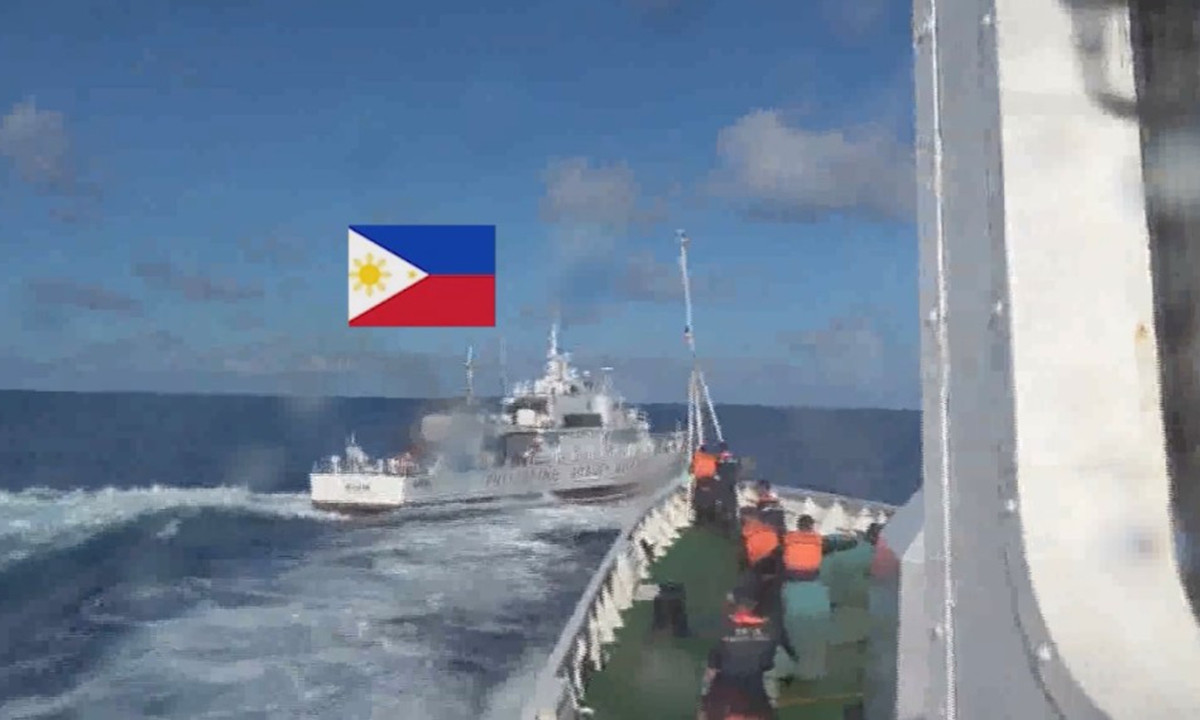
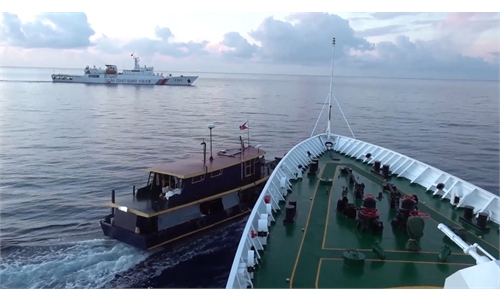
Ignoring repeated dissuasion and warnings from the Chinese side, the Philippines organizes multiple types of vessels to insist on intruding into waters near China's Huangyan Dao under the pretext of delivering supplies to fishing boats on August 11, 2025. During the incident, the Philippine Coast Guard ship 4406 makes multiple high-speed crossing maneuvers in front of the bow of the CCG ship 3104. Photo: Source
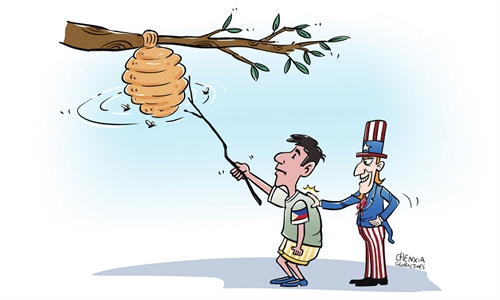
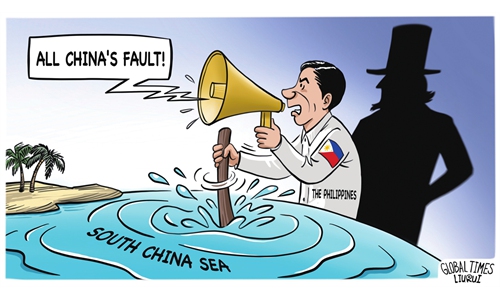
Since the incident on Monday, in which Philippine vessels illegally intruded into the waters near China's Huangyan Dao, Manila has continued to distort the facts both at home and abroad over the past few days, reversing right and wrong and smearing China for taking the so-called "dangerous maneuvers" against Philippine vessels. On Wednesday, the US destroyer Higgins illegally intruded into the territorial waters of China's Huangyan Dao - something that is hard to believe was merely a coincidence. At the same time, the Philippines and the US have played a diplomatic double act: Manila slanders China for "dangerous maneuvers and unlawful interference," while the US ambassador to the Philippines immediately follows up with condemnations of China and Western media chime in on the sidelines.The territorial scope of the Philippines has long been determined by a series of international treaties, and China's Nanhai Zhudao lies outside Philippine territory. China has indisputable sovereignty over these islands, and there is no territorial dispute between China and the Philippines in the South China Sea. From the US colonial period through Philippine independence and up until 1997, the Philippine government never raised any objection to China's sovereign activities at Huangyan Dao. Manila's so-called "sovereignty" claim over this island is fundamentally a farce created out of nothing. Philippine vessels should not be there in the first place. By repeatedly provoking and harassing the Chinese vessels at sea and colluding with external forces to stir up trouble in the South China Sea, the Philippine side is seriously undermining regional stability and the very foundations of the international legal order.
In recent years, the Philippines has been continuously making provocations. In February 2023, the Philippines and the US signed the Enhanced Defense Cooperation Agreement and granted the US access to four additional military bases. Following that, the Philippines began to frequently create friction incidents in the South China Sea. In the same month, the Philippines repeatedly hyped allegations that the China Coast Guard had aimed lasers at Philippine vessels, signaling the first signs of its provocations against China. In April, the Philippines escalated its actions by dispatching a coast guard vessel to dangerously approach a Chinese Navy Type 054A frigate in the waters near Zhongye Dao. In August, the Philippines further challenged China's bottom line by insisting on sending coast guard and supply ships to illegally intrude into the waters of Ren'ai Jiao despite Chinese warnings, eventually prompting China to respond with water cannons. Afterward, the Philippines launched a series of full-scale provocations against China in multiple areas, including Ren'ai Jiao, Huangyan Dao, Xianbin Jiao, and Tiexian Jiao - either intruding into these waters or colliding with Chinese vessels - plunging the South China Sea into instability.
All of this clearly shows that the responsibility for China-Philippines maritime friction lies entirely with the Philippine side. Take the August 11 incident as an example: it was the Philippines that first attempted to violate China's territorial sovereignty, and only afterward did the China Coast Guard take measures to drive them away. This fact is crystal clear. If there is any danger in those waters, the Philippines is the unequivocal creator of that danger.
What is even more concerning is that the Philippine provocations are by no means isolated events - they follow a systematic and coordinated script. Since 2023, the Philippines has carried out more than 20 such infringement operations on average each month. In just the first five months of 2025, it staged more than 10 scripted provocations in areas such as Xianbin Jiao and Tiexian Jiao. These provocations have repeatedly escalated tensions in the South China Sea, keeping the region ranked among the top in international security risk assessments.
Now, Manila's script of "infringement-hype-playing the victim" has become a routine: First, it sends ships to forcibly intrude into the waters; then, it uses Western media to amplify the "China threat," and finally, it poses as the "victim" to garner sympathy. On the other hand, the Philippines disguises its own intrusive actions as the struggles of fishermen for a living, deliberately creating the illusion that China is bullying Filipino fishermen and attempting to stir up nationalist sentiments domestically. Manila frequently uses the term "dangerous maneuvers," which should rightly be reserved for itself.
The South China Sea "is not an issue." The civilization of the South China Sea has historically embodied the core concepts of peace, harmony, cooperation, and win-win outcomes. For a long time, China and ASEAN countries have insisted on resolving disputes through dialogue and consultation among the directly involved parties, working together to maintain peace and stability in the South China Sea and effectively safeguarding the overall stability of the situation. Recently, at the 15th East Asia Summit Foreign Ministers' Meeting held in Kuala Lumpur, the so-called security issue in the South China Sea not only did not become a focal point, but attention has increasingly shifted toward cooperation and development, indicating that the Philippines' persistent provocations against China and its attempt to frame China are unpopular.
In the face of provocations from the Philippines, China remains unwavering in its determination to uphold territorial sovereignty and maritime rights, as well as to work with regional countries to maintain peace and stability in the South China Sea. The Philippines' provocations cannot alter the overall situation in the South China Sea; if it continues to create incidents, it will face more targeted countermeasures from China. Manila will inevitably pay the price for its repeated mistakes and obstinacy. Drawing on historical lessons and the expectations of neighboring countries, it is time for Manila to regain rationality and respect for bottom lines.
RELATED ARTICLES