US reportedly places trackers in AI chip shipments to catch diversions to China; move could be another sign of US 'contradictory mindset'

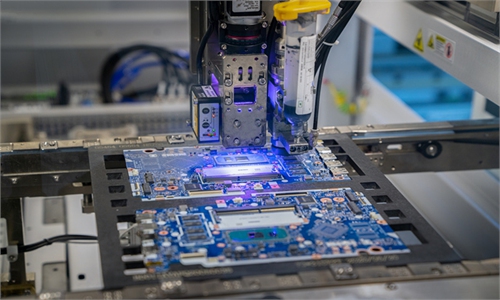
Chip. Photo:VCG
The US authorities have secretly placed location-tracking devices in targeted shipments of advanced chips they see as being at high risk of illegal diversion to China, Reuters reported on Wednesday.
The measures aim to detect artificial intelligence (AI) chips being diverted to destinations that are under US export restrictions, and apply only to select shipments under investigation, according to Reuters.
Reuters did not name its sources who it claims to have "direct knowledge of the previously unreported law enforcement tactic." It also noted that location trackers are a decades-old investigative tool used by US law enforcement agencies to track products subject to export restrictions, and they have been used to combat the illegal diversion of semiconductors in recent years.
The report also said that the sources did not know which parties were involved in installing them, or where along the shipping route they were put in.
However, Reuters described the move as showing the lengths to which the US has gone to enforce its chip export restrictions on China, even as the US administration has sought to relax some curbs on Chinese access to advanced American semiconductors.
The report comes as the US government has recently taken various actions against US chip exports to China.
Nvidia and AMD have reportedly agreed to share a portion of their sales revenue from China of certain chips as part of an unusual arrangement with the US administration in order to obtain export licenses to the Chinese market, the Financial Times reported on Monday.
Asked to comment on reports that Nvidia and AMD have agreed to give the US government 15 percent of their revenues from chip sales in China, under an arrangement to obtain export licenses for the semiconductors, Lin Jian, a spokesperson form the Chinese Foreign Ministry, said on Monday that China has made its position clear more than once on the US export of chips to China.
In a separate question about US export controls on high-bandwidth memory (HBM) chips, Lin said that "China's position on opposing the politicization and weaponization of tech and trade issues, and on malicious blockade and suppression against China, is consistent and clear. Such practices disrupt the stability of global industrial and supply chains and are in no one's interests."
Meanwhile, US President Donald Trump on Monday suggested he might allow Nvidia to sell a scaled-down version of its next-generation advanced GPU chip in China, with a 30 percent to 50 percent reduction in performance, US media reported.
Analysts also stressed that this reflects the US' complex and contradictory mindset - a carefully planned "wanting it all" approach. The US does not want to lose access to the Chinese market, but at the same time it is afraid of being overtaken by China in AI.
A Chinese expert told the Global Times on Monday that if the Reuters' report is accurate, it would amount to another proof that demonstrates the US' complex and contradictory mindset on chips sales to China.
Global Times
RELATED ARTICLES