ARTS / CULTURE & LEISURE
China’s scorching summer heat fuels nighttime sightseeing
Under the stars
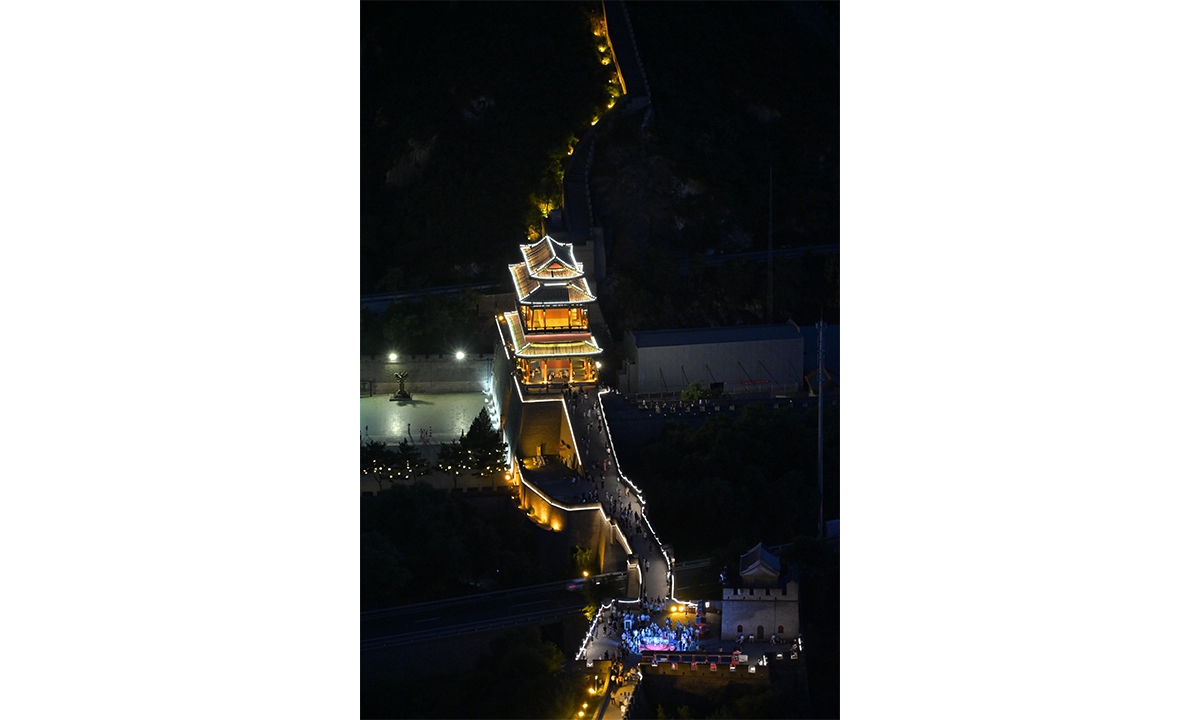
A night view of the Juyongguan section of the Great Wall in Beijing, on July 5, 2025 Photo: Courtesy of Zheng Lei
When 19-year-old Huang Minfei arrived at the Longmen Grottoes, in Luoyang, Central China's Henan Province, on the night of August 3, the site was already packed with visitors, but the comparably cooler evening air and the grottoes illuminated by lights made the visit well worth it.During a four-hour evening visit, Huang strolled past mountains, rivers, and hundreds of ancient Buddhist caves. "It was cooler at night than during the day," she told Global Times. "And the atmosphere feels completely different."
Huang is part of a growing wave of travelers who are choosing to explore China's cultural landmarks under the stars. Indeed, while much of the country swelters under prolonged heat waves this summer, an increasing number of tourists is escaping the scorching daytime temperatures, by heading out at night, giving rise to a new "rest by day, go out by night" travel trend, according to Xinhua News Agency.
On Xiaohongshu.com, a Chinese lifestyle-sharing platform, a quick search for "night tour" reveals a flood of posts about everything from well-known scenic spots to "museum magic nights."
Data from Chinese online life service provider Meituan.com showed that, since early July, searches and reviews for "night tours" have roughly doubled compared with a month earlier, while searches for the keywords "scenic night tours" jumped nearly 230 percent month-on-month.
"China's night-time cultural tourism market is bursting with vitality," Sun Jiashan, a researcher at the Central Academy of Culture and Tourism Administration, told Global Times.
"Cultural places, including museums, scenic areas, and parks, are offering a growing variety of experiences and distinct activities, providing people with more options and enriching their cultural life during this hot summer."
Night delights
Huang had already visited the Longmen Grottoes a few years ago during the daytime, but this nighttime visit was an entirely different experience.
"In the daytime you can clearly see the details, the textures of the Buddha sculptures, and the weathering of the stone," she said. But at night, floodlights trace the outlines of statues and cliffs, creating fascinating shadows and a sense of mystery. The massive Lushena Buddha, bathed in warm light, appears both solemn and gentle "as if speaking to you across more than 1,000 years," Huang told Global Times.
At Luoyang's Yingtian Gate, Huang stopped to see its evening illumination. "The lighting was spectacular. The city tower was truly majestic," she said. Fewer people, cooler temperatures, and the comfort of strolling outdoors at night made the experience all the more appealing.
"Luoyang at night, especially after the lights come on, is a completely different world from how it appears in the daytime," she noted.
Farther east, 22-year-old Cheng Xi cycled around the famed West Lake scenic area in Hangzhou, East China's Zhejiang Province, after dark on August 11. "It's too hot during the day to go out," she said. "Besides, I wanted to try night riding."
Cheng mainly passed the Baidi Causeway at the West Lake scenic area in Hangzhou, capital city of Zhejiang Province, and the famed Leifeng Pagoda. In her words, there are fewer visitors at night, making sightseeing more enjoyable.
In Beijing, Zheng Lei, 41, began his evening at the Juyongguan section of the Great Wall at 6:30 pm on July 5. According to him, the section was open to night visitors, with a square hosting live music, snack stalls, and even a stage where tourists could sing karaoke.
From the top of the wall, he could see the city lights stretching toward the horizon. "The Wall's outline, lit up against the night sky, is really amazing," he said.
Nighttime tourism isn't limited to scenic landscapes. Cultural institutions are extending their hours to meet growing demand as well.
In line with the trend, the Shanghai Museum launched a 168-hour "sleepless night" program from August 11 to August 17, keeping its doors open around the clock. The 168-hour carnival will include cultural events such as new book releases, Egyptian dancing performances, interactive games and creative promotional activities.
On Monday, 21-year-old Zhu Jingyi joined the late-night queue to see the standout exhibition "On Top of the Pyramid: The Civilization of Ancient Egypt. The temperature felt more comfortable at night," Zhu told Global Times. "And there were far fewer people than during the day, which made the visit more immersive." For her, wandering through the exhibits in the middle of the night was a wholly novel experience.
Amenities within reach
According to Sun, the boom in night tourism is closely tied to well-developed infrastructure and on-site services.
For example, along the West Lake in the evening, tourists can enjoy Song Dynasty (960-1279) themed dance performances and interactive games. At the same time, more than 100 lakeside stalls provide visitors with a variety of West Lake-themed goods as well as handcrafted items, and a musical fountain show.
In Central China's Hunan Province, the Changsha Museum has also extended summer hours until 8:30 pm throughout August, adding 2,000 extra night tickets each day, except for Mondays. During the evening visiting hours, the museum ensures that multimedia devices, self-guided AR smart glasses, and other public facilities stay fully operational, enhancing visitors' cultural experiences on summer nights, Xinhua reported.
At Shanghai Museum, located on the People's Square, night entry during the "sleepless night" promotion was priced at 74 yuan ($10.3) - half the regular ticket price, with 3,000 tickets available for each session. During nighttime visiting hours, cultural and creative products were also offered at half price.
RELATED ARTICLES