ARTS / CULTURE & LEISURE
Drone racing takes flight at Chengdu World Games with youth and speed at the forefront
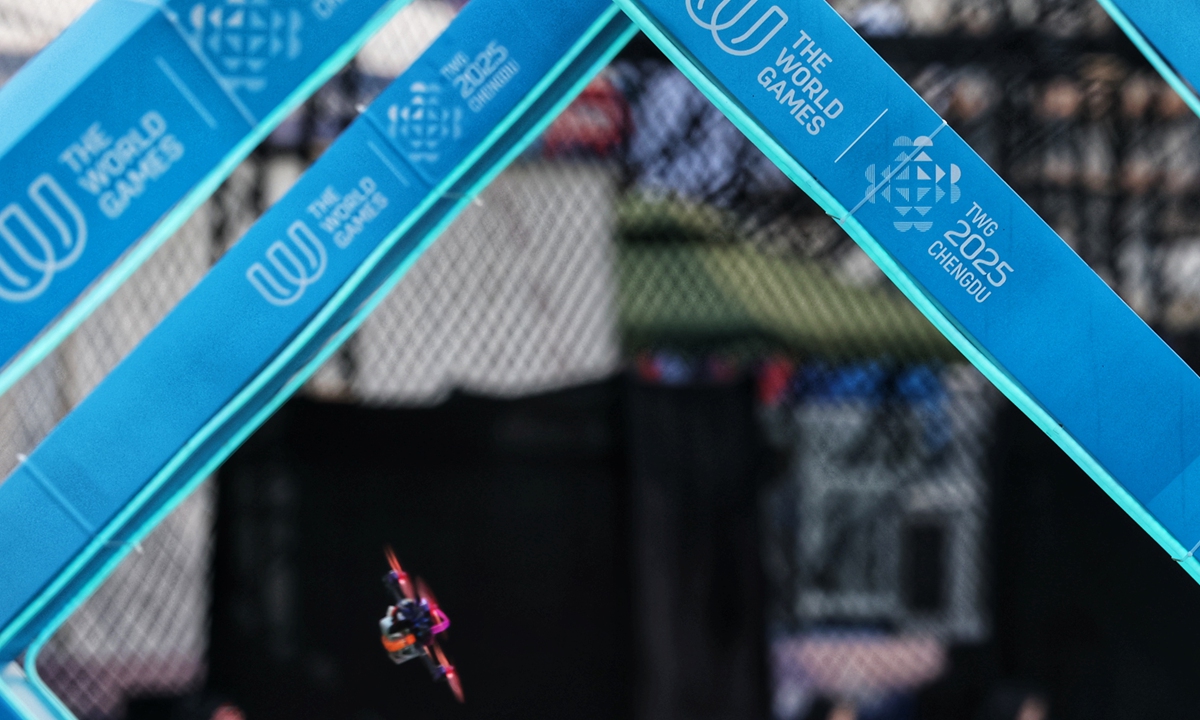
On Thursday, the Chengdu World Games entered the seventh competition day since its opening, with the drone racing event kicking off. Photo: Cui Meng/GT
On Thursday, the Chengdu World Games entered the seventh competition day since its opening, with the drone racing event kicking off. First included in the World Games in 2022, drone racing is an emerging sport that ingeniously blends technology, speed and advanced piloting skills, earning it the nickname "F1 in the air" among enthusiasts.
Each heat in the qualifiers features four pilots competing at the same time. This year's event has attracted 31 athletes, who will compete in the qualifying, knockout and final rounds for the sole gold medal to be awarded on August 16. Representing Team China are He Yutong, Huang Yueqi and Li Tianxing.
This relatively niche sport has a distinct "younger" field of competitors. Among China's three entrants, Li Tianxing is just 13 years old but already has several years of drone flying experience.
Li told the Global Times she began flying drones in the second semester of first grade, at the age of seven. For the first five years, she mainly flew small drones, and has only been training on full-size racing drones for one year. Her current results place her within the top 20.
"I've learned a lot from competing alongside top pilots from around the world, including flying techniques and modification tips," she said. "My daily training focuses mainly on flying and basic skill drills to improve reaction speed."
German pilot Schroder Arvin told the Global Times that the aerial racing venue and services are "highly professional," with well-equipped facilities and attentive staff.
During the races, pilots wear FPV (first-person view) goggles to control their drones from a cockpit-like perspective. They must complete three laps of a 500-meter course within three minutes, navigating more than 40 obstacles such as single gates, double-decker gates, cross gates and slalom gates. The pilot with the shortest time wins.
"Top speeds can reach nearly 300 kilometers per hour. Elite pilots must be as skilled in mechanical tuning as F1 drivers, as quick in reflexes as eSports players, and as resilient under pressure as extreme athletes. The charm of the sport lies in pushing the limits of human-machine synergy," said Li Ye, head of the third events division at the Air Radio Model Sports Management Center of China's General Administration of Sport.
According to Li, drone racing is not just a "game of speed" but a comprehensive test of athletes' technical ability, mental strength, physical fitness, and strategic thinking. The sport is marked by its youthfulness and inclusivity.
The competition adopts a mixed-gender format, eliminating gender divisions on the track. Even athletes with disabilities can participate in wheelchairs, highlighting the sport's principle of equal participation for all.
RELATED ARTICLES