World Games for humanoid robots garners global spotlight
Businesses actively seize opportunities as nation advocates new quality productive forces
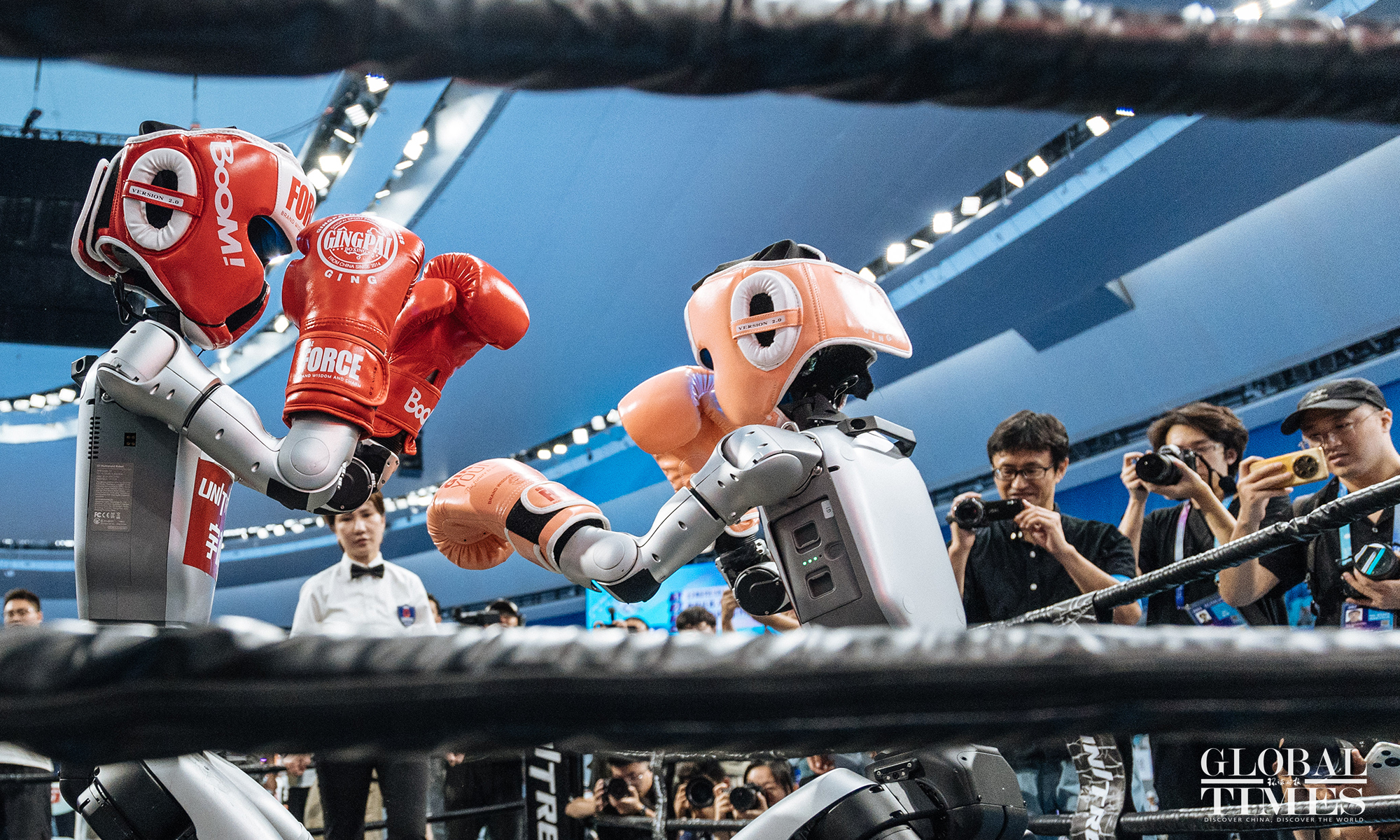
The 2025 World Humanoid Robot Games opened at Beijing's National Speed Skating Oval on August 15, 2025, featuring events such as football, freestyle combat, group dance, and the 1,500-meter race. A humanoid robot from Beijing Lingyi Technology, a wholly-owned subsidiary of Hangzhou-based Unitree Robotics, claimed the Games' first gold medal with a world-record time of 6:34.40 in the 1,500-meter race. Photos: Li Hao/GT
After a fierce competition, Chinese robot firm Unitree Robotics' humanoid robot won the first gold medal at the inaugural World Humanoid Robot Games (WHRG) on Friday, once again drawing global attention and highlighting the rapid advancement of China's robotics industry as the nation promotes new quality productive forces.
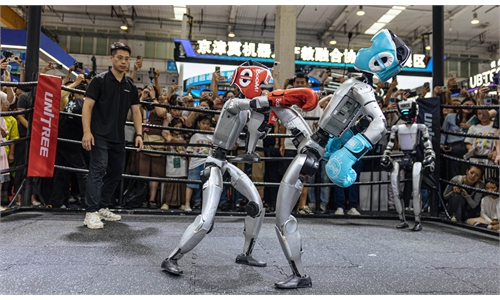
The ongoing 2025 WHRG, held in Beijing from Thursday to Sunday, attracted humanoid robot companies from home and abroad, showcasing their latest cutting-edge products while competing in popular human sports ranging from football to gymnastics.
Taking place just a week after the successful conclusion of the 2025 World Robot Conference in Beijing, this global event highlights the nation's efforts to build an open international platform for cooperation and development in robotics and artificial intelligence (AI), supporting the promotion of new quality productive forces, a Chinese industry analyst said. Businesses are also showing strong interest in seizing the opportunities offered by this robot technology showcase.
As the world's first comprehensive competitive event organized specifically for humanoid robots, the event has drawn the participation of 280 teams from 16 countries across five continents, with over 500 robots competing in 538 events across 26 major categories, including sports such as football, athletics, and gymnastics.
The WHRG kicked off its first day of competitions on Friday, with Beijing Lingyi Technology emerging as a dark horse to claim the championship in the morning's 1,500-meter final.
Public records show the team is a wholly owned subsidiary of Hangzhou Unitree Robotics Co. "The champion robot is the very same one that appeared in the 2025 Spring Festival Gala, exactly the same model. It's highly iconic, and it was also our company's very first humanoid robot. In the 1,500-meter race, it averaged a speed of 3.8 meters per second, with a top speed much faster than that. This time, it was more about showcasing peak speed and endurance," said Wang Xingxing, founder and CEO of Unitree Robotics, after the race. "I believe this robot serves as a strong boost and a landmark for the entire industry."
When asked whether the championship-winning running humanoid robot would be adapted for other applications, Wang told the Global Times that they have been developing robots for a variety of scenarios, including simple industrial applications, scientific research, and education, as well as AI algorithm development and some service-sector uses.
However, athletics competitions are fundamentally different from everyday work, so the algorithms used there may not be directly applicable, Wang said. "Still, I think these competitions provide an excellent platform for testing the stability and reliability of both hardware and algorithms. Simply put, if a robot can handle fitness, intense exercise, or long-distance running, then it would be very reliable for use in ordinary daily life," Wang said.
In addition to Unitree Robotics, other domestic industry players have also actively taken part in the event. Zhou Yuxi, an employee of Guangzhou-based technology company High Torque Robotics, told the Global Times on Friday that they had been testing their robot for about two months in preparation for the competition. "Its performance is now very stable, with a steady gait and enough battery life to complete the matches. If it competes in the small-group category, it has a chance of taking first place," Zhou said.
The arena is just one way to showcase its capabilities, as the applications for robots in the future are much broader. Zhou said that they plan to make it safer, lightweight, and easy to disassemble, making it suitable for scientific research.
"Its small design also makes it convenient for home use, where it could accompany children or monitor the elderly. For example, it could help elderly people make phone calls when they are bedridden. This is the current direction of our development," Zhou said.
Xue Qingheng, an employee from Inter City (Beijing) Technology Co, told the Global Times at the event on Friday that they had brought two robots to participate in the track and field and dance competitions. Speaking about the games, Xue said it was encouraging that the government provides a range of policy support, including the establishment of an international platform for businesses to showcase their best capabilities in the booming robotic field.
"Before long, robots will become practical helpers," Xue added. "They will be widely used in agriculture, healthcare, education, and other fields, gradually becoming part of people's everyday life."
"The launch of the 2025 WHRG once again reflects the rapid shift from theory to practice, from large models to real-world applications in the robotics field," Ma Jihua, a veteran telecom industry observer, told the Global Times on Friday, noting that humanoid robots, particularly those using AI, are moving beyond theoretical research into practical use across a growing range of industries.
The 2025 WHRG came just a week after the 2025 World Robot Conference, which was held in Beijing. The just-concluded event showcased more than 1,500 cutting-edge products from about 200 domestic and international robotics companies, including ABB, Festo, Estun, Galbot, and CITIC Heavy Industries.
Recent robotics events show that their capabilities are improving, with actions such as running and standing becoming more stable and responsive, highlighting China's advantage in applying AI across diverse scenarios, Ma said.
From both policy and consumer perspectives, the recent major robotics events intensively held in Beijing highlight China's commitment to creating an open international platform for collaboration and development in robotics and AI, while advancing the country's drive to foster new quality productive forces, the Chinese expert said.
RELATED ARTICLES