Volkswagen to work with XPeng as German automaker seeks to strengthen technological edge in competitive Chinese market
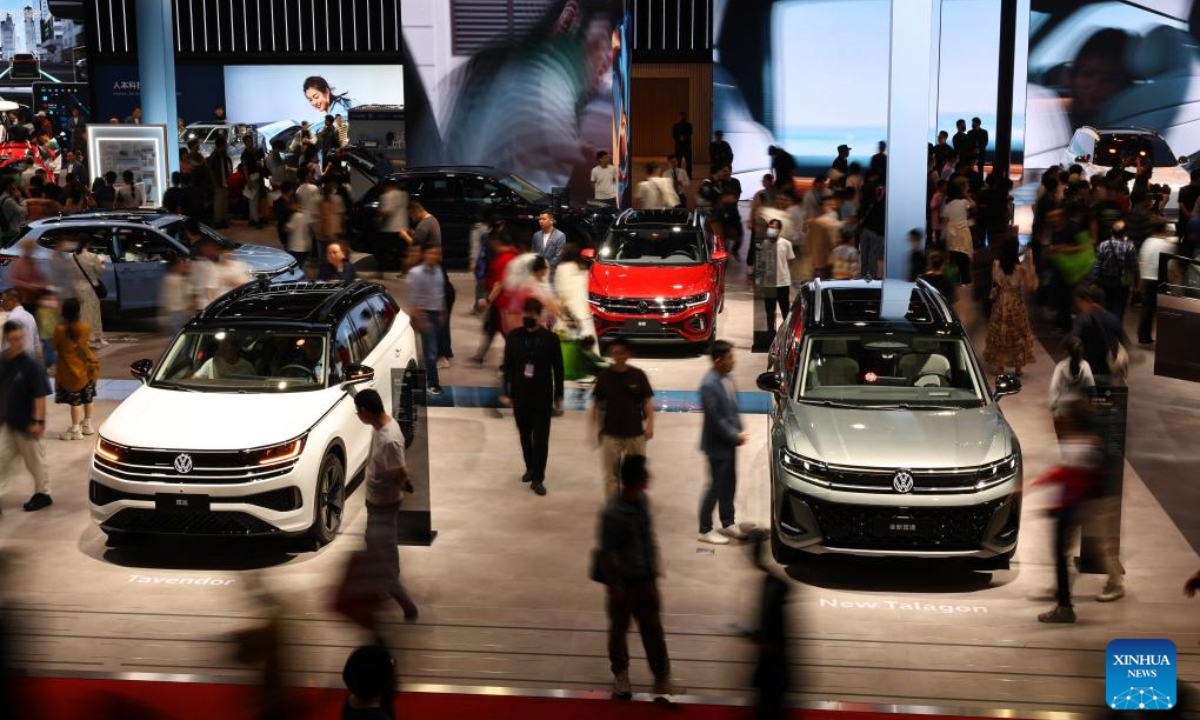
Visitors look at Volkswagen cars on the 21st Shanghai International Automobile Industry Exhibition in east China's Shanghai, May 1, 2025. People visit the auto show here on the first day of the May Day holiday. (Xinhua)
Chinese electric vehicle (EV) maker XPeng Motors announced in a filing to the Hong Kong Stock Exchange on Friday that it has expanded a strategic cooperation with Volkswagen Group China on the development of the China Electronic Architecture (CEA), a next-generation electronic and electrical architecture. This move comes after the two companies agreed to jointly develop the regional control electronic and electrical architecture CEA, on July 22, 2024.
This move underscores the growing trend of multinational automakers partnering with Chinese companies to enhance their capabilities in intelligent and electric vehicle technologies, said an industry analyst.
In the statement, XPeng Motors said that the expanded cooperation will see the CEA integrate not only into Volkswagen's pure electric vehicle platforms in China, but also into its gasoline and plug-in hybrid models. This strategic technical cooperation between the two parties will expand to a broader market, it said.
The collaboration aims to accelerate the development of the CEA and deploy it across a broader range of vehicles, so as to enhance Volkswagen's global competitiveness and enable rapid software iteration and over-the-air updates, drastically reducing the vehicle development timeline, according to the statement.
The cutting-edge electronic and electrical architecture co-developed by the two companies is being rapidly advanced at an unprecedented "China speed" and has already reached several crucial project milestones, according to XPeng's announcement.
Starting in 2027, the CEA architecture jointly developed by the two companies will be extended from the locally developed pure electric models of the Volkswagen brand to include fuel and hybrid models manufactured in China, according to a statement Volkswagen Group China sent to the Global Times on Friday.
Ralf Brandstaetter, chairman and CEO of Volkswagen Group China, said in the company's statement that "by integrating the CEA architecture into our extensive range of fuel vehicles, we will further strengthen our technological edge in the conventional power vehicle market. Meanwhile, in China's fiercely competitive automotive market, we keep refining our cost structure to ensure we consistently offer customers highly appealing vehicle options."
This will not only strengthen the competitiveness of our global electric platform in China, but also reduce technological complexities and increase our cost efficiency across the region, Brandstaetter said, adding that this is the next milestone for our "in China for China" strategy and an important step in our transformation toward becoming a leading manufacturer of intelligent, fully connected electric vehicles.
The CEA will be jointly developed by a team of experts from XPeng, Volkswagen China Technology Company and CARIAD China, who together will strengthen the software-oriented approach and foster the development of state-of-the-art features, such as the latest generation of advanced automated driving assistance systems and intelligent cockpit software, according to a Volkswagen Group China's press release on July 22.
From 2026, the CEA will be used in locally produced all-electric vehicles of the Volkswagen brand, it added.
"Regarding the automotive sector, the trend has shifted from bringing foreign technology to China to exporting Chinese technology to the world," said He Xiaopeng, chairman and CEO of XPeng, noting that the company is collaborating with Volkswagen to develop the electronic and electrical architecture for Volkswagen's new-energy vehicles in China, while also contemplating strategies to expand this technology globally, Xinhua News Agency reported.
This partnership is part of a broader trend of multinational automakers seeking to leverage China's strengths in intelligent and electric vehicle technologies. As the global automotive industry accelerates its transition toward intelligent and electric vehicles, such partnerships are expected to play a crucial role in driving innovation and growth, Cui Dongshu, secretary-general of the China Passenger Car Association, told the Global Times on Friday.
"Through this cooperation, Volkswagen Group China can draw on China's intelligent electric vehicle technology to make up for its own shortcomings in the field of intelligence, while XPeng can enhance its international competitiveness by leveraging Volkswagen's global resources and brand influence," Cui noted.
As the world's largest automotive market and a leader in smart electric vehicle technologies, China is increasingly becoming a key driver of global automotive innovation, Cui said, adding that the partnerships between multinational automakers and Chinese companies are not only beneficial for the companies involved but also for the global automotive industry as a whole, as they facilitate the exchange of knowledge and technology and accelerate the development of next-generation vehicles.
Chinese and European auto companies have engaged in deep collaboration in the EV sector. In March, German carmaker BMW partnered with Chinese tech giant Huawei to develop an in-car digital ecosystem specifically tailored for the Chinese market, Xinhua reported. BMW and Alibaba have also announced an expanded strategic partnership to work together to develop an AI engine based on Alibaba's Qwen large language model, per Xinhua.
Cui noted that these recent moves highlight the accelerating integration within the global automotive sector. China's advantages in intelligent driving algorithms, data processing, and ecosystem development, combined with the strengths of multinational automakers in vehicle manufacturing and brand heritage, will propel the entire industry toward a higher level of intelligence.
RELATED ARTICLES