ARTS / FILM
Chinese film Dongji Rescue premieres in London, honoring Chinese fishermen's bravery in saving British POWs, shared struggle against fascism

Photo:Sun Wei/GT
"At the darkest hour of the Second World War, China and the UK fought on different fronts but shared a common mission: to defend humanity against fascism and aggression. Fighting side by side, our peoples forged a deep friendship," Chinese Ambassador to the UK Zheng Zeguang said in his speech at the reception for the World War II film, Dongji Rescue, in London on August 15 (local time).
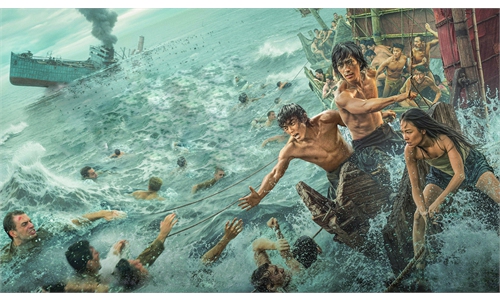
Dongji Rescue, based on a true historical event, tells the story about the long-overlooked bravery of Chinese fishermen who rescued 384 British prisoners of war (POWs) during the Second World War. The film will be released on August 22 in the UK and Ireland, followed by wider European releases from August 29.
The film recounts the harrowing events of October 1942, when the Japanese transport ship Lisbon Maru, carrying more than 1,800 POWs from Hong Kong, was torpedoed by a US submarine off the Zhoushan Islands in East China. As the vessel sank, Japanese guards locked prisoners below deck, condemning many to drown. Against this backdrop, fishermen from Dongji Island defied both danger and Japanese orders to rescue the survivors - an act largely absent from previous wartime narratives.
"In today's turbulent and fast-changing world, we should work together to uphold the post-WWII international order, address global challenges, and contribute to world peace, stability, and prosperity," Ambassador Zheng said at the event in London.
The making of Dongji Rescue was an extraordinary feat of dedication. According to co-director Fei Zhengxiang, who worked alongside Guan Hu, the project spanned six years of preparation, more than 20 script drafts, and a full-scale reconstruction of a fishing village as it stood 80 years ago.
The film is rooted in a real-life story nearly lost to history.
"Many veterans and families mentioned the ship. It clearly had an enormous impact not only on those onboard, but also on all the other POWs who lost friends when it sank. I thought it was one of the greatest untold stories of the war," Professor Tony Banham, historian and author of The Sinking of the Lisbon Maru, told the Global Times.
For Banham, the Dongji fishermen's rescue is the heart of the story: without their intervention, there may have been no survivors.
"Helping each other is actually the normal, natural reaction," he said.
Julian Alcantara, whose uncle Joseph Viotto of the Royal Artillery died in the sinking, said his family lived for decades with unanswered questions.
"The Lisbon Maru experience was a mystery to our family," Alcantara said. "All we had known was that my uncle had been captured by the Japanese in Hong Kong and transported on this ship, which was torpedoed, and on which he died."
It was only after watching Fang Li's documentary film The Sinking of the Lisbon Maru that his family began to understand what had happened.
"The documentary answered so many questions. The message to future generations is to keep telling these stories so the memories of those no longer with us stay alive," Alcantara said. As a producer, Alcantara has worked in the film industry around the world for more than 25 years, including China.
Gerry Borge, son of survivor John Emanuel Borg, a Royal Scots drummer, also shared an emotional response.
"I can visualize my father and my uncle in the ship. I had tears in my eyes when it finished," he told the Global Times.
Earlier this year, Borge reunited with descendants of the fishermen who took part in the rescue. He described attending the monument's commemoration and the profound moment of standing on the rocks of Dongji Island, gazing out to sea.
"It's a very special emotion," he said. "War is crazy, stupid, unnecessary. I want younger generations to understand that. It's important for people to come together, to support one another and to help."
While Nazi atrocities dominate Western collective memory, Japanese war crimes in Asia - including the Nanjing Massacre, forced labor, the mistreatment of POWs, among other crimes - remain far less widely acknowledged in the West.
Banham noted that British forces in the Far East often called themselves "the forgotten army," overshadowed by the war in Europe.
"It does feel like Victory over Japan Day (VJ Day) has always been treated with less importance than Victory in Europe Day (VE Day)," Alcantara said. " When we think or read about the war in Asia and Pacific, it is often in the context of the Americans," he added.
By bringing Dongji Rescue to European audiences, the film offered a vivid reminder of China's human and moral contribution to the Allied victory, said Borge.
"There are many events in both recent and not-so-recent history that have been overlooked or forgotten, such as the sinking of the Lisbon Maru," Alcantara told the Global Times. "Telling these stories in films or documentaries allows them to be known and remembered by a much wider audience."
Banham sees books, documentaries, and feature films as complementary tools for preserving history. "A history book has the most details, but few people read it. A documentary has fewer details but more viewers. A feature film has the fewest details, but far more viewers."
"When I wrote the book it was difficult, because I had to find the men and their families while they were still around to tell their story. It truly was a race against time. But the fact that they had never told their stories before was also a blessing as it gave me a clean slate on which to build their memories into a lasting story. It was a great privilege to do that," Banham said.
"Dongji Rescue, together with the documentary The Sinking of the Lisbon Maru which premiered earlier this year, bring to life the heroic act for those Dongji fishermen," said Ambassador Zheng.
Guided by the islanders' code - those in peril at sea must be saved - the Chinese fishermen risked their lives to rescue strangers. The film bridges the histories of two nations, reminding both Chinese and British audiences that compassion can transcend borders, even in war.
As it opens in Europe, the film offers not only a chance to honor the bravery of the Dongji fishermen, but also an opportunity to remember the Second World War - as a global struggle against fascism, he said.
RELATED ARTICLES