Hainan unveils plan to boost marine tourism, targeting 40b yuan in revenue and 18m tourists by 2027: report
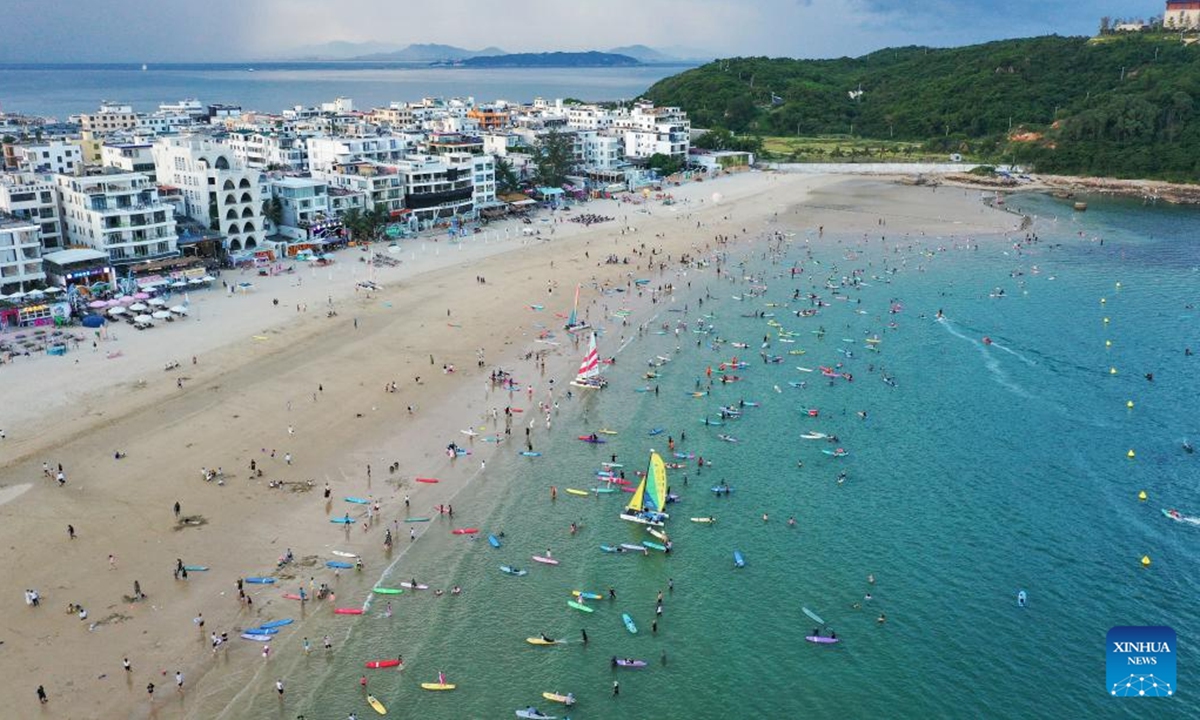
An aerial drone photo taken on Aug. 9, 2025 shows tourists surfing on a beach in Sanya City, south China's Hainan Province. Tourists are flocking to Sanya for the pleasure of surfing during the summer vacation. (Xinhua/Guo Cheng)
South China's Hainan Province has rolled out a three-year action plan to boost the local development of marine tourism, aiming to generate more than 40 billion yuan ($5.57 billion) in revenue and attract 18 million tourists by 2027, the Hainan Daily reported on Sunday.
The province will also strive to establish 35 A-level marine tourism scenic spots, eight tourism resorts, 20 intangible cultural heritage preservation and utilization projects, 10 marine ranch tourism projects, more than 100 coastal rural tourism resorts and villages, and 500 marine-themed homestays over the three years. The plan proposes to have Sanya, Haikou, Qionghai, Danzhou, and Sansha lead the development of a multi-tiered marine tourism product system.
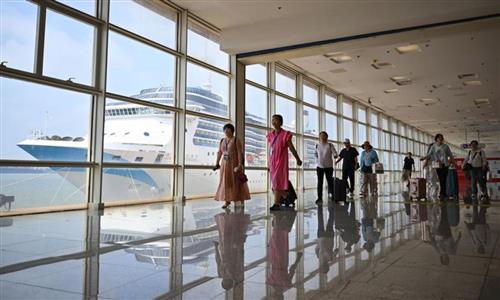
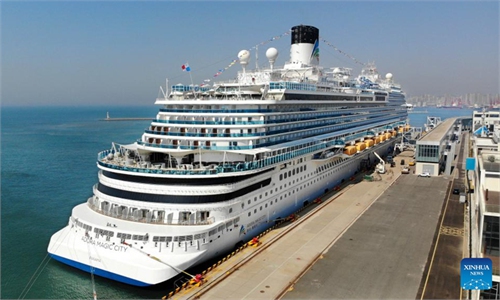
For detailed implementation, the action plan proposes to promote maritime tourism products by expanding cruise tourism routes and exploring ASEAN international routes.
The province will launch themed island-hopping yacht routes, explore yacht-based rocket launch viewing, attract international yacht brands and establish a smart "one-code access" platform for five yacht bases. It plans to build four or five maritime tourism complexes and explore deep-sea tourism pilots.
For coastal tourism, the plan focuses on developing A-level marine-themed scenic spots emphasizing mountain-sea integration, marine culture, technology and sports, while promoting national-level tourism resorts and new marine cultural and lifestyle consumption spaces in local vacation areas.
To integrate marine industries, the province will build three surfing destinations, five diving bases, seven sea fishing bases and two sailing and windsurfing training bases. It also aims to develop a "low-altitude + marine" tourism model, and create "sea-viewing platforms," "coastal attractions" and marine-themed micro-scenic spots along the tourism highway, fostering a "land-sea integration" pattern.
China's extensive coastline offers ideal conditions for marine tourism development. Unlike other tourism forms, marine tourism's versatility - encompassing sightseeing, vacation, leisure and wellness - along with its ability to leverage cruise home ports, fosters a comprehensive tourism model with diverse market segments and products, Jiang Yiyi, a tourism and sports expert at Beijing Sport University, told the Global Times on Sunday.
As for how maritime tourism bolsters the local economy, Wang Peng, an associate research fellow at the Beijing Academy of Social Sciences, said that it drives economic growth by boosting industries like catering, accommodation, and transportation, injecting strong momentum into local economies.
Marine tourism creates numerous jobs across tourism services and resource conservation, alleviating employment pressure. Additionally, it promotes industrial upgrading by optimizing local economic structures, facilitating the transformation of traditional industries into high-end services, and enhancing value and competitiveness, Wang told the Global Times on Sunday.
In the summer season, marine tourism enters its peak, with localities stepping up promotion efforts.
As of 5 pm on August 11, the joint operations launched by the Qingdao Marine Tourism Development Co in East China's Shandong Province, had recorded 2.61 million tourist visits this year, up 79.96 percent compared with last year's total, and 66,800 sailings, up 16.16 percent, the People's Daily reported on August 15.
The report noted that Qingdao has been optimizing its tourism products, such as launching a unified ticket for buses, subways and ferries, while advancing cruise experiences. In the first half of this year, Qingdao welcomed more than 42,000 cruise passengers.
The Jinshitan scenic area in Northeast China's Liaoning Province has launched the "aerial view of Dalian" low-altitude sightseeing project, alongside a shared drone program, upgrading the existing three-dimensional tourism model (beach, sea and underwater) to a four-dimensional "beach, sea, underwater, and sky" integrated experience, the Xinhua News Agency reported in July.
Marine tourism has evolved into a multi-dimensional experience, integrating activities like sailing, windsurfing, diving, and low-altitude projects, creating a dynamic development space. Cities like Qingdao and Sanya exemplify successful models, blending culture, sports and tourism, Jiang said.
Coastal cities in China could further integrate culture and extend industry chains, enriching formats through deeper synergy among culture, sports, tourism and commerce for a more robust marine tourism ecosystem, she noted.
Both Jiang and Wang highlighted the implications for other domestic regions to develop distinctive local tourism sectors based on their unique characteristics.
To emulate coastal cities' tourism models, inland regions can tap into discovering local unique natural resources and developing leisure and vacation-oriented tourism, Jiang said, adding that they can leverage dedicated events to build a vibrant, healthy and dynamic destination brand and image.
Localities can support tourism through subsidies, tax incentives and regulations, promoting innovative products, while integrating tourism with other sectors to enrich offerings and enhance economic benefits, Wang noted.
RELATED ARTICLES